

Changwon G-NEX International Student Job Fair on November 2: On-Site Interviews With Some 20 Local Companies, and Which Visa Comes After a Job Offer, E-7, D-10 or F-2-R
November 2 international student job fair at CECO, Changwon: schedule, pre-registration, companies, directions, the three visa routes after a job offer (direct E-7, D-10 job-seeking, F-2-R regional), 2026 E-7 and D-10 requirements, and the Changwon Immigration fast track for graduating students.
Key Points
- A job fair for international students preparing to work in Korea will be held on Monday, November 2, at the Changwon Exhibition Convention Center (CECO).
- Gyeongsangnam-do is holding the event with NIIED (National Institute for International Education) and the Gyeongnam Regional Office of SMEs and Startups on the first day of the 2026 Gyeongnam Global Innovation Festa (G-NEX), and some 20 Gyeongnam companies will take part, offering job consultations and on-site interviews to international students at universities in the province.
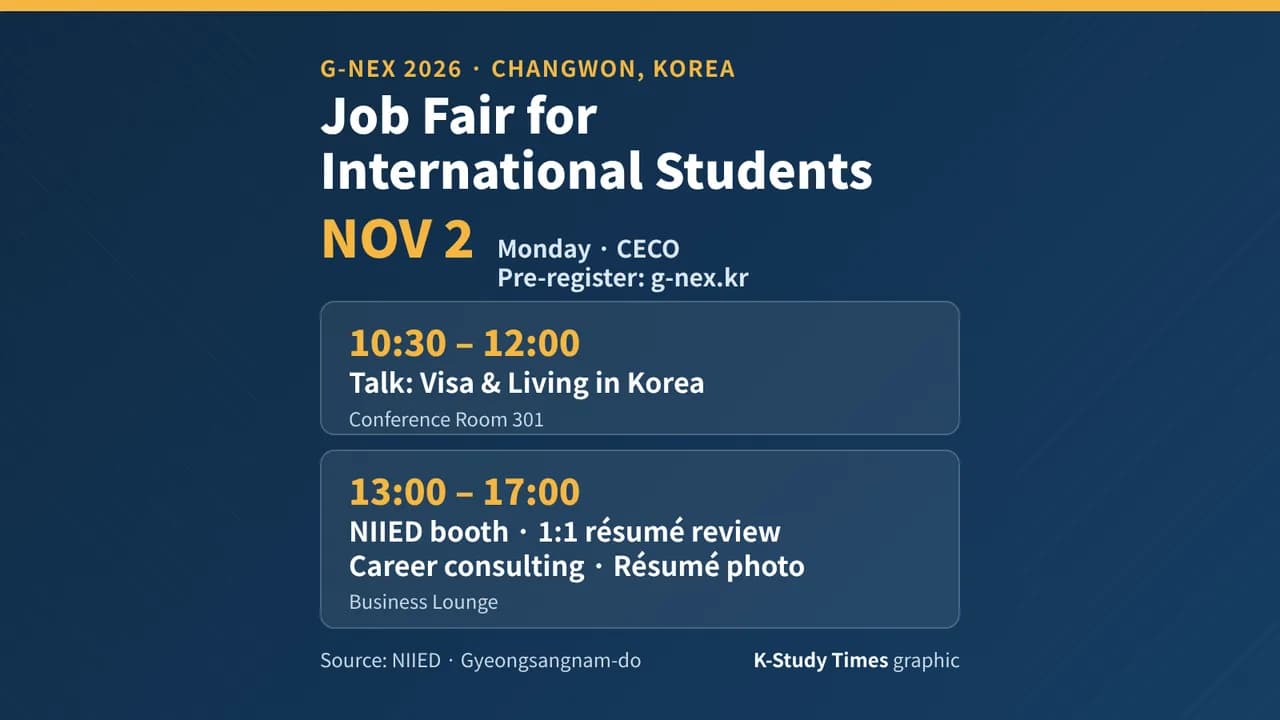
A job fair for international students preparing to work in Korea will be held on Monday, November 2, at the Changwon Exhibition Convention Center (CECO). Gyeongsangnam-do is holding the event with NIIED (National Institute for International Education) and the Gyeongnam Regional Office of SMEs and Startups on the first day of the 2026 Gyeongnam Global Innovation Festa (G-NEX), and some 20 Gyeongnam companies will take part, offering job consultations and on-site interviews to international students at universities in the province. The job fair and the NIIED booth run from 1 p.m. to 5 p.m. in the Business Lounge, and the special lecture on visas and settling in Korea runs from 10:30 a.m. to 12 noon in Conference Room 301. Pre-registration at g-nex.kr comes first for admission.
Your Day on November 2
The morning lecture comes first. The 'Visas and Settling into Life in Korea' lecture starts at 10:30 in Conference Room 301 and ends at 12 noon. International students thinking about working in Korea after graduation will come away with questions to ask at the afternoon job consultations.
From 1 p.m. to 5 p.m., the job fair and the NIIED booth open together in the Business Lounge. The NIIED booth offers five services: one-on-one résumé editing and job consulting, résumé photos, personal color analysis, interview makeup, and instant photo-booth strips. To have your résumé edited, bring both a printout and an editable file, and arrive when the booth opens at 1 p.m. It is better to get the photo and makeup done before interviewing at the company booths.
The event as a whole runs three days, from November 2 to 4. On the first day, an AI conference runs from 3 p.m. to 4:30 p.m., and over the three days there are exhibition halls for universities in the province, a global hall with some 10 overseas partner universities and institutions, and some 30 company booths. Among the 10 university student competitions is a speech contest for international students, and there are AI mock interviews and AI cover letter analysis to try. The international student job fair and the lecture are held on November 2 only.
Which Companies Are Coming
Some 20 Gyeongnam companies are taking part in the international student job fair. This year G-NEX is newly running industry-academia-research networking meetings and one-on-one meetups centered on six of Gyeongnam's key industries, including manufacturing AX (AI transformation of manufacturing), shipbuilding and offshore, and robotics and future vehicles, with 18 universities in the province and their industry partners participating. At the first event last December, 55 industry-academia companies and institutions took part and 47 companies came to the job fair. Last year's job fair was for university students in general; the international student job fair is new this year. Gyeongsangnam-do is holding the fair under a plan to raise the number of international students in the province to 10,000 by 2028 and lift their employment rate from 15% to 25%, and 24 institutions, including the 17 universities in the province with international students, the Changwon Immigration Office and the Gyeongnam Visa Support Center, are organized into an international student support council.
The list of participating companies is under the 'Company Participation' menu at g-nex.kr. Write your résumé with companies in Gyeongnam's key industries in mind, such as manufacturing AX, shipbuilding and offshore, and robotics and future vehicles. Put a sentence linking your major to the job, your Korean proficiency (TOPIK level), your expected graduation date and your earliest start date on the first page. These are the same items you enter at pre-registration, such as expected graduation date, desired job and language skills, so keep them consistent.
How to Pre-Register
Admission to G-NEX follows pre-registration. On the pre-registration screen at g-nex.kr, choosing International Student as the participant type makes year of study, expected graduation date, desired job and whether you want interviews or consultations required fields. Preferred work region and employment type, certifications and language skills, key competencies and areas of interest, and preferred industry are optional, but fill them in because they are used to match you with consultations and job information in your industry of interest. Name, phone number, email, participant type, planned attendance date and programs are required for everyone, and under programs choose 'International Student Job Fair' and 'International Student Gyeongnam Settlement Lecture'. Your admission ticket and notices are sent to the name and phone number you register, so enter your name as it appears in your passport and a number that can receive messages.
What Happens to Your Visa After a Job Offer
Once a job consultation leads somewhere, the next question is your residence status. Prospective graduates have three routes.
First, if you are hired before graduation: straight from Student (D-2) to a work status. Holders (or expected holders) of a Korean associate degree can change to Specific Activities (E-7) without work experience if the job is related to their major, and holders (or expected holders) of a Korean bachelor's degree or higher can do so even if it is unrelated to their major. You must sign an employment contract with the company's representative, and occupation and wage conditions apply. The job must fall within the 83 E-7 permitted occupations (mechanical engineer, applications software developer, overseas sales representative, ship welder and others), and the annual salary must be at or above the 2026 wage requirement set by the Ministry of Justice. The wage requirement in effect from February 1 to December 31, 2026 is KRW 31.12 million per year for professional (E-7-1), KRW 25.89 million per year for semi-professional (E-7-2) and general skilled (E-7-3), and KRW 26 million per year for skilled worker (E-7-4). There are conditions on the hiring company too. Domestic-market-oriented companies employing fewer than 5 Korean nationals, and companies where E-7 workers exceed 20% of Korean national employees, are restricted from hiring more (up to 50% is allowed in advanced industries with a recommendation from the competent ministry). Asking at the consultation "how many E-7 foreign workers does this company currently employ, and how many Korean employees" gives you a sense of whether this condition applies. The application documents are the application form, passport, alien registration card and fee, the employment contract, company establishment documents such as the business registration certificate, a career certificate (if applicable), copies of certifications (if applicable), and an employment recommendation letter or documents proving the need for employment.
Second, if no job is confirmed by graduation: Job Seeking (D-10). Holders (or expected holders) of an associate degree from a Korean junior college and of a bachelor's degree or higher from a Korean university can apply. Normally you must clear a points-based requirement that scores education, experience and Korean ability, but the points system is waived if no more than 3 years have passed since you earned an associate degree or higher at an accredited Korean university and you hold a valid TOPIK level 4 or higher score report. Passing the stage 4 interim evaluation of the Ministry of Justice's Korea Immigration & Integration Program (KIIP), or being assigned to stage 5 in the pre-evaluation, also qualifies for the waiver. When changing from Student (D-2) to D-10 for the first time, you do not need to submit proof of living expenses. The documents are the application form, passport, alien registration card and fee, a degree certificate or academic transcript, a job-seeking plan, and a copy of a national technical qualification (if applicable). D-10 is extended in 6-month increments, and the maximum period you can work as an intern at one company on D-10 is 6 months. If within the past 1 year you resigned voluntarily through no fault of the employer and then changed to D-10, you cannot get it again.
Third, if the hiring company is in a region covered by the regional specialized visa: Regional Specialized Talent (F-2-R). In Gyeongnam, 11 cities and counties are covered: Miryang, Uiryeong, Haman, Changnyeong, Goseong, Namhae, Hadong, Sancheong, Hamyang, Geochang and Hapcheon. If the annual salary in the employment contract is at or above the Gyeongnam living wage of KRW 30,371,880 and the contract term is 1 year or longer, you can obtain a Gyeongsangnam-do recommendation and change to F-2-R with TOPIK level 3 (or KIIP stage 3). Applications in Gyeongnam are accepted until 16:00 on December 31. It is also covered by the Changwon Immigration fast track along with E-7. Requirements and application offices by region are in the comparison of F-2-R regional specialized visa notices from 10 cities and provinces.
For all three routes, the application for change of status is filed at the immigration office with jurisdiction over your place of residence (for F-2-R, you first obtain the recommendation letter from the metropolitan or provincial government). For Gyeongnam (excluding Gimhae, Miryang and Yangsan), that is the Changwon Immigration Office (30 Je2budu-ro, Masanhappo-gu, Changwon, 055-981-6000). Gyeongsangnam-do and the Changwon Immigration Office launched a dedicated fast track for prospective graduates changing to a work visa on January 29, 2026. It operates at window 7 of the civil affairs office on the 1st floor of the Changwon Immigration Office from 2 p.m. to 4 p.m. on the second and fourth Thursdays of every month, and a prospective graduate who comes with the university's international student officer is processed on the spot without an advance reservation. Previously, the wait after booking an appointment was usually 2 months or more. Those changing from D-10 to a work status and those subject to residence permit restrictions cannot use it. To use it, ask your university's international student office about the operating days from November onward and the dates a staff member can accompany you, and set a date first.
Four Things to Ask at the Booth
Write down the answers to these four questions at the job consultation and you can choose your visa route. Which residence status the company plans to hire you under (and, if E-7, which occupation code), whether the start date is before or after graduation, where the workplace is (F-2-R if it is in a regional specialized visa area), and what the annual salary is (for E-7, KRW 25.89 million to 31.12 million or more per year depending on the occupation category; for F-2-R, the Gyeongnam living wage of KRW 30,371,880 or more). Also let the company know on the spot that an E-7 application includes an employment recommendation letter or documents proving the need for employment.
Getting There and What to Bring
The Changwon Exhibition Convention Center is at 362 Woni-daero, Seongsan-gu, Changwon, Gyeongsangnam-do. Changwon has no urban rail, so go by train or bus. From KTX Changwon Jungang Station it is 5km on city bus 220 or 221; from Changwon Station, 6.5km on bus 109 or 113 or the BRT; from Changwon Bus Terminal, 2km on bus 103. From Gimhae International Airport it is 35km, 40 minutes by car. If you drive, there are 915 parking spaces; the fee is KRW 500 for the first 30 minutes, KRW 200 for every 10 minutes after that, and a maximum of KRW 6,000 per day (leaving within 15 minutes is free).
| Item | Details |
|---|---|
| Pre-registration | Pre-registration at g-nex.kr, participant type 'International Student', attendance date November 2, programs 'International Student Job Fair' and 'International Student Gyeongnam Settlement Lecture' |
| Résumé | Several printed copies plus an editable file. On the first page: major-to-job link, TOPIK level, expected graduation date and earliest start date |
| ID | Alien registration card |
| Morning lecture | 10:30~12:00, Conference Room 301, visas and settling in |
| Afternoon booths | 13:00~17:00, Business Lounge, résumé editing, job consulting, photos, interview makeup |
| What to ask at the booth | Residence status (E-7 occupation), start date (before or after graduation), workplace (whether in a regional specialized visa area), annual salary |
| Prospective graduates | Check with your university's international student officer on the Changwon Immigration fast track days (second and fourth Thursdays) and the dates they can accompany you |
| Venue | Changwon Exhibition Convention Center, 362 Woni-daero, Seongsan-gu, Changwon, Gyeongsangnam-do, 055-212-1000 |
For event inquiries, call the Gyeongsangnam-do call center at 055-120. Detailed requirements for each residence status can be checked with the Immigration Contact Center 1345.
Related Articles
- Korea Life
- Korea Life
- Korea Life
- Korea Life
- Korea Life
- Korea Life
Comments
Please sign in to post a comment.
You will return to this article after sign-in.
Sign inNo comments yet.