What kind of study destination is Busan? 17,606 international students across 14 universities
Using official data, this report examines Busan's size, transport and industries, along with international-student enrollment and the composition of degree and language programs at 14 four-year universities.

Key Points
- Busan's 14 four-year universities had 17,606 international students at the end of June 2026.
- Kyungsung University and Dong-A University each had more than 2,000, while 10 universities had at least 1,000.
Busan's 14 four-year universities had 17,606 international students at the end of June 2026. Kyungsung University and Dong-A University each had more than 2,000, while 10 universities had at least 1,000. Degree students form the majority at some institutions; at others, more than half of the international students are enrolled in language training.
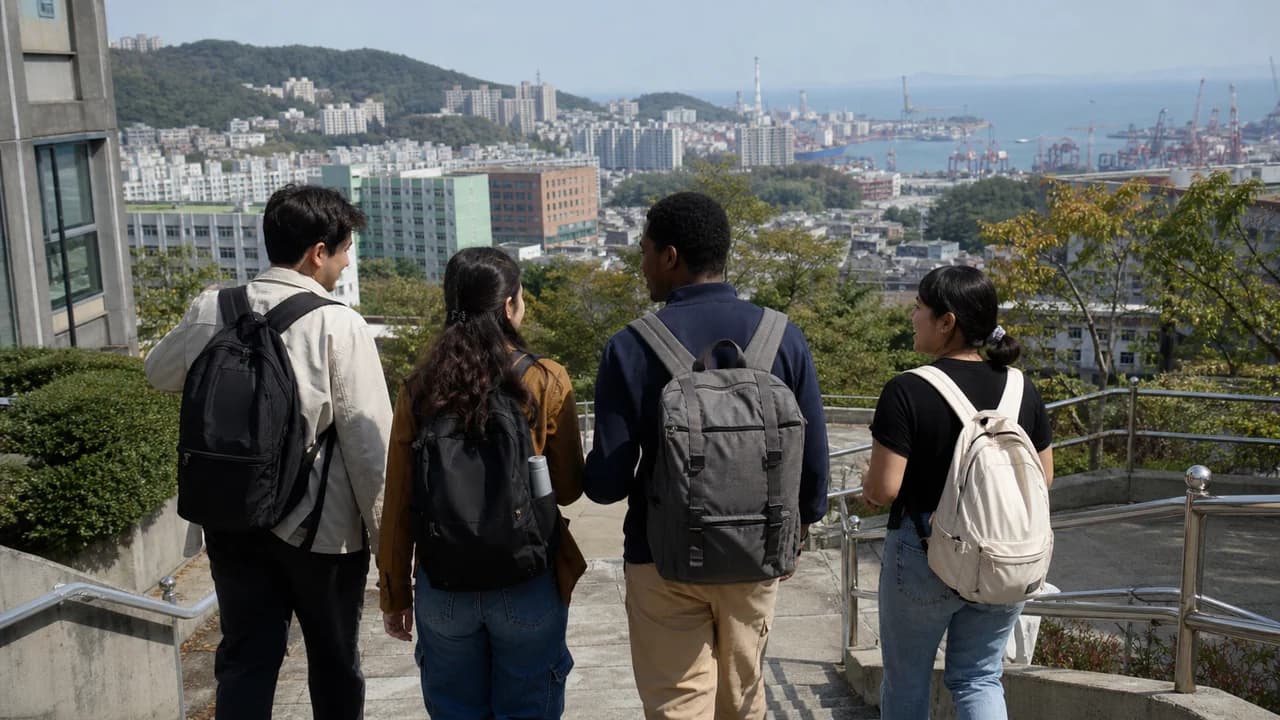
Busan is a port city and South Korea's second-largest city, with a population of 3.3 million. Its universities are spread from Geumjeong-gu to Nam-gu, Sasang-gu, Yeongdo-gu and Haeundae-gu. Choosing a university in Busan therefore means deciding not only on a major and tuition, but also where in the city to live, study and travel.
A city of 3.3 million stretched along the coast
Busan's population stood at 3,307,030 in April 2026, according to the city government. That total included 71,669 foreign residents. The city covers 771.33 square kilometers and is divided into 15 districts and one county. Because its urban areas extend between the coast and the mountains, travel times between campuses can vary considerably even within Busan.
Metro Lines 1 through 4 connect with the Busan-Gimhae Light Rail Transit and the Donghae Line. Announcements on the metro are made in Korean, English, Japanese and Chinese. Busan Station, served by KTX high-speed trains, Gimhae International Airport and the international passenger terminal with routes to Japan bring domestic and international transport links together in the city.
There is no single university district. Pusan National University, Busan University of Foreign Studies and the Catholic University of Pusan are in Geumjeong-gu. Kyungsung University, Pukyong National University and Tongmyong University are in Nam-gu. Some campuses are close to one another, including Dongseo and Silla universities in Sasang-gu and Korea Maritime & Ocean and Kosin universities in Yeongdo-gu. Travel between different parts of the city, however, requires separate calculations for transfers and commuting time.
| Area | Main university campuses | Transport and living environment |
|---|---|---|
| Geumjeong-gu | Pusan National University, Busan University of Foreign Studies, Catholic University of Pusan | Northern area on Metro Line 1, where university districts connect with residential neighborhoods. |
| Nam-gu | Kyungsung University, Pukyong National University, Tongmyong University | A cluster of universities around Daeyeon Station on Metro Line 2 and Yongdang-dong. |
| Sasang-gu and Busanjin-gu | Dongseo University, Silla University, Dong-eui University | Between western Busan and the city center; access to Metro Line 2 and the Busan-Gimhae Light Rail Transit matters. |
| Seo-gu and Saha-gu | Dong-A University | The Bumin, Gudeok and Seunghak campuses are in different areas, so students should first identify the campus for their major. |
| Yeongdo-gu | Korea Maritime & Ocean University, Kosin University | Island campuses where buses account for much of the commute. Kosin University also operates a medical campus in Songdo. |
| Haeundae-gu | Youngsan University Busan Campus | Located in eastern Busan. Youngsan University also operates a campus in Yangsan. |
| Yeonje-gu | Busan National University of Education | A small national university specializing in elementary teacher education. |
Degree programs account for 11,871 students at 14 universities
K-Study Times totaled the 14 four-year universities listed by the Busan city government in the Ministry of Justice's international-student management dataset released in July 2026. Bachelor's, associate, master's and doctoral programs accounted for 11,871 students, or 67.4% of the total. University language institutes and other foreign-language training programs had 5,080 students, while exchange students and designated researchers numbered 655.
| University | Total | Degree programs | Language training | Exchange, research and other |
|---|---|---|---|---|
| Kyungsung University | 2,124 | 1,456 | 567 | 101 |
| Dong-A University | 2,082 | 919 | 1,103 | 60 |
| Busan University of Foreign Studies | 1,762 | 1,211 | 464 | 87 |
| Youngsan University | 1,630 | 1,243 | 386 | 1 |
| Dongseo University | 1,625 | 1,038 | 512 | 75 |
| Silla University | 1,596 | 1,101 | 480 | 15 |
| Tongmyong University | 1,576 | 1,364 | 198 | 14 |
| Pusan National University | 1,547 | 1,044 | 371 | 132 |
| Pukyong National University | 1,400 | 948 | 386 | 66 |
| Dong-eui University | 1,195 | 997 | 115 | 83 |
| Catholic University of Pusan | 461 | 330 | 131 | 0 |
| Korea Maritime & Ocean University | 353 | 189 | 151 | 13 |
| Kosin University | 252 | 31 | 216 | 5 |
| Busan National University of Education | 3 | 0 | 0 | 3 |
Similar totals can conceal very different student populations. Of Tongmyong University's 1,576 international students, 1,364 were in degree programs; at Dong-eui University, the figure was 997 out of 1,195. Their degree-program shares were 86.5% and 83.4%, respectively. Dong-A University had 1,103 language trainees, more than its 919 degree students. At Kosin University, language trainees accounted for 216 of the total 252.
Pusan National University had 618 master's and doctoral students, more than its 425 undergraduate students. Pukyong National University also had a large graduate population, with 522 master's and doctoral students compared with 426 undergraduates. At Korea Maritime & Ocean University, 189 degree students and 151 language trainees formed groups of a similar size. These figures show why applicants should look beyond an institution's total and examine the student population in the program they plan to enter.
Industries from ports and logistics to tourism and film
Busan's economy cannot be explained by its port alone. Services accounted for 75.8% of the city's industrial structure in 2023, and manufacturing for 17.4%. Busan Port handled 24.3 million TEUs in 2024, ranking seventh among the world's container ports. Port logistics, shipbuilding and marine industries remain the city's foundation, alongside tourism and MICE, finance, digital content, film and video, and biohealth.
The city's academic landscape reflects those industries. Korea Maritime & Ocean University specializes in maritime studies, ocean science and ocean engineering. Pukyong National University combines fisheries and marine studies with engineering and natural sciences. Pusan National University has the research base of a comprehensive university. Among private universities, regional and language studies at Busan University of Foreign Studies, design and media at Dongseo University, and the broad academic offerings of Dong-A and Kyungsung universities widen the range of choices. This industrial structure provides context for understanding courses, field training and university-industry cooperation in the city.
Busan targets 30,000 international students by 2028
In its Study Busan 30K Project, announced in 2024, the city set targets of attracting 30,000 international students by 2028, raising the science and engineering share to 30%, and reaching a 40% conversion rate to employment or job-seeking visas after graduation. The plan links universities, companies and the Busan Global City Foundation to support recruitment, study, daily life, employment and settlement.
Those are targets for 2028. As of June 2026, the actual international-student population at the 14 universities comprised 11,871 degree students, 5,080 language trainees and 655 exchange students, researchers and others. Future assessments of Busan's international-student policy will need to track not only total recruitment, but also the share in degree programs, majors connected to local companies and the number of graduates who actually change their immigration status to remain in the region.
Data and methods
City size, transport and industry data came from the Busan city government's Busan at a Glance, City Environment, Public Transportation and Invest Busan pages. The city's international-student targets were checked against its Study Busan 30K Project. The university scope covers the 14 four-year institutions on Busan's list of local universities. Student totals were aggregated by university from the Ministry of Justice's international-student management dataset on the Public Data Portal, with a reference date of June 30, 2026. For universities such as Pusan National and Youngsan that also operate campuses outside Busan, the source data are reported at university level and cannot be separated by campus.
Related Articles
- Universities
- Universities
- Universities
- Kyungsung University’s Winter 2026 Korean-Language Program: Overseas Applications Close September 18Universities
- Universities
- Universities
Comments
Please sign in to post a comment.
You will return to this article after sign-in.
Sign inNo comments yet.