

Korea student record policy raises privacy standards for study diagnostics
Korea's student-record policy discussion and personal-data minimization principles show what international students should check before using Korea study diagnostic and counseling services.
Key Points
- As of July 2, 2026, Korea's Ministry of Education announced measures around limiting commercial use of student records and strengthening public career and admission counseling.
- The announcement is about Korea's domestic student-record system, so it should not be copied directly onto every international-student document process.
As of July 2, 2026, Korea's Ministry of Education announced measures around limiting commercial use of student records and strengthening public career and admission counseling. The announcement is about Korea's domestic student-record system, so it should not be copied directly onto every international-student document process. Still, it raises the right question for Korea study applicants: how much personal data should a diagnostic or counseling service ask for?
Core answer
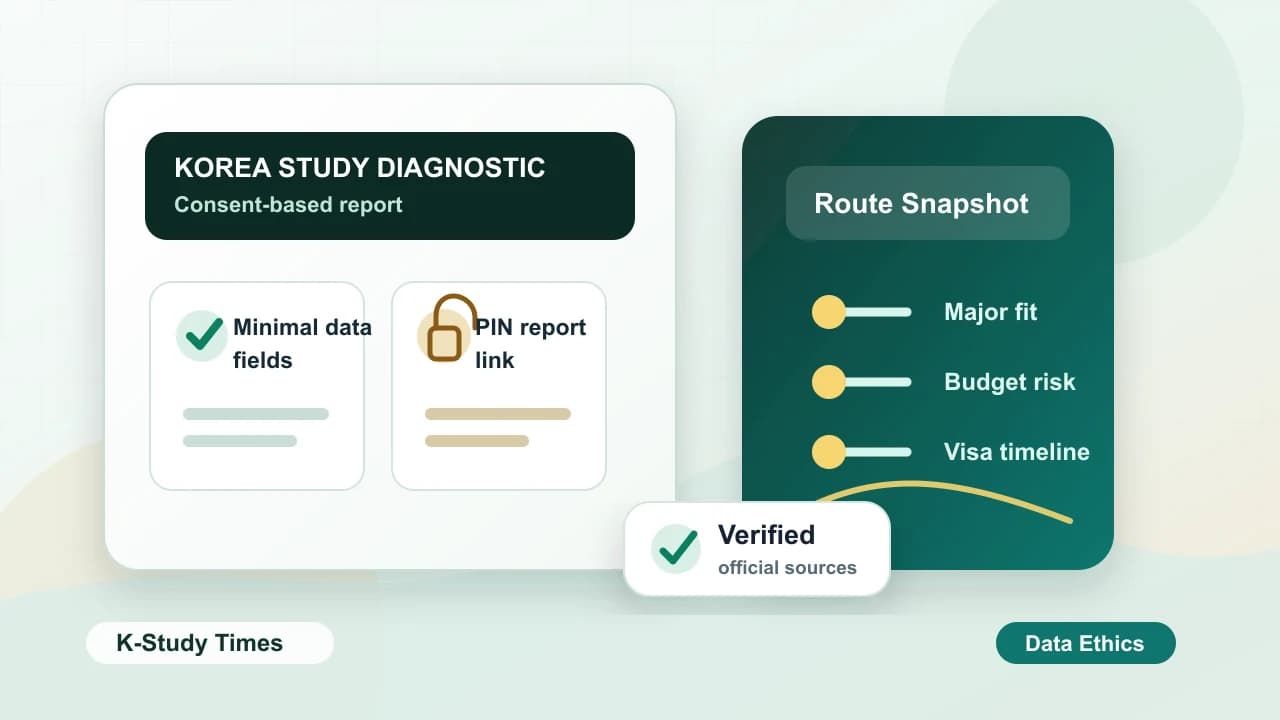
A reliable Korea study diagnostic does not start by asking for passport numbers, exact addresses, family-sensitive details, health information, or original academic documents. It should first ask for the minimum data needed to understand the route: current stage, target degree, preferred major, language readiness, budget range, scholarship need, and intended intake.
| Stage | Reasonable data | Why it is needed | Warning sign |
|---|---|---|---|
| First diagnostic | country, study stage, target course, major interest, language, budget | to identify a first route | passport number or exact address at the start |
| PDF report | display name, report language, intended intake | to personalize the report | forcing unrelated sensitive data |
| Counseling request | contact method, contact value, consent, topic | to follow up with the student | vague consent wording |
| Document review | transcript, certificate, language score, finance proof | only when application review starts | asking for original files during a free quiz |
Why the Korean policy item matters, but has limits
The Ministry of Education item concerns domestic student records and public counseling. International applicants often use overseas transcripts, graduation certificates, language scores, and financial documents, and those requirements depend on each university and visa route. That is why the announcement should be treated as a trust signal, not as a direct rule for every foreign-student file.
The useful lesson is narrower: educational data affects a student's future. A counseling service should explain why it collects each item and delay document-level collection until the purpose is clear.
Five checks before using a Korea study test
First, the test should say what it is diagnosing: major fit, university group, scholarship readiness, visa and budget risk, or admission timing.
Second, free diagnostics and paid counseling should be separated. A free test can identify direction; a full review should compare official admission guides and actual documents.
Third, data collection should be staged. The result calculation should not require a phone number or email unless the user requests a report or consultation.
Fourth, the result should separate what is known from what still needs review. A short quiz cannot confirm scholarship, visa, or admission outcomes.
Fifth, the test should connect to official routes such as Study in Korea online applications, student visa guidance, and university admission pages.
Free diagnostic vs full consultation
| Item | Free first diagnostic | Full consultation |
|---|---|---|
| Purpose | find direction | review feasibility |
| Data | preference, target degree, language, budget range | academic record, graduation status, scores, finance proof |
| Result | major cluster, preparation risks, next test | university group, roadmap, document gaps |
| Privacy | minimum profile and consent-based contact | documents only for a clear counseling purpose |
What applicants should not provide too early
In a first diagnostic, avoid entering passport numbers, alien registration numbers, national ID numbers, exact addresses, health information, or family-sensitive information. Such data may become necessary in official admission or visa procedures, but it should not be required to calculate a general study-fit result.
Email and name are also personal data. They can be collected for sending a PDF report or arranging counseling, but the service should make that purpose clear.
Before Sharing Documents
Before sending transcripts, passports, addresses, or family information, applicants should check why the document is needed, who will view it, how long it will be stored, and whether it is required at the current stage.
FAQs
Do I need to upload my transcript for a free diagnostic?
Usually no. A first diagnostic can work with your target degree, current stage, language readiness, budget range, and intended intake. Transcript review should be a separate step.
Are name and email personal data?
Yes. They identify or contact a person. They can be used for report delivery or counseling if the purpose and consent are clear.
Can a diagnostic tell me whether I will be admitted?
No. It can show route signals and risks, but admission depends on official university requirements, documents, grades, interviews, quota, and timing.
What should I try first?
First separate what is already clear from what still needs official review: target degree, current academic stage, intended intake, language readiness, budget range, and document status. Document-level review should be handled only after a separate purpose and consent are confirmed.
Related Articles
- Features
- Features
- Features
- Features
- Features
- Features
Comments
Please sign in to post a comment.
You will return to this article after sign-in.
Sign inNo comments yet.