

The Korean Society for Immigration Policy Successfully Concludes Summer Academic Conference on \"Region-Led Immigration Policy as a Solution to Regional Decline\"
The Korean Society for Immigration Policy held its summer academic conference at Kangwon National University to discuss region-led immigration policies and ways to build a settlement ecosystem.
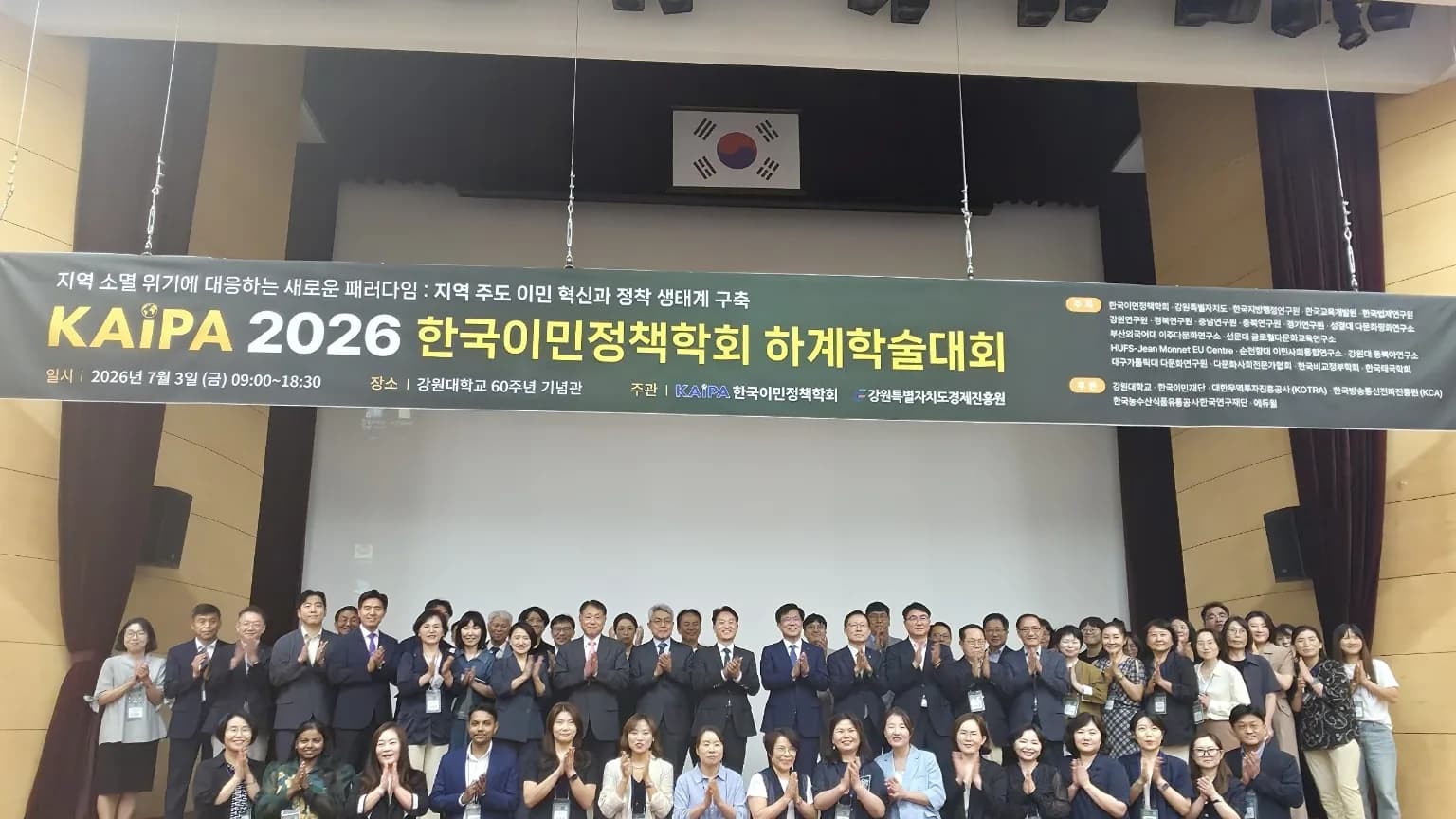
# The Korean Society for Immigration Policy Successfully Concludes Summer Academic Conference on "Region-Led Immigration Policy as a Solution to Regional Decline"
The Korean Society for Immigration Policy held its summer academic conference at Kangwon National University to discuss region-led immigration policies and ways to build a settlement ecosystem.
Korean Society for Immigration Policy: "The Solution to Regional Decline Is a Locally Driven Immigration Policy"
Korean Society for Immigration Policy Summer Academic Conference Concludes Successfully...
Held on the Largest Scale Ever in Korea’s Immigration Field
- 32 breakout sessions, over 70 academic papers presented, and participation by over 300 domestic and international experts
- In-depth discussions on policy alternatives for region-led immigration innovation and the establishment of a settlement ecosystem
The Korean Association for Immigration Policy (President Im Dong-jin) successfully held its 2026 Summer Academic Conference on July 3 at the 60th Anniversary Hall of Kangwon National University under the theme “A New Paradigm for Addressing the Crisis of Regional Decline: Regionally Led Immigration Innovation and the Establishment of a Settlement Ecosystem,” and presented regionally led immigration policies and strategies for building local community settlement ecosystems to overcome the crisis of regional decline.
The Society’s Summer Academic Conference was attended by approximately 300 experts from domestic and international academia, government, local governments, research institutions, and public agencies, with over 70 research papers presented across 32 sessions. In addition, international sessions—including English-language sessions featuring both domestic and international researchers—were held, serving as an opportunity to expand international academic exchange on Korean immigration policy. In particular, considering the number of sessions, the number of papers presented, and the number of presenters, discussants, and participants, this conference was the largest in the history of academic conferences in the field of immigration in Korea.
At the opening ceremony, Lim Dong-jin, President of the Korean Association for Immigration Policy, emphasized, “The Republic of Korea is facing a complex crisis of low birth rates, an aging population, and the decline of local communities. Immigration policy must now evolve beyond a mere population supplementation policy to become a national growth strategy that drives the sustainable development of local regions.” He went on to state, “Establishing a regionally led system of immigration innovation and social integration—one that attracts the talent needed by local communities and ensures their stable settlement—is the key to the nation’s new competitiveness.”
Welcome remarks were delivered by Woo Sang-ho, Governor of Gangwon Special Self-Governing Province; Jeong Jae-yeon, President of Gangwon National University; and Seo Dong-myeon, Director of the Gangwon Special Self-Governing Province Economic Promotion Agency. Congratulatory speeches were given by Cha Yong-ho, Director General of the Immigration and Foreigners Policy Bureau at the Ministry of Justice; Yuk Dong-il, President of the Korea Institute of Local Administration; Ko Young-seon, President of the Korea Institute of Education Development; Bae Sang-geun, President of the Gangwon Research Institute; Kim Young-bae, President of the Chungbuk Research Institute; Yoo Cheol-kyun, President of the Gyeongbuk Research Institute; Nam Ki-beom, Director of the Multicultural Peace Research Institute at Sungkyul University; and Hong Moon-sook, Director of the Migration and Multicultural Research Institute at Busan University of Foreign Studies—all emphasized the necessity of region-based immigration policies and the importance of social integration.
At the summer academic conference, the latest research findings and policy proposals were presented across a wide range of fields, including regional immigration policy, policies for international students, foreign labor policies, social integration, multicultural education, immigration administration, overseas Koreans, refugee policy, regional settlement, and the role of local governments.
Various policy proposals exploring the direction of immigration policy following the inauguration of the new administration and strategies to address regional depopulation were also discussed. In particular, research comparing immigration and social integration policies in major countries around the world—including the United States, Canada, Australia, the United Kingdom, Germany, France, Japan, Singapore, and Taiwan—as well as a local government-centered immigration policy model to address regional depopulation, strategies for the regional settlement of international students and skilled workers, and plans for establishing community integration governance were the focus of intense discussion and drew significant interest from attendees.
The participating experts agreed that the core of South Korea’s immigration policy should shift from a central government-led management system to a local government and community-centered implementation system. They also emphasized that building a regional settlement ecosystem—one that integrates education, employment, housing, and social integration—to enable foreign residents, international students, and skilled professionals to settle stably in local communities should become a core task of the new administration’s immigration policy.
This academic conference served as a forum for collaboration, bringing together academia, the government, local governments, and research institutions, including the Ministry of Justice, Kangwon National University, Kangwon Special Self-Governing Province, the Korea Institute of Local Administration, the Korea Institute of Curriculum and Evaluation, the Kangwon Research Institute, the Chungbuk Research Institute, the Gyeongbuk Research Institute, the Institute for Multicultural Peace at Sungkyul University, and the Institute for Migration and Multicultural Studies at Busan University of Foreign Studies. Through this event, the conference reaffirmed its status as a leading policy and academic platform for sharing academic research findings and practical policy experiences, as well as for discussing the future direction of South Korea’s immigration policy.
Im Dong-jin, President of the Korean Association for Immigration Policy Studies, stated, “Immigration policy is no longer a supplementary measure to offset population decline, but a core national strategy that determines the country’s sustainable growth and the future of local communities,” adding, He added, “The Korean Association for Immigration Policy will continue to lead evidence-based immigration policy research and development as a policy platform connecting the central and local governments, academia, and the policy field, thereby contributing to the advancement of South Korea’s immigration policy and the sustainable growth of local communities.”
This academic conference is regarded as the event with the broadest participation of domestic researchers and policy experts in the field of immigration, once again demonstrating its status as the leading academic platform for immigration policy research in Korea.
Related Articles
- Policy
- Policy
- Policy
- Policy
- Policy
- Policy