

With the release of the official 2027 GKS-U announcement, applicants from India should review the schedule separately for the four slots allocated through the diplomatic mission selection process and the university-specific selection processes.
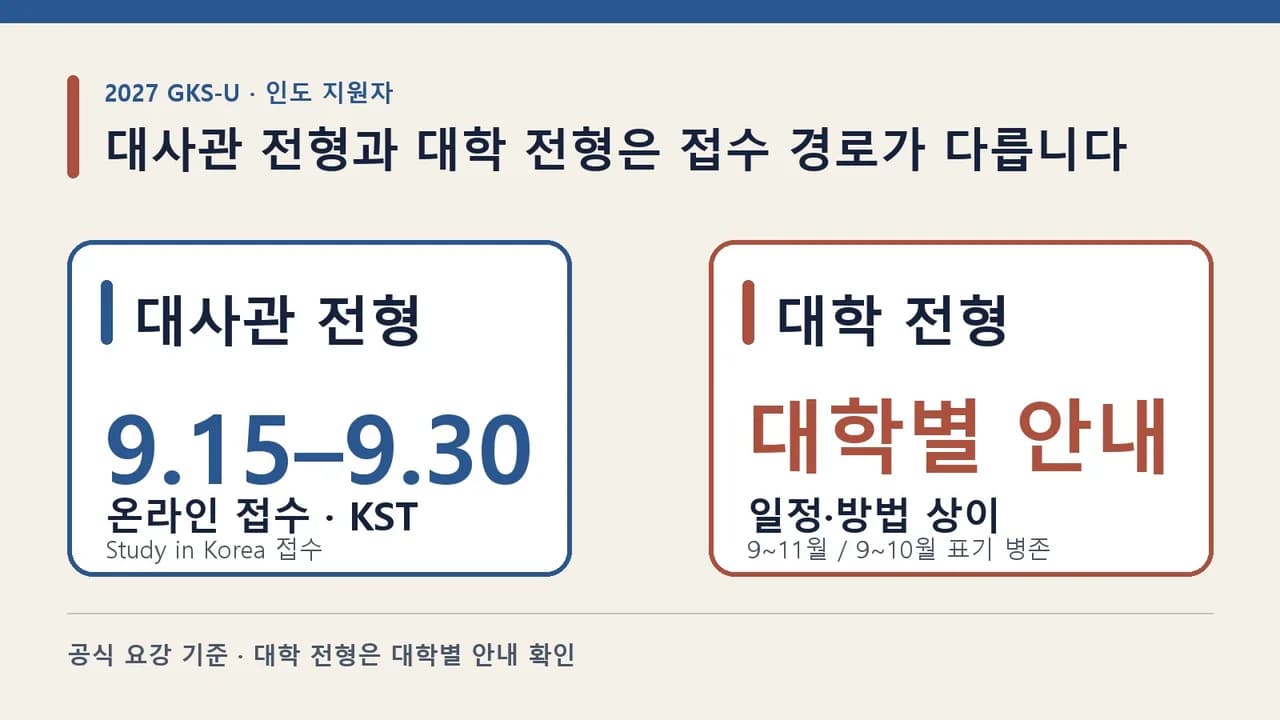
On September 9, 2026, the official announcement for the 2027 GKS-U was released. The quota for the diplomatic mission track is four candidates in total: two for the General track and two for the R-GKS track. Online applications for the diplomatic mission track will be accepted from September 15 to 30; for the university track, applicants must check the official announcements from each university to confirm the actual application deadlines.
Key Points
- On September 9, 2026, the official announcement for the 2027 GKS-U program was released.
- The allocation for the Indian diplomatic mission track is four spots in total: two for the General track and two for the R-GKS track.
On September 9, 2026, the official announcement for the 2027 GKS-U program was released. The allocation for the Indian diplomatic mission track is four spots in total: two for the General track and two for the R-GKS track. Applicants must first verify their eligibility and any application restrictions; online applications for the diplomatic mission track will be accepted from September 15 to 30. The university-based selection process will be conducted from September to November according to each university’s individual schedule; therefore, applicants should check the official announcements from each university for the actual application deadlines.
The 2027 GKS-U program has a total of 286 slots, with 4 allocated to the Indian Embassy track
The National Institute for International Education (NIIED) posted a notice for the “2027 Global Korea Scholarship for Undergraduate Degrees” on Study in Korea on September 9, 2026. The total number of students to be selected for the 2027 GKS-U is 286.
The Embassy Track comprises a total of 156 students: 88 in the General category, 61 in the R-GKS category, and 7 for overseas Koreans and adoptees. The University Track consists of 100 students for the University International College (UIC) program and 30 for the Associate Degree program.
The country-specific allocation for the Embassy Track in India is 2 students for the General category and 2 for the R-GKS category, for a total of 4 students. This number refers to the Diplomatic Mission Track quota allocated to India; it does not mean that there is a separate quota of 4 spots exclusively for Indian nationals or a separate national quota within the University Track. The University Track’s UIC program is open to applicants from all countries worldwide, while the Associate Degree program is open to applicants from 74 invited countries.
| Category | Overall Selection Structure | Points for Indian Applicants to Note |
|---|---|---|
| Embassy Track | General: 88, R-GKS: 61, Overseas Koreans and Adoptees: 7 | India’s allocation: General: 2, R-GKS: 2, Total: 4 |
| University Selection | UIC: 100 students, Associate Degree: 30 students | There is no separate country-specific quota for India; applicants must check eligible universities, departments, and university-specific schedules |
Before Deciding on an Application Path, Check Official Eligibility Requirements and Application Restrictions
Before deciding whether to apply through the Embassy Selection or the University Selection process, applicants from India must first verify that they meet the basic eligibility requirements for the 2027 GKS-U program and are not subject to any application restrictions.
Nationality, Age, Educational Background, and Academic Performance Requirements
As a general rule, applicants must hold the nationality of a GKS host country. Separate criteria apply to the UIC program, which is open to applicants from all countries worldwide. The applicant’s parent or legal guardian must be a foreign national; applicants or their parents who hold dual citizenship—including Korean citizenship—are ineligible to apply.
If the applicant or a parent previously held Korean citizenship, they must submit documentation issued by the Korean government verifying renunciation or loss of Korean citizenship. Furthermore, if an applicant’s nationality changes during the review period, they will be excluded from consideration—except for UIC applicants.
Eligibility is limited to applicants born on or after March 1, 2002. For the bachelor’s degree program, applicants must be high school or junior college graduates or prospective graduates; for the associate degree program, applicants must be high school graduates or prospective graduates. Prospective graduates must be expected to graduate by December 31, 2026.
Applicants holding a bachelor’s degree or higher are not eligible to apply to GKS-U. Applicants holding an associate’s degree may only apply to the bachelor’s degree program.
Academic performance must meet one of the following three criteria based on the applicant’s cumulative GPA from their most recent school:
- A converted score of 80 or higher out of 100
- Ranked in the top 20% of their class
- A CGPA of 2.64/4.0, 2.80/4.3, 2.91/4.5, or 3.23/5.0 or higher
In addition, applicants must be physically and mentally healthy enough to study in Korea for an extended period, have no criminal record, and have no disqualifying factors for international travel.
Applicants must also verify any application restrictions
Even if you meet the basic eligibility requirements, you cannot apply if you fall under any of the application restrictions listed in the admissions guidelines. In particular, please check the following:
- Graduates or prospective graduates of high schools (including international schools) or junior colleges in Korea are not eligible to apply. Graduates of online programs offered by schools located in Korea and students currently enrolled in their final year at a school located in Korea are also subject to these restrictions.
- Individuals who were previously selected as GKS scholarship recipients and received scholarship benefits for a degree program are ineligible. This restriction also applies to those who were admitted as GKS degree program or International Reconstruction Talent Korean Language Training Program scholarship recipients but subsequently lost their scholarship status. However, participants in the National Institute for International Education’s Outstanding Exchange Student Program and recipients of the International Reconstruction Talent Korean Language Training Program are eligible to apply.
- Individuals who have received a degree program scholarship from a Korean government agency other than the National Institute for International Education are ineligible to apply.
- Individuals who were finally accepted as GKS degree program scholarship recipients within the last three years but withdrew before enrollment or had their acceptance revoked are ineligible to apply.
- Applicants may not apply simultaneously to both the Embassy Track and the University Track. Within the Embassy Track, applicants may apply to only one of the following categories: General, Overseas Koreans/Adoptees, or R-GKS. Similarly, within the University Track, applicants must select only one program—either UIC or Associate Degree—and apply to only one university and one department.
Since eligibility restrictions may vary depending on an individual’s past academic record and scholarship history, applicants with relevant history must directly refer to II. Eligibility and Restrictions in the official admissions guidelines.
After confirming eligibility, applicants must distinguish between the application processes for the Embassy Track and the University Track.
The Embassy Track and the University Track differ in terms of the application authority, application method, number of universities that can be selected, and selection procedures.
The Embassy Track requires online application through the “Study in Korea” Comprehensive System for Studying in Korea. The application period runs from September 15, 2026, at 11:00 a.m. to September 30, 2026, at 6:00 p.m.; all times are in Korea Standard Time (KST). After registering as a member of the system, complete the application form and upload the required documents.
For the General Embassy-Administered Selection, you may select up to three universities from among Type A and Type B universities, and your selection must include at least one Type B university. For the R-GKS program, you may only select Type B universities and may apply to a maximum of two universities. You cannot apply to multiple departments within the same university.
University Admissions through Study in Korea does not accept applications via a centralized online system like the Embassy-Administered Track. Applicants must apply according to the application methods and schedules set by each individual university, and may apply to only one university and one department.
The current Korean-language admissions guide (September 14 edition) states that the application period for the University-Based Admissions Track is September–November 2026, according to each university’s individual schedule. Therefore, you must refer to the official admissions announcements of the university you are applying to to confirm the actual start and end dates, submission methods, and required supplementary documents.
| Item | Embassy-Based Admissions Track | University-Based Admissions Track |
|---|---|---|
| Application Entity | Study in Korea Online System | Individual Universities |
| Application Period | September 15, 2026, 11:00 a.m. – September 30, 2026, 6:00 p.m. KST | September–November 2026 (university-specific schedules). Actual deadlines are based on each university’s official announcements |
| University Selection | General: Up to 3 (at least 1 Type A or B), R-GKS: Up to 2 (Type B) | 1 university, 1 department |
| First-Round Screening | Embassy | University |
| Subsequent Procedures | Second-round screening by NIIED, followed by third-round screening by the university | Second-round screening by NIIED, followed by final selection |
Applicants must verify the actual list of eligible universities and departments in “University Information” and check for any additional requirements
Meeting the basic GKS eligibility requirements does not automatically qualify you to apply to all participating universities and departments. Applicants must select their target universities and departments from those listed in the University Information attached to the official 2027 GKS-U announcement on Study in Korea.
Depending on the university and department, separate language test scores, academic requirements, major-specific conditions, or additional supporting documents may be required. Therefore, applicants should not submit their applications after merely confirming the general GKS eligibility requirements; they must also verify the additional requirements of their intended university and department by referring to both the University Information and the university’s official announcement.
When preparing documents, you must distinguish between the initial submission and the submission for the second-round review following initial qualification
Applicants for the first round of the Embassy Selection Process must complete the application form, personal statement, study plan, and consent form on the Study in Korea system, and upload required supporting documents such as letters of recommendation and certificates verifying nationality, family relationships, graduation (or expected graduation), and academic transcripts.
For the university-based selection process, applicants must submit the application form and supporting documents specified by the National Institute for International Education in accordance with the university’s guidelines; additional documents may be required by the university.
The main required documents are as follows:
- Application form, personal statement, study plan, letters of recommendation, applicant consent form, self-assessment of health, and consent for the collection and use of personal information
- Proof of the applicant’s and parents’ nationality and family relationships
- Proof of high school graduation or expected graduation, and academic transcripts
- Relevant graduation and academic records when applying to a bachelor’s program with an associate’s degree
- Supporting documents regarding renunciation or loss of Korean nationality, status as an overseas Korean or adoptee, or status as a Korean War veteran, as applicable
- TOPIK or official English test scores, awards and activity records, and a copy of the passport, as submitted by the applicant
The 2027 Application Guidelines allow for the simplification of certain document preparation procedures required for the second screening stage—such as Apostille certification or consular certification—during the first screening stage. However, applicants must check the guidelines provided by the relevant diplomatic mission or university to confirm the scope of documents eligible for simplification and the submission method.
Candidates who pass the first round must submit original documents and documents meeting the requirements specified in the application guidelines—such as Apostille certification or consular certification—for the NIIED’s second-round screening. Documents issued in a language other than Korean or English must be accompanied by a notarized translation, and the method of certifying required documents must be prepared in accordance with the detailed requirements in the application guidelines.
Results for the first round of the diplomatic mission screening will be announced by October 16, and the list of final successful candidates is scheduled to be announced on January 7, 2027.
The results of the first round of the Embassy Screening are scheduled to be announced by October 16, 2026. Following this, after the second round of screening by NIIED and the third round of screening by the universities participating in the Embassy Screening, the final list of successful candidates is scheduled to be announced on January 7, 2027. The application guidelines note that the entire schedule is subject to change during the selection process.
Applicants who do not pass the first round of the Embassy Selection Track may reapply through the University Selection Track. However, applicants cannot apply to both tracks simultaneously. Additionally, since the actual application deadlines for the University Selection Track vary by university, applicants considering reapplication should check both the announcement date for the first-round results of the Embassy Selection Track and the official deadline for their preferred university.
The steps for Indian applicants to follow can be summarized as follows: First, check the official eligibility requirements and application restrictions; next, identify the Embassy Track or University Track pathways, as well as the universities and departments for which you are eligible to apply. Afterward, review the additional requirements and actual deadlines in the “University Information” section and each university’s announcement, then prepare and submit the required documents for the respective track.
Official Reference Sources
- Study in Korea 2027 GKS-U Official Announcement (September 9, 2026; current version attached, 0914): https://www.studyinkorea.go.kr/ko/plan/gksNoticeRead.do?bbsId=BBSMSTR_000000000461&nttId=4522
- In the attachment section of the official announcement posted above, you must review the 2027 GKS-U Korean Application Guidelines, University Information, and Application Forms.
- Check University Information for eligible universities and departments, as well as any additional application requirements for each university and department.
- For the Embassy-Administered Track, review the official application guidelines on the Study in Korea online system. For the University-Administered Track, check the official recruitment announcement of your desired university for the actual application period, deadline, application method, and additional required documents.
Related Articles
- Scholarships
- Scholarships
- Scholarships
- Scholarships
- Scholarships
- Scholarships
Comments
Please sign in to post a comment.
You will return to this article after sign-in.
Sign inNo comments yet.