

Korea AI and Software Engineer Salary: NAVER, Kakao and a Study Roadmap for Indian Students
Based on KOSA software wage data, ADIGA occupation wages, NAVER and Kakao 2025 business reports, and D-2 to D-10/E-7 visa flow checked on July 1, 2026, this guide explains how Indian students should read Korea AI and software salary signals.
Key Points
- For Indian students who judge Korean study by employment and income, AI and software are practical options next to semiconductors and batteries.
- Korea has computer science, AI, data science, electrical engineering and industrial engineering programs, and Korean employers need software talent in platforms, games, finance, manufacturing, electronics, mobility, cloud, security and public IT projects.
For Indian students who judge Korean study by employment and income, AI and software are practical options next to semiconductors and batteries. Korea has computer science, AI, data science, electrical engineering and industrial engineering programs, and Korean employers need software talent in platforms, games, finance, manufacturing, electronics, mobility, cloud, security and public IT projects. The real question is simple: what income signals are visible in Korea, and what major roadmap should an Indian student prepare before applying?
As of July 1, 2026, the salary evidence has to be read in three layers. First, the Korea Artificial Intelligence and Software Industry Association, or KOSA, publishes software engineer average wages used for software project cost estimation. Second, ADIGA occupation data shows wage ranges for application software developers, system software developers and computer system analysts. Third, NAVER and Kakao 2025 business reports published through KIND/DART show company-wide average pay per employee.
These numbers are useful, but they are not the same. KOSA data is a software project wage benchmark, ADIGA is an occupation survey indicator, and NAVER/Kakao figures are company-wide employee averages. The company average pay figure is not a starting salary for an Indian student after graduation. Still, together they show that the Korea AI and software route can have strong income potential, but it requires a clear major choice, project evidence, workplace Korean readiness and a D-10/E-7 visa plan.
Core Answer: Do Not Start With the Word AI Alone
AI engineer sounds attractive, but employability requires a narrower target. If a student wants to build machine learning models, computer science, mathematics, statistics and data science matter. If the goal is to put AI into a service, backend engineering, cloud, API design, databases and MLOps become important. If the target is manufacturing, battery or semiconductor data, industrial engineering, electrical engineering, control, statistics and Python-based data analysis can be the stronger path.
Indian students should not search only for AI master's in Korea. For employment, they should ask three questions first. Do I have strong computer science fundamentals? Do I have visible proof such as GitHub, a paper implementation, a capstone project, internship work or open-source contribution? Can I explain the job language of the role I want after graduation? Employers respond better to evidence of a system, model, dataset or service than to a vague statement that the student studied AI.
Salary Indicators: Read KOSA, ADIGA and Company Average Pay Separately
KOSA's 2026 software engineer average wage announcement is based on the 2025 software engineer wage survey. It lists the application software developer monthly average wage at KRW 7,754,124 and the daily average wage at KRW 378,250. It also lists IT architect at KRW 11,103,230 per month, data analyst at KRW 8,499,309 per month and information security specialist at KRW 10,411,680 per month. KOSA explains that the wage includes base pay, allowances, bonuses, retirement benefit provision and company-paid statutory contributions.
ADIGA gives another view. Application software developers are listed with 2023 wages of KRW 50.0 million at the lower level, KRW 65.5 million on average and KRW 86.25 million at the upper level. System software developers are listed at KRW 46.0 million, KRW 60.0 million and KRW 90.0 million. Computer system analysts and designers are listed at KRW 60.0 million, KRW 70.0 million and KRW 93.5 million. ADIGA states that the wage information is based on self-reported survey data from an average of 30 workers per occupation.
| Source | Verified wage indicator | Meaning | Caution |
|---|---|---|---|
| KOSA application software developer | 2026 applied monthly average KRW 7,754,124 | Software project wage benchmark | Not a hiring salary table or an entry-level salary. |
| KOSA data analyst | Monthly average KRW 8,499,309 | Data role wage benchmark | Shows market value but not a company's offer. |
| KOSA IT architect | Monthly average KRW 11,103,230 | Senior design and architecture benchmark | Not a new graduate role. |
| ADIGA application software developer | 2023 lower KRW 50.0M, average KRW 65.5M, upper KRW 86.25M | Occupation wage reference | Based on a small self-reported occupation survey. |
| ADIGA system software developer | 2023 lower KRW 46.0M, average KRW 60.0M, upper KRW 90.0M | System and embedded software reference | Actual pay varies by company, industry and experience. |
| ADIGA computer system analyst | 2023 lower KRW 60.0M, average KRW 70.0M, upper KRW 93.5M | System design and analysis reference | More design and analysis oriented than a beginner developer role. |
What NAVER's KRW 146 Million and Kakao's KRW 109 Million Mean
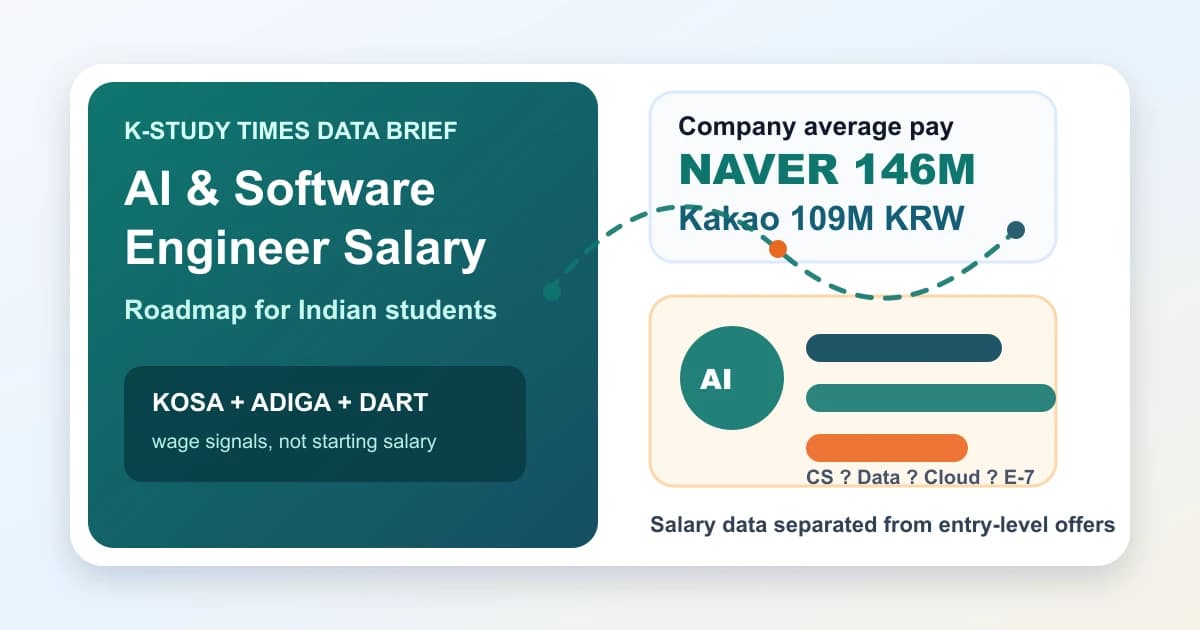
NAVER's 2025 business report on KIND/DART lists 5,047 employees as of December 31, 2025, average tenure of 7.7 years, annual payroll of KRW 711,423 million and average pay per employee of KRW 146 million. The report note states that pay includes salary, bonus, welfare benefits and other earned income items, and that stock option exercise gains and RSU payments are reflected.
Kakao's 2025 business report lists 3,922 employees, average tenure of 6 years and 3 months, annual payroll of KRW 439,510 million and average pay per employee of KRW 109 million.
These numbers are powerful motivation signals, but they must be interpreted strictly. NAVER and Kakao average pay figures are company-wide employee averages, not starting salaries for software engineers. They can include developers, planners, designers, sales, corporate staff, experienced employees, high performers and stock-based compensation effects. The right interpretation is that major Korean platform companies can show high compensation levels, not that every graduate will earn the same amount immediately.
| Company | Employees in 2025 report | Average tenure | Average pay per employee | How Indian students should read it |
|---|---|---|---|---|
| NAVER | 5,047 | 7.7 years | KRW 146 million | A signal of high company-wide compensation; stock option and RSU effects may be included. |
| Kakao | 3,922 | 6 years 3 months | KRW 109 million | A large internet company average, not a role-specific hiring salary. |
Major Roadmap for Indian Students
AI and software hiring depends on skill combinations more than the title of the degree. Indian students should not stop at choosing between a master's in computer science and a master's in AI. They should first define the target role, build the required coursework and portfolio, then compare Korean graduate programs and scholarship conditions.
| Target role | Recommended major | Skills to prepare | Evidence to show |
|---|---|---|---|
| Backend or platform engineer | Computer science, software engineering | Data structures, operating systems, databases, networks, Java/Kotlin/Python, cloud | API server, database design, deployment, performance improvement |
| AI/ML engineer | AI, computer science, data science, statistics | Linear algebra, probability, machine learning, deep learning, Python, PyTorch, MLOps | Model training code, data pipeline, evaluation, paper implementation |
| Data engineer or analyst | Data science, industrial engineering, statistics, computer science | SQL, Python, Spark, data modeling, experiment design, visualization | Data pipeline, dashboard, analytical report |
| Security or cloud engineer | Cybersecurity, computer science, networks | Linux, network security, cloud, incident response, DevOps | Vulnerability analysis, cloud deployment, security project |
| Manufacturing AI | Industrial engineering, electrical engineering, computer science, AI | Sensor data, anomaly detection, control, statistics, process understanding | Quality prediction, anomaly detection, manufacturing data project |
Korea's advantage is not only AI. Software connects with semiconductors, batteries, automobiles, displays, games, internet platforms, finance and public digital transformation. A student who is not a pure AI researcher can still build a strong route through manufacturing data, semiconductor equipment software, battery life prediction, smart factories, financial platforms or security.
What to Check in Korean Graduate Programs
KAIST Kim Jaechul Graduate School of AI points applicants to KAIST admissions for detailed admission information, and KAIST's graduate admissions page explains spring and fall graduate admission tracks. Seoul National University provides graduate admission information for international applicants. POSTECH also operates international graduate admission information and GKS notices. These official pages are starting points for Indian students comparing AI and software graduate options in Korea.
However, the school name is not enough. Applicants should check whether the program can be completed in English, whether the professor and lab accept international master's students, whether the research topic matches the applicant's project history, how much tuition and living cost scholarship can cover, and whether the lab or department has industry collaboration or internship opportunities. AI graduate schools, computer science departments, data science programs and electrical engineering departments can all be candidates, but research fit and portfolio evidence decide the strength of the application.
Employers Are Broader Than NAVER and Kakao
If Korean software employment is reduced to only platform companies, students miss many paths. NAVER and Kakao are major platform companies in search, messaging, content, advertising, commerce, cloud and AI. But Indian students should also consider manufacturing and service companies. Samsung Electronics, LG Electronics, Hyundai Motor Group, LG Energy Solution and Samsung SDI need AI, data, cloud, embedded and security talent. Financial institutions run data, security, payment and risk systems. Game and content companies need server, client, data, recommendation and payment systems. SI and cloud firms run public and enterprise projects.
Counseling should therefore begin with the role: backend, AI, data, security or manufacturing AI. Platform companies are competitive and portfolio-heavy. Manufacturing AI and data roles can connect more directly with Korea's industrial strengths. If an Indian student is strong in math and coding and is also interested in industry, battery, semiconductor and automobile data roles can become a more persuasive roadmap than a generic platform-company dream.
D-2 to D-10 and E-7 Planning
Study in Korea explains that international students in regular degree programs need a D-2 visa. After graduation, students considering job search or professional employment may need to review D-10 and E-7 status. This is not an automatic switch. HiKorea's integrated manual and Ministry of Justice notices have to be checked for occupation, degree, major, employment contract, wage requirement and company conditions.
AI and software jobs may connect with information technology, software, data, security and system design occupations. But the job title alone is not enough. The student's degree, major, employer contract, wage level and actual job description should align. That is why Indian students should plan possible status of stay from the graduate application stage, not only after graduation.
What Indian Students Should Do Now
- Check weak points in data structures, algorithms, operating systems, databases and networks.
- Narrow the target role to backend, AI/ML, data, security or manufacturing AI.
- Build at least two pieces of evidence: GitHub, paper implementation, capstone, internship, data project or open-source contribution.
- Align GPA and English test scores with Korean graduate admission requirements.
- Treat Korean not only as an admission issue but as workplace readiness for meetings, code reviews and reports.
- Back-calculate D-2 study, D-10 job search and possible E-7 professional employment requirements.
- Before counseling, prepare a question about what data, system or product you want to work with, not only the phrase "I want AI."
FAQs
Is NAVER's KRW 146 million average pay a starting salary for developers?
No. It is the average pay per employee in NAVER's 2025 business report. It may include company-wide employees, average tenure, salary, bonus, welfare benefits, stock option gains and RSU payments. It should not be read as an entry-level developer salary.
What does Kakao's KRW 109 million average pay mean?
It is Kakao's company-wide average pay per employee in the 2025 business report. It is a useful compensation signal for a large internet company, but it is not a role-specific or career-level hiring salary.
Should Indian students look only for an AI master's?
No. Backend, data, security, manufacturing AI and embedded software can lead to different majors. Computer science, data science, electrical engineering and industrial engineering can all be valid depending on the target role.
Is KOSA software engineer average wage an annual salary?
KOSA publishes monthly, daily and hourly average wages used as software project labor cost benchmarks. It includes base pay, allowances, bonuses, retirement benefit provision and company-paid statutory contributions. It is not an individual hiring salary table.
Can an English-track master's lead to a job without Korean?
An English-taught program can be a candidate, but Korean becomes useful in employment for meetings, documentation, visa paperwork and team communication. Even when it is not an admission requirement, Korean can be practical workplace capital.
Does D-2 automatically become E-7 after graduation?
No. D-10 job search and E-7 professional employment depend on occupation, degree, major, employment contract, wage requirement and company conditions. Students should review possible occupation categories before applying to graduate school.
Related Articles
- Universities
- Universities
- Universities
- Universities
- Universities
- Universities
Comments
Please sign in to post a comment.
You will return to this article after sign-in.
Sign inNo comments yet.