

Study OLED and Display Engineering in Korea: Electronics and Materials Routes
A guide for international students considering OLED, display engineering, electronics or materials science in Korea, covering industry data, graduate routes, scholarships and costs.
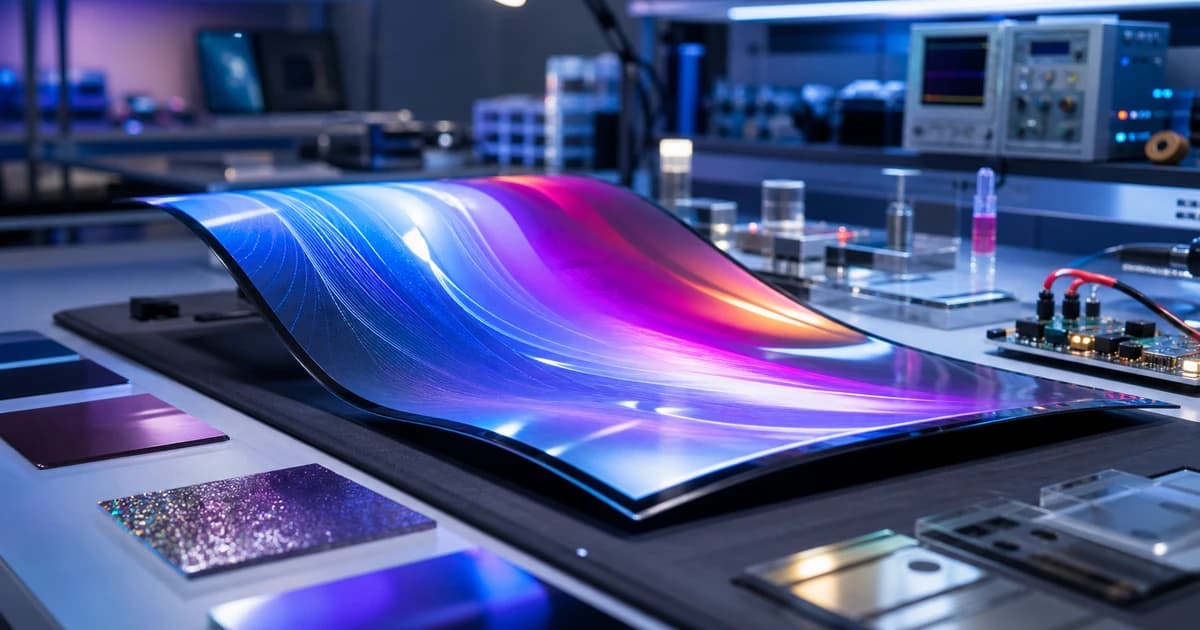
Key Points
- Korea has a strong base in OLED revenue and high-value display technology.
- Display engineering connects electronics, materials, chemistry and semiconductor processes.
- International students can apply through undergraduate admission or English-taught graduate routes.
- Applicants should distinguish revenue data from shipment-volume data.
The display industry is a prime example of the intersection of electrical engineering and materials science. Smartphones, TVs, automotive panels, and laptop screens are all the result of a combination of device, materials, process, and circuit technologies. South Korea has a strong industrial base in OLEDs and high-value-added displays, making it a worthwhile option for international students interested in studying related fields.
Industry data must be interpreted by breaking down the metrics. According to a report by UBI Research, Samsung Display and LG Display will account for a significant share of OLED market revenue in 2025. However, in terms of shipment volume, Chinese companies are catching up rapidly; therefore, it is more accurate to say that “South Korea is strong in high-value-added OLED revenue and technological leadership” rather than “South Korea dominates the entire display market.”
Related majors include electrical engineering, materials science and engineering, chemistry, chemical engineering, and semiconductor processes. The required foundational courses and research labs vary depending on specific subfields such as OLED light-emitting materials, thin-film deposition, panel drive circuits, micro-OLEDs, and automotive displays. Since semiconductors and displays overlap significantly in terms of processes and materials, this field offers broad career prospects.
International students can enroll through the undergraduate international admissions track or graduate programs taught in English. The Department of Electrical and Computer Engineering at Seoul National University’s ranking of 28th in QS Electrical and Electronic Engineering—as reported by The Korea Times—can be verified through public reports, and research-oriented universities such as KAIST and POSTECH are also worth considering in the fields of electronics and materials. Individual department rankings should be treated with caution until verified by official sources.
Costs and scholarships are particularly important at the graduate level. The application periods and requirements for the Global Korean Scholarship (GKS), on-campus international scholarships, and lab-specific scholarships vary. Applicants must prepare materials such as information on whether courses are taught in English, contact details for prospective advisors, research proposals, letters of recommendation, and language test scores; laboratories specializing in materials and processes often require a strong foundation in basic science.
For applicants in the display field, it is advantageous to take a broad approach to choosing a major. Rather than searching for a specific “OLED Department,” it is more practical to look for laboratories conducting display research within the fields of electrical engineering, materials engineering, or chemical engineering. By reviewing paper keywords, faculty lab websites, and recent projects, you can provide a more convincing explanation in your application of why you chose that particular lab.
You must also consider industry trends. The expansion of shipments by Chinese companies creates competitive pressure, while automotive, micro-OLED, and AR/VR displays represent new demand. Since the required foundational courses and portfolio will vary depending on the specific area a student aims to pursue, it is essential to identify specific products and technologies of interest during the application preparation phase.
When choosing a major, it is more natural to view semiconductors and displays as related fields rather than competing ones. Since both fields require knowledge of electronics, materials, and processes, assessing a student’s background in mathematics, physics, and chemistry—as well as their research interests—first can broaden the range of departments they can apply to.
Applicants should first decide which subfield they wish to pursue: OLED, semiconductor processes, materials, or circuits. They should distinguish between industry metrics based on revenue and those based on shipment volume when using news articles and application materials, and compare each university’s English-language graduate programs, research labs, scholarship conditions, and language requirements. It is also advisable to determine whether the major title—Electrical Engineering or Materials Engineering—better aligns with one’s research plan.
Related Articles
- Universities
- Universities
- Universities
- Universities
- Universities
- Universities
Comments
Please sign in to post a comment.
You will return to this article after sign-in.
Sign inNo comments yet.