

Korea aerospace engineer salary for Indian students: KAI, Hanwha Aerospace and major roadmap
An India-focused guide that separates official aerospace occupation wage data from KAI and Hanwha Aerospace company-average pay, then connects major choice, lab evidence, D-10 and E-7 planning.
Key Points
- The article separates occupational wage data from company-average employee pay instead of presenting one salary promise.
- Indian STEM students should connect aerospace interest to major, lab and project evidence before reading D-10/E-7 pathways.
- The aerospace slug does not overlap with the existing semiconductor, battery, automotive EV, AI software, shipbuilding, display OLED or robotics India series.
# Korea aerospace engineer salary for Indian students: KAI, Hanwha Aerospace and major roadmap
Indian STEM students should read Korean aerospace salary data in layers: ADIGA occupation wage, KAI and Hanwha Aerospace company averages, and individual starting salary are different signals.
When considering aerospace engineering as a major while studying in Korea, questions generally fall into two categories. One is whether there is actually an aerospace industry in Korea, and the other is whether this path can lead to employment and income. The second question is particularly important for Indian STEM students and their parents. This is because aerospace engineering is not just a major with a fancy name, but a highly challenging career path that requires the long-term development of skills in mathematics, physics, mechanical engineering, electronics, control systems, and software.
The key to answering these questions is to distinguish between different types of data. ADIGA’s salary figures for aerospace engineers are occupational group indicators based on a 2023 survey, while the average salaries reported in KAI and Hanwha Aerospace’s 2025 annual reports are compensation metrics based on the companies’ total workforce. Both sets of data are useful as indicators of industry trends, but they do not represent the individual starting salary of a specific international student immediately after graduation.
Average Salary and Starting Salary Must Be Distinguished
ADIGA’s occupational information for aerospace engineering technicians, based on data from the Korea Employment Information Service’s “Employment 24,” presents the 2023 survey wage indicators as follows: lower quintile at 5,745 ten-thousand won, median at 7,250 ten-thousand won, and upper quintile at 9,600 ten-thousand won. Korea Aerospace Industries (KAI)’s 2025 Annual Report, filed with the KRX, disclosed an average salary per employee of 120 million won (source notation: 1 eok 2,000 man won) and an average tenure of 13.7 years. Hanwha Aerospace’s 2025 Annual Report disclosed an average salary per employee of 124 million won (source notation: 1 eok 2,400 man won) and an average tenure of 13 years.
| Category | Verified Salary/Wage Indicators | Meaning | Notes |
|---|---|---|---|
| Wages for Aerospace Engineers | Lower quartile: 5,745 ten-thousand won, median: 7,250 ten-thousand won, upper quartile: 9,600 ten-thousand won | Reference data on wages for this occupational group | Not the starting salary for new hires at a specific company |
| KAI 2025 Annual Report | Average employee salary: 120 million won (source notation: 1 eok 2,000 man won); average tenure: 13.7 years | Average for all employees at a leading aerospace company | Reflects differences based on long-term tenure and job roles |
| Hanwha Aerospace 2025 Annual Report | Average employee salary: 124 million won (source notation: 1 eok 2,400 man won); average tenure: 13 years | Average for all employees at an aerospace and defense manufacturing company | Individual compensation varies by division, role, and performance |
The conclusion this table offers to Indian students is clear: the Korean aerospace industry is a field that offers attractive compensation for high-level technical positions. At the same time, one should not predict outcomes based solely on the name of a major. You must first decide which role you are targeting: aircraft structure, propulsion, control, avionics, satellites, or production and quality.
What Official Career Information Says About the Work of an Aerospace Engineer
The ADIGA page on aerospace engineering technicians describes roles that involve designing, developing, and testing aircraft by applying aerospace engineering principles and technologies. The job description includes aerodynamics, propulsion, structures, stability, and control. Job responsibilities are further divided into areas such as preliminary design, component design and development, prototype fabrication and testing, flight testing, noise and vibration analysis, thermodynamic analysis, and propulsion system development.
Relevant academic majors are not limited to just aerospace engineering. ADIGA lists mechanical engineering, mechatronics engineering, semiconductor and ceramics engineering, and aerospace engineering as related fields. This underscores that the aerospace industry is a systems-based industry that integrates mechanical, electronic, materials, and software disciplines. Indian students do not need to search solely for the major titled “aerospace engineering.”
Major Roadmap for Indian Students
If you’re aiming for a career in aerospace, you should decide on a job category before considering the name of the university. Rather than thinking, “I just need to major in aerospace engineering,” you should first determine which area suits you best: structures, propulsion, control, avionics, satellites, or manufacturing.
| Area of Interest | Recommended Major | Required Courses & Skills | Possible Job Roles |
|---|---|---|---|
| Aircraft Structures & Airframe | Aerospace Engineering, Mechanical Engineering, Materials Science & Engineering | Statics, Dynamics, Materials Science, CAD/CAE | Airframe Design, Structural Analysis, Testing & Evaluation |
| Propulsion & Thermal Fluids | Aerospace Engineering, Mechanical Engineering | Thermodynamics, Fluid Mechanics, CFD, Turbomachinery | Propulsion Systems, Thermal Analysis, Engine & Component Development |
| Avionics & Control | Electrical and Electronic Engineering, Computer Engineering, Control Engineering | Control Engineering, Embedded Systems, Sensors, Software | Avionics Systems, Flight Control |
| Satellite & Space Systems | Aerospace Engineering, Electrical Engineering, Mechanical Engineering | Orbital Mechanics, Systems Engineering, Communications, Thermal Control | Satellite Systems, Payloads |
| Manufacturing, Quality, and Testing | Industrial Engineering, Mechanical Engineering, Materials Science and Engineering | Quality Control, Test and Measurement, Reliability | Manufacturing Technology, Quality Assurance, Testing and Evaluation |
The key point in this table is not the major names, but the evidence. Master’s applicants should look at what the research labs are actually studying. Undergraduate and transfer applicants should check the prerequisite courses, language requirements, scholarship opportunities, and each university’s admission criteria for international students.
How to Research Pathways at Korean Universities
When searching for master’s and doctoral programs in aerospace engineering in Korea, you should consult both the official admissions office and the department’s website. The KAIST Graduate School of International Studies admissions page provides application and selection guidelines for international applicants. The graduate admissions guide for Seoul National University’s Department of Aerospace Engineering lists academic performance, study plan, personal statement, letters of recommendation, research achievements, and readiness as evaluation criteria.
| Item to Check | Why It’s Important | Where to Check |
|---|---|---|
| Eligibility for International Students | Verify whether your nationality and academic background qualify you for the admission track | University International Admissions Office, Graduate School Admissions Office |
| English Proficiency and Korean Language Requirements | Determine whether it’s an English-track program or if TOPIK is required | Admission Guidelines, Department FAQs |
| Suitability for the Research Lab | Research topics and experience with equipment are crucial for aerospace positions | Department research lab and faculty pages |
| Scholarship Structure | Check the financial burden of tuition and living expenses, as well as the possibility of becoming a research assistant | University scholarship guide |
| Career Paths After Graduation | Check if the program connects to preparation for D-10 and E-7 visas | Study in Korea, HiKorea, University Career Development Center |
Be especially cautious with programs bearing company names or industry-academia collaboration programs. Programs for current corporate employees, domestic retraining programs, and regular admission programs for international students may differ. You must check the admission guidelines for the relevant year to confirm whether international students are eligible to apply.
Preparing in Reverse: From D-2 to D-10 and E-7
International students pursuing degree programs in Korea are typically granted D-2 residency status. If you plan to seek employment in Korea after graduation, you must separately consider the pathways for the D-10 job-seeking residency status and the E-7 professional employment residency status. The “Employment System for International Students” page on Study in Korea outlines the basic framework for international students to verify employment-eligible residency statuses and hiring procedures.
Jobs in the aerospace field differ from simple part-time work. They are likely to be linked to positions in mechanical engineering, electrical and electronic engineering, information and communications technology (ICT) and software, metallurgy and materials, production engineering, quality assurance, and research and development. However, the final residency status review is not determined by the major alone. The degree, work experience, job description, employment contract, salary requirements, and company requirements are all reviewed together.
Pre-publication QA Checklist
- Sources 200: ADIGA, KRX KAI, KRX Hanwha Aerospace, KAIST, SNU, Study in Korea—all URLs confirmed as HTTP 200.
- Structure: 7 H2 headings, 3 tables, 5 FAQs.
- SEO/GEO: Includes
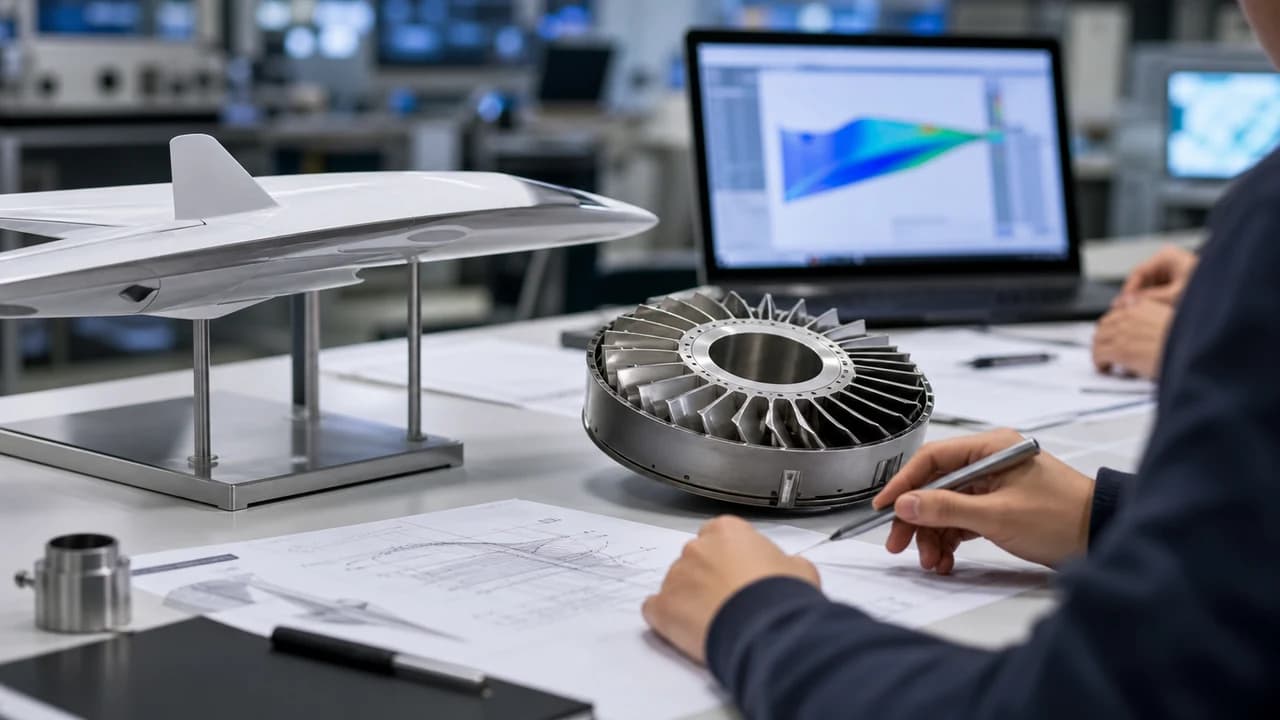
seoTitle,description,primaryKeyword, and key answer paragraphs. - Images: Scenes of aerospace design reviews; company logos, military-classified imagery, and actual documents are prohibited.
- Internal link candidates: India STEM career article series,
/strength-map-check,/study-fit-check. - Duplication: No overlap with the 7 Indian job types in the live sitemap. Aerospace is a new job category.
- Wording: Distinction between average salary and starting salary maintained; no language implying guaranteed results.
- Encoding: UTF-8; no patterns suggesting character corruption.
FAQs
Is the average salary of 7,250 ten-thousand won for aerospace engineering technicians the starting salary for new hires?
No. The ADIGA salary for aerospace engineering technicians is a wage indicator for the occupational group based on a 2023 survey. The lower, median, and upper salary ranges should be interpreted as industry benchmarks and should not be taken as the starting salary for new hires at a specific company.
What does the average salary of 120 million won (source notation: 1 eok 2,000 man won) for KAI employees mean?
This is the average salary per employee as reported in KAI’s 2025 Annual Report. The reference date is 2025-12-31, and the average tenure is 13.7 years. Since this is the average for all company employees, it does not represent first-year compensation.
Is the average salary of 124 million won (source notation: 1 eok 2,400 man won) at Hanwha Aerospace the starting salary for new hires?
No. It is the average salary figure for all employees as reported in Hanwha Aerospace’s 2025 Annual Report. It reflects differences across the aviation and defense sectors, as well as variations in job roles, performance, and years of service.
Should Indian students only apply to aerospace engineering programs?
No. You can also find labs and projects related to aerospace careers in mechanical engineering, electrical and electronic engineering, computer engineering, materials engineering, and industrial engineering.
If I’m in the English track, do I not need to prepare for Korean?
English scores may be more important during the admissions process. However, when it comes to employment, you’ll need to understand meetings, safety training, equipment documentation, and on-site communication, so practical Korean language preparation is necessary.
Related Articles
- Universities
- Universities
- Universities
- Universities
- Universities
- Universities
Comments
Please sign in to post a comment.
You will return to this article after sign-in.
Sign inNo comments yet.