

30 junior colleges in Gyeonggi recruit international students: 14,224 students at 28 institutions, median tuition KRW 6.92 million
This article reviews all 30 junior colleges in Gyeonggi recruiting international students, comparing tuition, international-student enrollment, and dormitory disclosures for 28 with verified addresses, along with their 2026 specialized-technical programs and admissions structure.
Key Points
- Thirty junior colleges in Gyeonggi Province recruit international students.
- At 28 institutions whose addresses and disclosure data are accurately linked, 14,224 international students were enrolled in 2025.
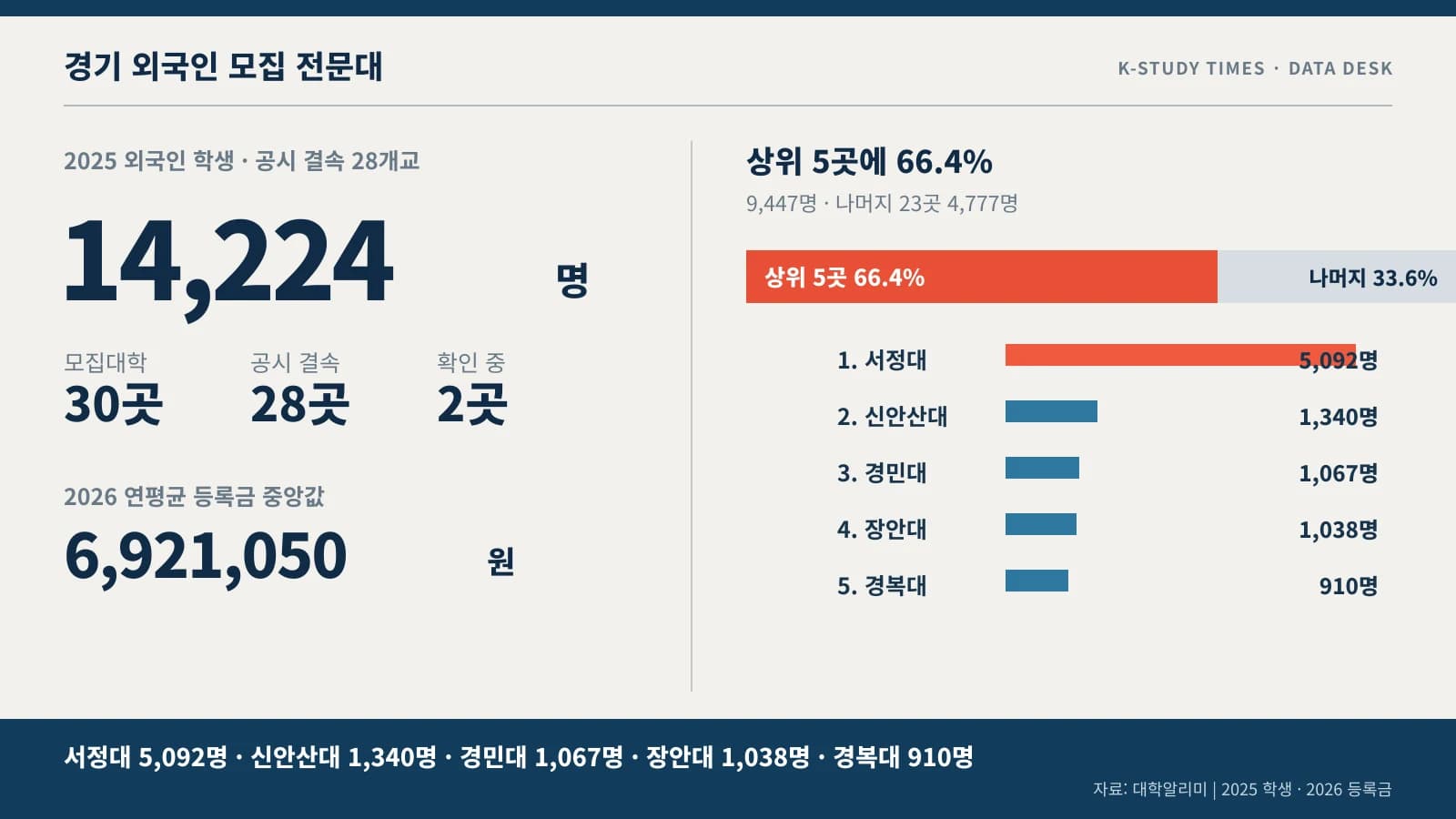
Thirty junior colleges in Gyeonggi Province recruit international students. At 28 institutions whose addresses and disclosure data are accurately linked, 14,224 international students were enrolled in 2025. The median average annual undergraduate tuition for the 2026 academic year was KRW 6,921,050.
Institutions called junior colleges vary widely in size and programs. Some have more than 5,000 international students, while others have single-digit enrollment. Average annual tuition ranged from KRW 5,826,000 to KRW 8,449,300, a difference of KRW 2,623,300. In 2026, programs at six Gyeonggi junior colleges entered the Ministry of Justice's pilot for fostering specialized technical programs, further differentiating education and employment paths after admission.
Two out of every three international students attend five colleges
Of international students at the 28 institutions, 9,447, or 66.4%, attend five colleges: Seojeong University, Shin Ansan University, Kyungmin University, Jangan University, and Kyungbok University. Seojeong University alone reported 5,092, accounting for 35.8% of the total.
| College | City | International students, 2025 | Average annual tuition, 2026 | Dormitory capacity |
|---|---|---|---|---|
| Seojeong University | Yangju | 5,092 | KRW 6,329,700 | 4.6% |
| Shin Ansan University | Ansan | 1,340 | KRW 7,167,500 | 0.0% |
| Kyungmin University | Uijeongbu | 1,067 | KRW 6,869,900 | 4.6% |
| Jangan University | Hwaseong | 1,038 | KRW 6,624,500 | 22.6% |
| Kyungbok University | Namyangju | 910 | KRW 6,969,600 | 26.4% |
They are followed by Dongwon University with 777, Dongnam Health University with 580, Bucheon University with 570, Kimpo University with 512, and Gyeonggi University of Science and Technology with 449. Four colleges with at least 1,000 international students account for 8,537, or 60.0% of the total.
Large enrollment does not mean the same operating model. Seojeong University emphasizes regional-industry-linked programs such as textiles and fashion; Jangan University offers programs for international students including global care welfare and K-modeling. Kyungbok University offers health, digital, and service fields and applies different Korean-language standards by program. Enrollment must be considered alongside the programs actually recruiting students.
Tuition ranges from KRW 5.83 million to KRW 8.45 million; nearly half falls between KRW 6.5 million and KRW 7 million
Among the 28 institutions, 13 have average annual tuition between KRW 6.5 million and KRW 7 million. Eight are between KRW 7 million and KRW 7.5 million, four are KRW 7.5 million or more, and three are below KRW 6.5 million.
The lowest disclosed amount is KRW 5,826,000 at Suwon Science College, and the highest is KRW 8,449,300 at Seoul Institute of the Arts. Arts and content-specialized institutions, including Kaywon University of Art & Design at KRW 8,044,800, Chungkang College of Cultural Industries at KRW 7,833,700, and Dong-Ah Institute of Media and Arts at KRW 7,798,200, are at the upper end. Seojeong University has the most international students, but its tuition of KRW 6,329,700 is about KRW 590,000 below the median for the 28 institutions.
Average annual tuition in the disclosure table compares all undergraduate programs at each school on the same basis. The amount paid when applying varies by major, program length, and scholarship. Kyungbok University's official admissions page covers 2-, 3-, and 4-year programs and a master's program in specialized technology; it also divides minimum TOPIK standards by department from Level 3 to Level 6. International admissions scholarships are stated as 30%–60% of tuition depending on TOPIK level.
Dormitory capacity ranges from 0% to 48.3%
The median dormitory capacity for all enrolled students is 8.6%. Korea Tourism College is highest at 48.3%, followed by Kookje University at 32.9%, Kyungbok University at 26.4%, Doowon Technical University and Jangan University at 22.6%, and Dongwon University at 21.3%.
Kaywon University of Art & Design, Suwon Science College, Suwon Women's University, Shin Ansan University, and Yuhan University report 0% capacity. Since Shin Ansan University with 1,340 international students and Yuhan University with 12 both have the same 0%, enrollment size alone cannot indicate housing conditions. When considering a college with a small or no dormitory, off-campus housing costs and commuting routes are as important as tuition.
Six of 16 Ministry of Justice specialized technical programs are in Gyeonggi
In February 2026, the Ministry of Justice designated one fostering-type specialized technical program at each of 16 junior colleges nationwide. The following six programs were selected in Gyeonggi.
| College | Designated program |
|---|---|
| Gyeonggi University of Science and Technology | Future Electric Vehicle Department |
| Daelim University College | Future Automotive Engineering Division |
| Bucheon University | Textile Fashion Business Department |
| Seojeong University | Global Textile Fashion Business Department |
| Osan University | Electrical Engineering Department |
| Yongin Arts & Science University | Automotive Machinery Department |
These six colleges had 6,873 international students in 2025, or 48.3% of all students at the 28 Gyeonggi junior colleges with linked disclosures. In March, the Ministry of Justice also created the K-CORE (E-7-M) visa for graduates of these programs. International students entering a designated program may, if they meet specified Korean-language requirements, receive an exemption from the D-2 visa financial-capacity requirement and expanded permitted hours for part-time employment. After graduation, they can apply for K-CORE by meeting Korean-language, major-related employment, and wage requirements.
Related Articles
- Universities
- Universities
- Universities
- Universities
- Universities
- Universities
Comments
Please sign in to post a comment.
You will return to this article after sign-in.
Sign inNo comments yet.