

Student visa reform timeline: D-10 job-seeker visa of 3 or 2 years by Korean level targeted for first half of 2027; Korean scores planned for part-time work from 2028 on
Justice Ministry targets: TOPIK 4+ financial-proof waiver, H2 2026; Korean-tiered D-10, university-certificate part-time permits, H1 2027; pre-contract permit pilot, H2 2027; no part-time permit without Korean scores from 2028 (plan). Changes and prep for current, incoming, graduating students.
Key Points
- In the student visa reform being pursued by the Ministry of Justice, Korean proficiency level is what separates benefits from restrictions.
- The ministry plans to exempt students with TOPIK level 4 or higher from visa financial proof in the second half of 2026, and in the first half of 2027 to split the period of stay on the job-seeker visa (D-10) into up to 3 years or up to 2 years depending on Korean proficiency.
In the student visa reform being pursued by the Ministry of Justice, Korean proficiency level is what separates benefits from restrictions. The ministry plans to exempt students with TOPIK level 4 or higher from visa financial proof in the second half of 2026, and in the first half of 2027 to split the period of stay on the job-seeker visa (D-10) into up to 3 years or up to 2 years depending on Korean proficiency. For part-time work (part-time employment permits), it plans to simplify permits based on university certificates from the first half of 2027, and from 2028 on to make permits unavailable to students without Korean test scores.
The ministry's view is that the better a student's Korean, the longer they have prepared to study in Korea and the more likely they are to find a job after graduating. The number of international students staying in Korea rose to 353,527 as of the end of August 2026, but the employment rate of 2019–2025 graduates, excluding those who left the country right after graduation, is 34.3%. The ministry also cited as a reason for the reform criticism that the current job-seeker visa is being used to extend stays or to work part-time rather than to look for jobs.
All of the measures below are still at the planning stage and will apply only once implementation is announced. Until then, visa, extension and part-time work applications follow the current rules.
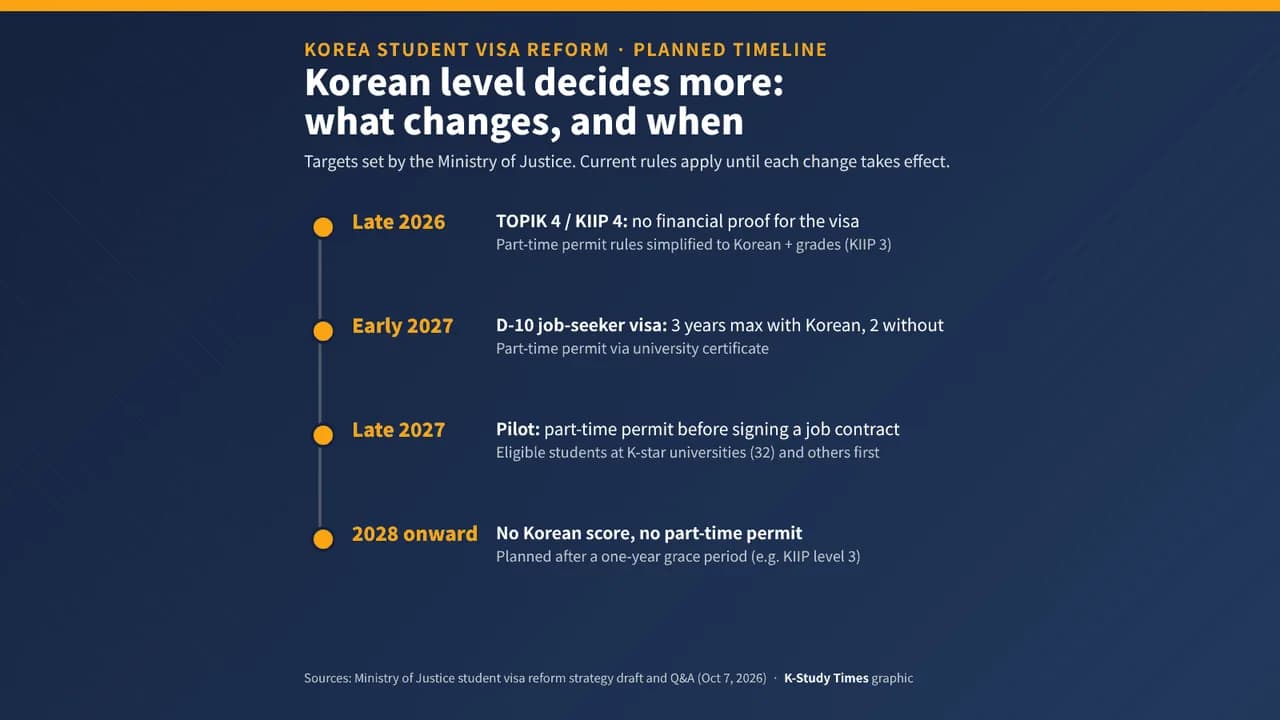
The planned timeline at a glance
| Target timing | What changes | Students affected |
|---|---|---|
| Second half of 2026 | Visa financial proof waived for TOPIK level 4 or KIIP level 4 and above, regardless of nationality or university certification | Incoming students, current students |
| Second half of 2026 | Lighter financial-proof burden when extending the period of stay | Current students |
| Second half of 2026 | Part-time work permit requirements streamlined around Korean and grades; tourist accommodation business allowed | Current students |
| First half of 2027 | Simplified part-time work permits based on certificates issued by verified universities | Current students |
| First half of 2027 | Job-seeker visa (D-10): up to 3 years if the Korean requirement is met, up to 2 years if not; preference for STEM and regional graduates | Soon-to-be graduates |
| First half of 2027 | Study-expense deposit scheme expanded in stages to students without Korean proficiency from countries subject to strengthened visa screening | Incoming students |
| First half of 2027 | Visa preferences halted for programs that minimize on-campus days, night and weekend programs with frequent illegal employment, and indiscriminately run English-taught track departments | Incoming students, current students |
| Second half of 2027 | Pilot of part-time work permits before an employment contract is signed, for students who meet the requirements | Current students |
| 2028 onward | No part-time work permit without Korean test scores (e.g., KIIP level 3) | Current students |
Current students: part-time work permits to change in stages
Stage 1 (second half of 2026) is a revamp of the requirements. Conditions that had several strands, such as attendance rate, would be narrowed down to Korean and grades, while Korean (e.g., KIIP level 3) would become a mandatory requirement. The rule restricting the accommodation business across the board would also be revised, and the ministry plans to allow the tourist accommodation business, which is short of workers, as an exception.
Stage 2 (first half of 2027) is university certificates. When a verified university issues a “part-time work confirmation,” the immigration office would grant the permit through a simplified procedure. Universities and immigration offices would jointly check whether certificates are properly issued and whether students comply with the requirements.
Stage 3 (second half of 2027) is a pilot of advance permits. After analyzing the results of Stage 2, the ministry will first pilot, at 32 universities participating in the K-STAR visa track and others, a system under which students who meet the Korean and grade requirements are granted permits before signing an employment contract.
From 2028 on, Korean test scores are required. The ministry plans to allow a one-year grace period for the Korean requirement, after which students without Korean test scores at this benchmark would be unable to obtain part-time work permits. Under current rules, students who do not meet the Korean benchmark (TOPIK level 3 for associate-degree students and first- and second-year bachelor's students, TOPIK level 4 for third- and fourth-year bachelor's students and master's and doctoral students, etc.) can still obtain a permit for up to 10 hours a week (15 hours for master's and doctoral students).
Financial proof: waived with Korean level 4
The current visa manual requires applicants to prove, with a bank balance certificate, an amount equivalent to one year's tuition and living expenses. The ministry plans to waive this requirement for students with TOPIK level 4 or KIIP level 4 or higher, regardless of nationality or whether their university is certified.
The burden of financial paperwork when extending the period of stay during studies would also be eased. Even under current rules, degree students at excellence-certified and certified universities with a C average or higher do not submit financial documents when extending (at certified universities, nationals of countries designated by the Minister of Justice and countries under intensive management are excluded). Examples of exemption requirements in the reform plan are KIIP level 4 or higher, or level 3 or higher together with a recommendation from the university president.
Conversely, the proposal is to apply the study-expense deposit scheme to students without Korean proficiency from countries subject to strengthened visa screening, regardless of university certification. The method the ministry gave as an example is for students to place a deposit in a local bank, move it to a Korean account after entry, and, once they prove enrollment, withdraw only a set amount each semester. The ministry plans to expand it in stages from the first half of 2027.
Incoming students: what to look at when choosing a school and department
The Korean-language requirement checked at visa issuance would apply to a wider group. Currently it applies only to students from countries designated by the Minister of Justice and countries under intensive management who enter universities under strengthened visa screening, and the benchmark is TOPIK level 4 for bachelor's programs and above and level 2 for associate degrees. Under the ministry's draft plan, after a grace period the scope would be widened to general (non-certified) universities or certified universities, the benchmark for associate degrees would be raised to TOPIK level 3, and scores from universities' own Korean tests would not be accepted.
A department's teaching format also affects visas. From the first half of 2027, programs that minimize on-campus days, night and weekend programs where many students have been caught working illegally, and English-taught track departments run indiscriminately with reliance on interpreters will have their visa preferences halted, department by department after review, even if the university is certified.
The ministry's policy is to allow weekend and night degree programs to qualify for student visas only in cases such as mandatory field training or master's and doctoral research courses. English-taught tracks, too, would qualify only if their necessity is recognized and they are approved by the Ministry of Justice, such as STEM master's and doctoral programs or programs for Global Korea Scholarship scholars.
For students applying through a study-abroad agency, a proposal to require agency information on the Standard Certificate of Admission is a task for the second half of 2026. A (tentatively named) overseas study-agency registration system, which would select and publish verified local agencies, is targeted for pilot introduction by the second half of 2027 together with the Ministry of Foreign Affairs.
Soon-to-be graduates: job-seeker visa length to depend on Korean
Under the current job-seeker visa (D-10), graduates of Korean universities receive their first 1 year without the points system, and the points system applies from the first extension onward. The period of stay is capped at up to 3 years; those who receive 3 years include graduates with strong Korean who obtained TOPIK level 4 or KIIP level 4 within 3 years of graduating and those with 80 points or more under the points system. Under the reform plan, the cap would be up to 3 years for graduates who meet the Korean requirement, and for those who do not, two 6-month extensions after the first year, for up to 2 years. STEM and regional university graduates are expected to receive preferential treatment on the Korean and regional requirements, taking into account the link between their major and their job.
The path to employment visas would also be widened. The ministry plans to create, by the first half of 2027, a new route for STEM graduates to switch to the skilled-worker employment visa (E-7); example requirements are a bachelor's degree or higher in STEM, grades of B or higher, and KIIP level 4 or higher. It would target fields short of workers, such as manufacturing, and the timing and scale of implementation will be decided after consultations among the relevant ministries. At a Korean Council for University Education (KCUE) policy forum on November 25, the ministry restated its target of the first half of 2027 for the job-seeker visa reform and also put forward a proposal to expand opportunities for associate-degree graduates to switch from student (D-2) to skilled worker (E-7-4) status.
The professional technical master's (TECH Master) program is run at 29 junior colleges with a capacity of 540 students, and admission requires a bachelor's degree and 2 years of experience in a related field. For students in this program, the ministry plans to create a “K-TECH Master” visa, leading from study (D-2) through employment (E-7) to residence (F-2), with a target of the first half of 2027.
The ministry is considering, as a task for the second half of 2026, issuing multiple-entry visit visas through Korean embassies and consulates abroad to graduates who earned a Korean degree and returned home. A “Student Employment Visa Checklist” compiling employment visa requirements by occupation will be released online in the second half of 2026.
Universities and laws are changing too
The Ministry of Education is pushing for an amendment that would put into law the basis for designating a specialized agency to handle support for international students and verification of overseas degrees. It also plans to disclose IEQAS certification results and link them to administrative measures, and to establish a legal basis for on-site inspections and corrective orders. The Ministry of Justice aims to complete, in the second half of 2027, an amendment that groups student visa and part-time employment rules into a separate chapter of the Immigration Act.
What to prepare now
- Korean level: TOPIK level 4 or KIIP level 4 is expected to make you eligible for the visa financial-proof waiver (target: second half of 2026). KIIP level 4 also appears among the example requirements for the financial waiver at extension and for the STEM E-7 switch.
- Part-time work: Even now, you must meet the Korean benchmark to work more than 10 hours a week (15 hours for master's and doctoral students). From 2028 on, the ministry plans to make permits unavailable without Korean test scores, so get them in advance.
- Where to apply: Visas at Korean embassies and consulates abroad; extensions of stay and part-time work permits through HiKorea and immigration offices.
- Check your department: Ask the admissions office whether the department you are applying to uses a teaching format subject to the halt in visa preferences.
Related Articles
- Visa
- Visa
- Visa
- Visa
- Visa
- Visa
Comments
Please sign in to post a comment.
You will return to this article after sign-in.
Sign inNo comments yet.