

KCUE guidelines: foreign degrees “should not be restricted on formal differences alone,” with criteria for 3-year bachelor's and non-thesis master's
KCUE's KARIC issued guidance for universities not to limit graduate eligibility solely on formal differences in foreign degrees, such as length of study or thesis. The test: recognition and further study in the awarding country. It is for reference; the summary has no South Asian examples.
Key Points
- The Korean Academic Recognition Information Center (KARIC), Korea's national information centre run by the Korean Council for University Education (KCUE), has prepared guidance for universities so that admission eligibility, particularly eligibility to apply to graduate school, is not restricted solely on the basis of formal differences in foreign degrees, such as length of study or whether a thesis was written.
- It sets out as the criterion whether the degree is officially recognised in the country where it was awarded and whether it confers eligibility to enter the next level of study.
The Korean Academic Recognition Information Center (KARIC), Korea's national information centre run by the Korean Council for University Education (KCUE), has prepared guidance for universities so that admission eligibility, particularly eligibility to apply to graduate school, is not restricted solely on the basis of formal differences in foreign degrees, such as length of study or whether a thesis was written. It sets out as the criterion whether the degree is officially recognised in the country where it was awarded and whether it confers eligibility to enter the next level of study. KCUE explained that the aim is to make universities' review of foreign academic credentials more professional and consistent as the number of international students in Korea has passed 300,000.
KARIC provides information on Korean and foreign degrees under the UNESCO Tokyo Convention and has been run by KCUE since 2019. KCUE released the Guidelines on the Recognition of Higher Education Qualifications, which contain these provisions, on 26 November, and on 27 November held a workshop in Seoul for university staff in charge of international admissions and international affairs. A second workshop will be held in Busan on 2 December. The two workshops are aimed at about 280 staff from about 180 universities. KCUE also plans to provide recognition consulting to individual universities from late 2026 to early 2027.
The benchmark: whether the next level of study is open in the awarding country
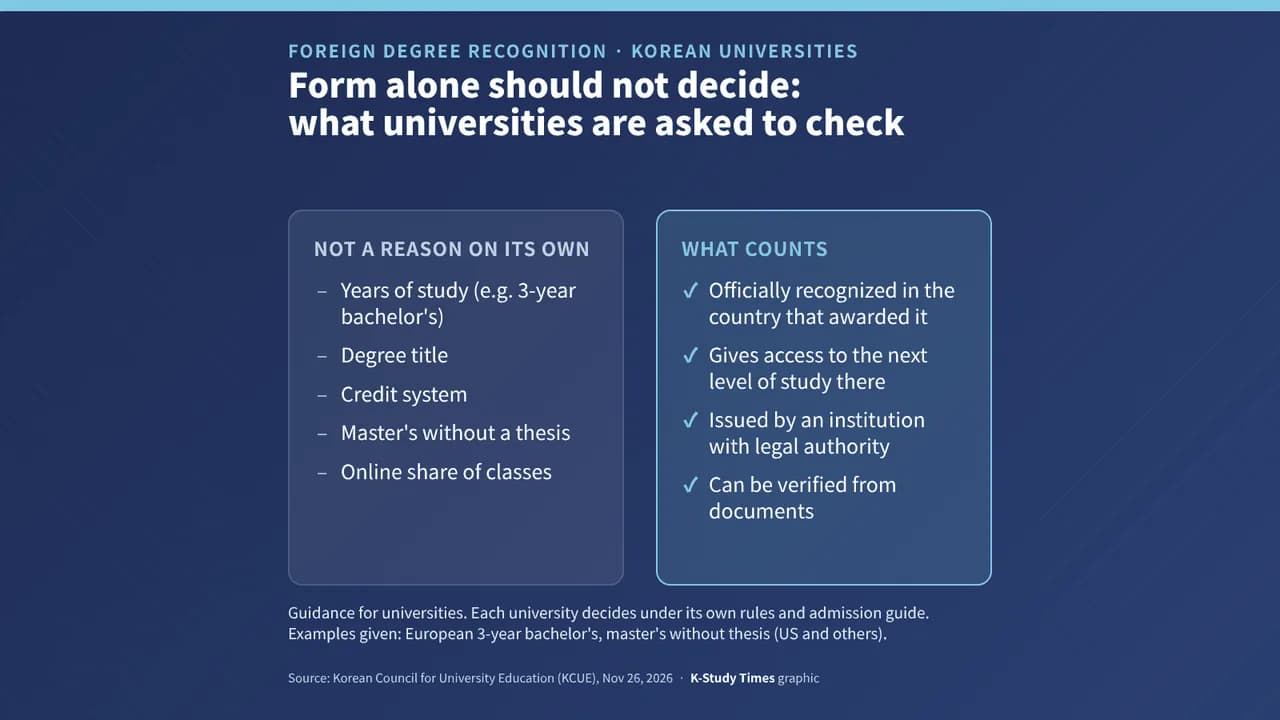
The summary of the guidelines states that “recognition of qualifications should not be restricted on the basis of mere formal differences alone.” Unless a clear substantial difference is identified, universities are to consider the possibility of recognition first. The formal differences listed include length of study, degree title, credit system and the way semesters are organised.
The summary gives two examples. A 3-year bachelor's degree under Europe's Bologna system confers eligibility to enter a master's programme in the country where it was awarded, so eligibility to apply for a master's programme cannot be restricted solely because its length of study differs from that of a 4-year bachelor's degree in Korea, the summary says. Likewise, if a master's degree earned in the United States or elsewhere through coursework or a capstone project without a thesis is recognised as a master's degree in the country where it was awarded and confers eligibility to enter a doctoral programme, eligibility to apply for a doctoral programme cannot be restricted solely on whether a thesis was written, according to the summary.
By contrast, the guidelines regard the following, among others, as substantial differences: cases where the awarding institution is not officially recognised in its country or has no authority to award degrees, where the degree does not confer eligibility to enter the next level of study in that country, and where it is difficult to confirm from the submitted documents that the degree was obtained. Degrees earned through online or distance education are not to be excluded for that reason alone and are to be assessed by the same criteria.
No examples for South Asian degrees
The summary contains no examples concerning degrees from South Asian countries such as India and Bangladesh. In India, the University Grants Commission (UGC) regulations of 2025 allow students who have completed a 3-year undergraduate programme to enter a 2-year master's programme.
The admission guidelines of Korean universities also contain no separate provisions on Indian 3-year bachelor's degrees. In its guide to graduate admission eligibility for international applicants, KAIST specifies the 3-year bachelor's degree under the Bologna system, along with 4-year degrees, as equivalent to a Korean bachelor's degree. In its admission guidelines for international graduate applicants for the 2027 spring intake, Pusan National University accepts as eligible only degrees from universities formally accredited by the education ministry of the relevant country, while Seoul National University requires a bachelor's degree or an equivalent or higher degree.
Recognition is separate from admission
Recognition of qualifications is a procedure that determines only whether an applicant meets the eligibility requirements. Academic and language abilities are evaluated in a separate selection assessment. As examples of eligibility decisions, the summary lists eligible to apply, additional documents required, on hold, and does not meet eligibility requirements.
Universities may set up a qualification review committee to deliberate on difficult cases and applicants' appeals. When a university finds a case difficult to decide on its own, it can use KARIC's “Recognition Q&A” service.
KCUE explained that the guidelines are material for universities to refer to when establishing their own standards and procedures. Actual recognition decisions are made by each university in accordance with its regulations, admission guidelines and internal review procedures.
KCUE said it prepared the guidelines as a follow-up to the Ministry of Education's innovation strategy for fostering international student talent (September 2026) and the Ministry of Justice draft strategy for improving the international student visa system (October 2026). The guidelines are based on the Global Convention on the Recognition of Qualifications concerning Higher Education, which Korea ratified in April 2025.
What applicants should check
- Check the eligibility wording in the admission guidelines. See whether, along with the phrase ‘a bachelor's degree or equivalent or higher academic background,’ there is a proviso on foreign degrees.
- Prepare evidence that the next level of study is open in the country where the degree was awarded. For an Indian 3-year bachelor's degree, have documents showing eligibility to enter a master's programme, proof that the university attended is formally accredited, and transcripts and records of credits completed.
- Ask the admissions office in writing before applying. Because the guidelines are a reference standard, admission guidelines may not change right away. Keep the written reply from the admissions office of the university you are applying to.
Further reading
- Applying for a Korean master's after an Indian bachelor's: PNU 2027 spring intake closes October 23 at 17:00, SNU and KAIST applications closed
- Steps to a D-2 student visa after admission: Standard Certificate of Admission → visa application
The guideline details are based on KCUE's press release (dated 26 November 2026) and the attached “Summary of the Guidelines on the Recognition of Higher Education Qualifications.” University cases are based on KAIST's graduate admission eligibility guide for international applicants (checked 28 November 2026) and the Pusan National University and Seoul National University graduate admission guides for international applicants for the 2027 spring intake; the Indian regulation is based on Section 11.5 of the UGC (Minimum Standards of Instruction for the Grant of Undergraduate Degree and Postgraduate Degree) Regulations, 2025 (26 March 2025).
Related Articles
- Policy
- Policy
- Policy
- Policy
- Policy
- Policy
Comments
Please sign in to post a comment.
You will return to this article after sign-in.
Sign inNo comments yet.