

Korea automotive and EV engineer salary: a Hyundai, battery and major roadmap for Indian students
Based on official Korean job wage data, Hyundai Motor's 2025 results, Hyundai employee compensation, SNE Research battery data, university pages and visa sources checked on June 28, 2026, this guide explains the auto and EV engineering route for Indian students.
Key Points
- For Indian students choosing an engineering major in Korea, the second question after semiconductors is often automotive and electric vehicles.
- Hyundai Motor is a familiar brand in India, and Korea's auto and battery industries now connect vehicles, EVs, hybrids, batteries, vehicle software, robotics and smart factories.
For Indian students choosing an engineering major in Korea, the second question after semiconductors is often automotive and electric vehicles. Hyundai Motor is a familiar brand in India, and Korea's auto and battery industries now connect vehicles, EVs, hybrids, batteries, vehicle software, robotics and smart factories.
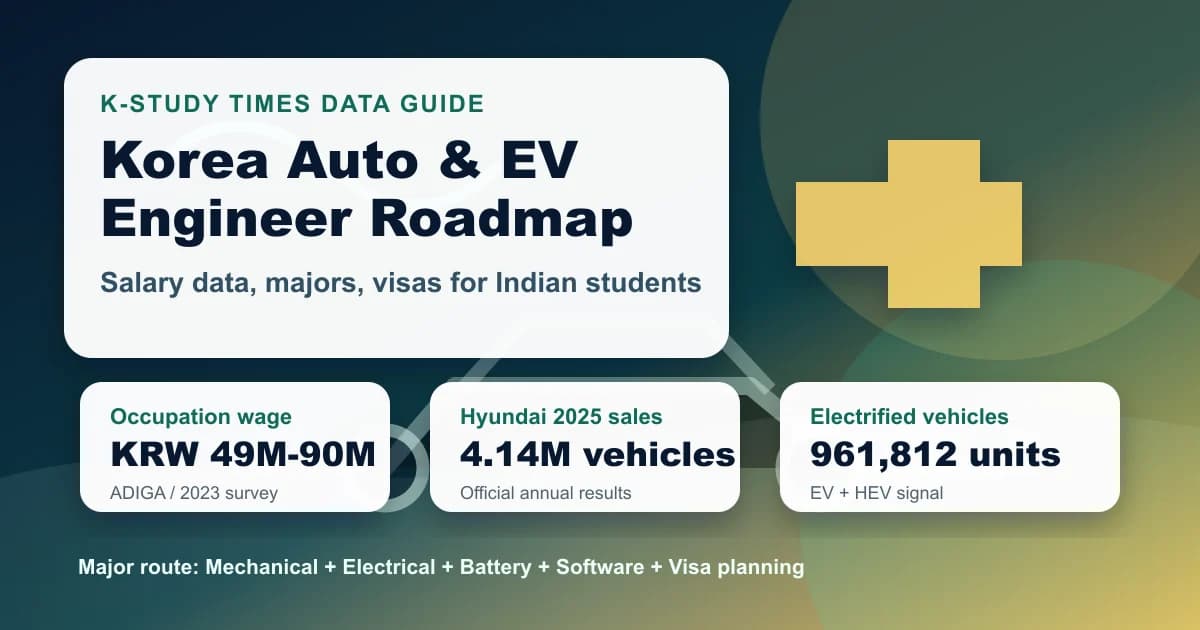
K-Study Times checked official sources as of June 28, 2026. The salary question has to be read in three layers. First, ADIGA's Automotive Engineering Technicians and Researchers job page, based on Korea Employment Information Service Employment24 data, lists 2023 wage indicators as KRW 49 million at the lower quartile, KRW 66 million at the median and KRW 90 million at the upper quartile. Second, Hyundai Motor's official 2025 annual results reported 4,138,389 global vehicle sales, KRW 186.3 trillion in revenue and 961,812 electrified vehicles sold. Third, Hyundai Motor's 2025 Sustainability Report Governance PDF cites KRW 124 million as average compensation per employee, based on its 2024 business report.
These are different indicators. The occupation wage figure is a job-group survey indicator. Hyundai's average compensation is a company-wide employee compensation indicator. Hyundai's 2025 results show company and industry scale. None of these should be read as a starting salary for an Indian graduate.
Key answer: automotive and EV is not only mechanical engineering
Students aiming for automotive or EV work in Korea can start from mechanical engineering, but the route does not end there. EVs and hybrids combine batteries, power electronics, vehicle software, controls, data, thermal management and production engineering. For Indian students, the practical formula is automotive or mechanical engineering + electrical/electronics, battery or software evidence.
| Category | Verified indicator | What it means | Caution |
|---|---|---|---|
| Automotive engineering occupation wage | 2023 survey: KRW 49 million lower, KRW 66 million median, KRW 90 million upper | A Korea Employment Information Service occupation wage indicator | It is a self-reported survey indicator, not a company starting salary. |
| Hyundai Motor employee compensation | KRW 124 million average compensation per employee, based on the 2024 business report | Company-wide employee compensation level | Cited in the 2025 Sustainability Report Governance PDF; not entry-level pay. |
| Hyundai Motor 2025 results | 4,138,389 vehicles sold, KRW 186.3 trillion revenue, 961,812 electrified vehicles | Scale and electrification direction of a major Korean automaker | Company performance does not equal personal salary or hiring probability. |
| Korean battery trio market share | 15.4 percent of global EV battery usage in 2025 | Combined share of LG Energy Solution, SK On and Samsung SDI | SNE Research says the share fell 3.3 percentage points year over year. |
Industry signal: read Hyundai results together with battery competition
Automotive and EV study is not only a Korea-only path. Hyundai is visible in India, and Korean automakers operate across India, the United States, Europe and Southeast Asia. A student who studies mechanical engineering, electrical engineering, batteries or software in Korea may later think about headquarters roles, supplier networks or regional operations. But the first counseling question should be the job role, not the company name.
Hyundai Motor announced its 2025 annual and fourth-quarter business results on January 29, 2026. The company sold 4,138,389 vehicles globally in 2025. Annual revenue reached KRW 186.3 trillion, up 6.3 percent year over year. Operating profit was KRW 11.47 trillion and operating margin was 6.2 percent.
The electrification signal is more important for students. Hyundai sold 961,812 electrified vehicles in 2025, up 27 percent year over year. This included 275,669 EVs and 634,990 HEVs. Electrified vehicles accounted for about 23 percent of total global sales. That points to demand for EVs, hybrids, power electronics, battery systems, software and data-based quality work, not only traditional internal combustion design.
Battery data should also be read carefully. SNE Research reported that the Korean trio, LG Energy Solution, SK On and Samsung SDI, recorded a combined 15.4 percent share of global EV battery usage in 2025, down 3.3 percentage points year over year. Korean battery companies remain important global players, but competition from CATL, BYD and other firms is intense. For students, that means battery and EV careers require real skills in electrochemistry, materials, thermal management, BMS, power electronics, manufacturing process and quality data.
What the official job profile says automotive engineers do
ADIGA's automotive engineering job profile says workers need deep knowledge of vehicle equipment, functions and performance. Related majors include automotive engineering, mechanical engineering and electrical/electronic engineering. Mechanical students need fluid mechanics, thermodynamics, solid mechanics and dynamics. Electrical and electronics students need knowledge of vehicle electronics, circuit logic, powertrain control, driving and braking control.
The same job profile notes that competition in unmanned vehicles, fuel-cell vehicles and eco-friendly cars may increase demand for automotive engineers with electrical and electronic backgrounds. This is a key signal for Indian students. Automotive engineering is no longer only about engines and bodies. Vehicle electronics, power electronics, sensors, controls, software and battery systems all matter.
Major roadmap for Indian students
| Target role | Recommended major | Courses and skills | Counseling question |
|---|---|---|---|
| Vehicle design and performance testing | Mechanical engineering, automotive engineering | Thermodynamics, fluid mechanics, solid mechanics, dynamics, CAD/CAE | Can I explain a vehicle structure or analysis project? |
| EV powertrain | Electrical/electronic engineering, mechanical engineering, mechatronics | Power electronics, motors, controls, battery systems | Do I have enough electrical/electronics coursework? |
| Battery and energy | Chemical engineering, materials science, energy engineering | Electrochemistry, materials, thermal management, BMS | Am I closer to materials, cells, packs or systems? |
| Vehicle software | Computer science, electronic engineering, AI | C/C++, Python, embedded systems, sensors, data | Do I have automotive software projects or GitHub evidence? |
| Production, quality and smart factory | Industrial engineering, mechanical engineering, data | Statistics, process control, quality, SQL/Python | Can I show manufacturing data or quality improvement experience? |
The difference from the Day 1 semiconductor article is important. Semiconductors often narrow into devices, processes, circuits and materials. Automotive and EV work is systems-oriented. The vehicle, battery, controls, software and manufacturing process connect with each other. Students should first diagnose whether their strength is mechanical, electrical/electronic, coding, chemical/materials or data.
University and graduate routes to check in Korea
Official university pages show several routes. KAIST Mechanical Engineering explains graduate admission for international students. Hanyang University's previously published 2026 Spring Graduate Admission Guide listed Automotive Engineering as a recruiting unit. Sungkyunkwan University's English Mechanical Engineering page describes graduate study as a route for professional mechanical engineers and researchers.
Do not choose a school only by the university name. In automotive and EV study, the lab and course sequence matter heavily. Even inside a mechanical engineering master's degree, topics can split into thermal management, vehicle dynamics, robotics, manufacturing, controls and battery systems. Indian students should search beyond the department name automotive engineering and compare mechanical engineering, electrical engineering, materials science, chemical engineering and computer science, together with English-track and scholarship conditions.
Reverse-plan D-2, D-10 and E-7
Study in Korea explains that degree-seeking international students are generally connected to D-2 student status. After study, students who need time for job search or professional employment preparation may consider D-10 and E-7 routes. This path is not automatic. HiKorea and Ministry of Justice guidance should be checked for occupation category, degree, major, employment contract, wage requirement and company conditions.
Automotive and EV jobs may connect to mechanical engineering, electrical/electronic engineering, materials engineering, chemical engineering, software or ICT specialist occupation groups. Students should not wait until graduation to check visa rules. The better order is: choose a target role, build lab or project evidence, match job descriptions, then check D-10 and E-7 eligibility.
Questions Indian students and parents should prepare
- Is the target role vehicle design, battery, vehicle software, production or quality?
- Is the student's undergraduate background closer to mechanical, electrical, computer science, chemical or materials?
- Does the student want an English-track master's route or a Korean-language undergraduate or transfer route?
- Is scholarship support essential, and what is the self-funded budget?
- What evidence can the student show: project, internship, paper, GitHub, CAD/CAE or data work?
- Is Korean being prepared only for admission, or also for workplace communication?
- If Korea employment is the goal, when will the student check D-10 and E-7 requirements?
FAQs
Is the KRW 66 million automotive engineering wage a starting salary?
No. ADIGA's automotive engineering wage figure is a 2023 occupation-level wage indicator. It lists KRW 49 million lower, KRW 66 million median and KRW 90 million upper, but it is a job-group survey indicator, not a company starting salary.
What does Hyundai's KRW 124 million average compensation mean?
Hyundai Motor's 2025 Sustainability Report Governance PDF cites KRW 124 million as average compensation per employee based on the 2024 business report. It is a company-wide employee compensation indicator, not a first-year salary.
Should Indian students search only for automotive engineering departments?
No. Automotive and EV jobs can be approached through mechanical engineering, electrical/electronic engineering, computer science, materials science, chemical engineering and industrial engineering. The job role should come before the department name.
Is Korea's battery industry still a strong path?
It can be, but the competition is intense. SNE Research reported the Korean trio's 2025 global EV battery usage share at 15.4 percent, down from the previous year. Students should prepare concrete skills in electrochemistry, BMS, manufacturing process and data.
Can an English-track student reach employment without TOPIK?
Some admission routes can be English-based. Employment is different. Workplace Korean may matter for meetings, safety training, internal documents and teamwork.
Does D-2 automatically change to E-7 after graduation?
No. E-7 review depends on occupation, degree, major, employment contract, wage requirement and company conditions. Students should check the latest HiKorea and Ministry of Justice guidance before graduation.
Related Articles
- Universities
- Universities
- Universities
- Universities
- Universities
- Universities
Comments
Please sign in to post a comment.
You will return to this article after sign-in.
Sign inNo comments yet.