

Justice Ministry data show 2,854 international students at five Busan junior colleges; skills and care pilots planned
An analysis of eight junior colleges identified by Busan examines international-student numbers, program and nationality mix, internationalization accreditation, and pilot programs in technical training and care work.
Key Points
- Busan identifies eight institutions as junior colleges.
- A comparison with Justice Ministry data found 2,854 international students at the five institutions whose names could be confirmed as of the end of June 2026.
Busan identifies eight institutions as junior colleges. A comparison with Justice Ministry data found 2,854 international students at the five institutions whose names could be confirmed as of the end of June 2026. Busan Institute of Science and Technology had 1,149, Kyungnam College of Information & Technology 915, and Dong-Eui Institute of Technology 655. Together, the three colleges accounted for 95.3% of the total. All three also appear in internationalization accreditation lists and Busan's pilot programs for skilled workers.
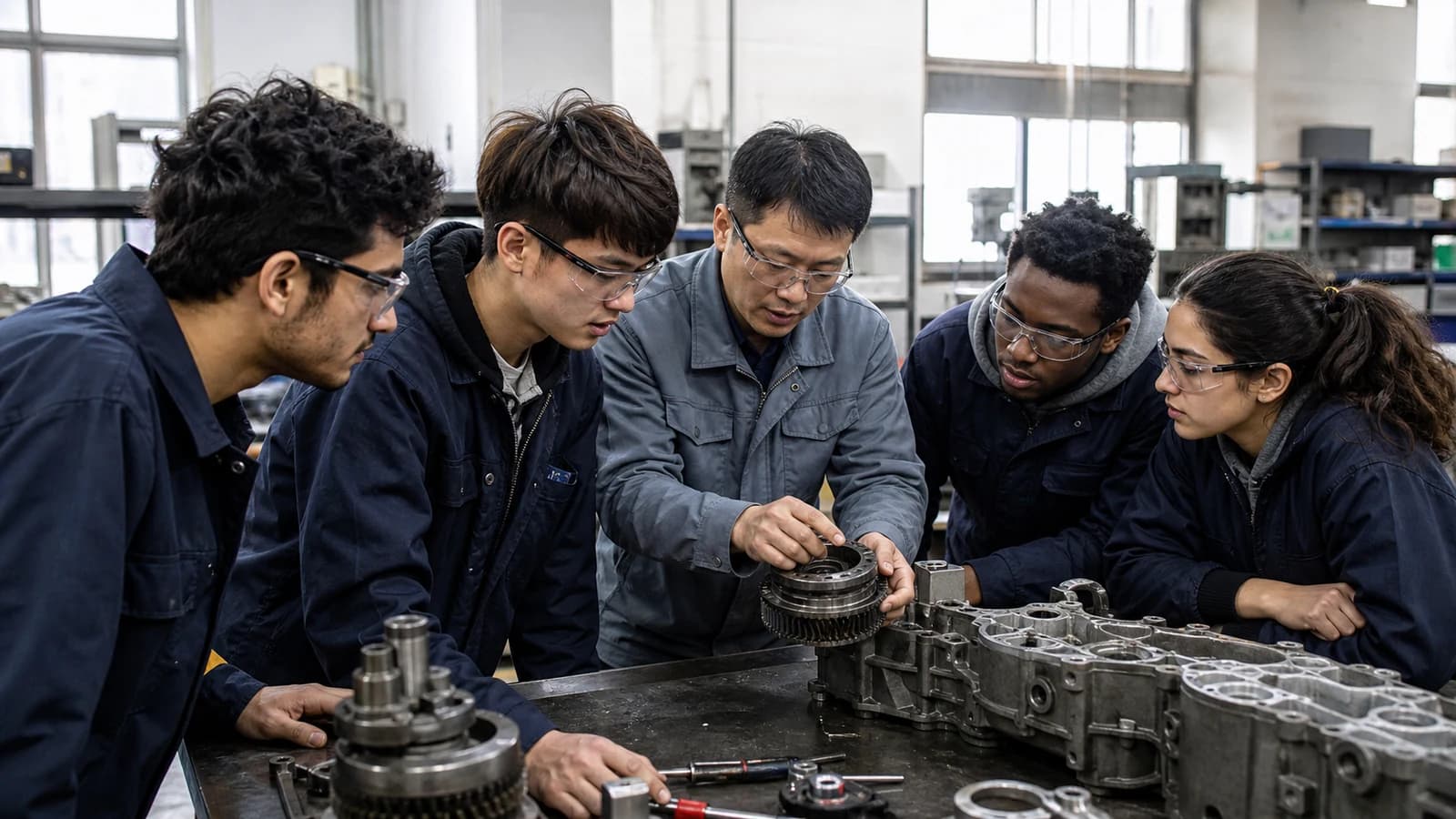
The direction of international-student policy at junior colleges is also becoming more specific. Pilot training for foreign care workers is planned at Kyungnam College of Information & Technology and Dong-Eui Institute of Technology. Mechanical-engineering programs at those two colleges and an automotive program at Busan Institute of Science and Technology are included in a pilot support program for skilled workers. The initiatives are an attempt by Busan to extend junior-college policy beyond language study to degree education and local employment.
Busan lists eight junior colleges
Busan's list of local universities classifies eight institutions as junior colleges: Kyungnam College of Information & Technology, Daedong University, Dong-Eui Institute of Technology, Busan Health University, Busan Kyungsang College, Busan Institute of Science and Technology, Busan Women's University and Busan Arts College. Korea Polytechnics Busan Campus, Busan Digital University and Hwasin Cyber University are listed under separate categories on the same city page and were excluded from this analysis.
K-Study Times searched the Justice Ministry's international-student management dataset using the current names of the eight colleges and identifiable former names. Degree programs include associate, bachelor's and master's courses. Language training combines university-affiliated language institutes and other foreign-language training courses.
| College | Total | Degree programs | Language training | Exchange students | Largest nationality groups |
|---|---|---|---|---|---|
| Busan Institute of Science and Technology | 1,149 | 460 | 689 | 0 | Vietnam 1,020, Sri Lanka 57, Nepal 35 |
| Kyungnam College of Information & Technology | 915 | 416 | 433 | 66 | Vietnam 747, Uzbekistan 57, Mongolia 38 |
| Dong-Eui Institute of Technology | 655 | 576 | 72 | 7 | Vietnam 443, Nepal 89, Uzbekistan 41 |
| Busan Women's University | 93 | 45 | 42 | 6 | Vietnam 64, Nepal 19, Myanmar 7 |
| Busan Health University | 42 | 16 | 26 | 0 | Vietnam 21, Uzbekistan 17, Kyrgyzstan 2 |
| Daedong University | — | — | — | — | No row found under this institution's name |
| Busan Kyungsang College | — | — | — | — | No row found under this institution's name |
| Busan Arts College | — | — | — | — | No row found under this institution's name |
The dash does not mean that an institution has no enrolled students. It means that no row under that institution's name was found in the Justice Ministry file. Busan Women's University appears in the source data under its former Korean title, while Busan Health University's total of 42 includes 41 under its current name and one under the former name Dongju College.
Degree students 53%, language trainees 44%
Of the 2,854 students, 1,513 were in degree programs, or 53.0%. Language trainees numbered 1,262, or 44.2%, and 79 exchange students made up the remaining 2.8%. Associate-degree students alone numbered 1,463, more than half of the total.
The mix varied sharply by college. At Dong-Eui Institute of Technology, 576 of 655 international students were in degree programs, a share of 87.9%. Busan Institute of Science and Technology had 689 language trainees, more than its 460 degree students. Kyungnam College of Information & Technology had similar numbers in degree programs and language training, at 416 and 433, plus 66 exchange students. Busan Women's University also had comparable groups, with 45 degree students and 42 language trainees.
Vietnamese students dominated the nationality breakdown. They numbered 2,295, or 80.4% of the total, followed by 143 from Nepal, 119 from Uzbekistan, 69 from Myanmar and 64 from Sri Lanka. Busan Institute of Science and Technology had 1,020 Vietnamese students, 88.8% of its international enrollment; the share at Kyungnam College of Information & Technology was 81.6%. Dong-Eui Institute of Technology enrolled 443 students from Vietnam, 89 from Nepal, 41 from Uzbekistan and 36 from Myanmar, among others.
Three colleges accredited for both degree and language programs
The International Education Quality Assurance System, run by the education and justice ministries, evaluates international-student admissions, support, management and outcomes each year. In the list of accredited institutions updated on March 3, 2026, Kyungnam College of Information & Technology, Dong-Eui Institute of Technology and Busan Institute of Science and Technology appear on the degree-program list. All three are also accredited for language training.
Accredited institutions receive measures that include eased visa-issuance screening standards for international students and longer permitted hours for weekday part-time work. The fact that the three colleges with the largest international enrollments all appear on both accreditation lists shows how strongly Busan's junior-college international education is concentrated at these institutions.
Care training in social welfare and K-Care; technical training in mechanics and automobiles
Two pilot programs linking junior-college international students with local workforce demand appear in Busan's population-policy briefing released in May 2026. The foreign care-worker college program is planned for the Department of Social Welfare at Kyungnam College of Information & Technology and the Department of K-Care at Dong-Eui Institute of Technology. The skilled-worker support pilot covers mechanical-engineering departments at those two colleges and the automotive department at Busan Institute of Science and Technology.
The two programs seek to connect major-based education with employment and settlement routes that respond to Busan's care needs in an aging society and labor demand in manufacturing and vehicle maintenance. For students, the decisive questions are increasingly not just the name of the college, but whether a particular major is included in a pilot program and what qualifications and status of stay are required after graduation.
Support within the colleges is also expanding. Kyungnam College of Information & Technology says that newly admitted foreign nationals in its September 2026 international intake will receive a 20% tuition reduction for the first semester. Dong-Eui Institute of Technology has operated an international-student leadership group since June 2026 to help new students adjust to campus and academic life and to provide mentoring, counseling and exchange activities.
The eight institutions share the same junior-college category, but their international-student populations and program mixes are not alike. In the current data, students are concentrated at three colleges. Dong-Eui Institute of Technology is degree-oriented, while language trainees form the larger group at Busan Institute of Science and Technology. Reading the accreditation lists alongside the workforce pilots shows which colleges and majors are included in current certification and implementation plans.
Data and methods
The institutional scope and college websites follow Busan's list of local universities. Student totals, nationalities and program types were aggregated by institution from the Justice Ministry's international-student management dataset on the Public Data Portal, dated June 30, 2026. The source file contains 319,147 rows; this analysis used 2,854 rows corresponding to the eight Busan junior colleges. Accreditation was checked against the education and justice ministries' list of institutions accredited under the International Education Quality Assurance System, and the pilot programs against Busan's May 2026 population-policy briefing.
Related Articles
- Universities
- Universities
- Universities
- Universities
- Universities
- Universities
Comments
Please sign in to post a comment.
You will return to this article after sign-in.
Sign inNo comments yet.