

F-2-R Regional Visa for Graduating International Students: 10 Provincial Notices Compared. TOPIK Level 3 and Living Wage Are the Baseline; Jeonbuk and Gyeongbuk Put Local University Graduates First
Busan, Daegu, Gyeonggi, Gangwon, Chungbuk, Chungnam, Jeonbuk, Jeonnam-Gwangju, Gyeongbuk and Gyeongnam issued 2026 Regional Specialized Talent (F-2-R) recommendation notices. Common requirements, deadlines, eligible counties, quotas, living wages, local-graduate priority and documents compared.
Key Points
- International students graduating from a Korean university who take a job at a company in a depopulation area can, with a provincial or metropolitan government's recommendation, change their status of stay to Regional Specialized Talent (F-2-R).
- Ten provincial and metropolitan governments are recruiting 2026 recommendation candidates: Busan, Daegu, Gyeonggi, Gangwon, Chungbuk, Chungnam, Jeonbuk, Jeonnam-Gwangju, Gyeongbuk and Gyeongnam (based on the Ministry of Justice's HiKorea link collection of October 7).
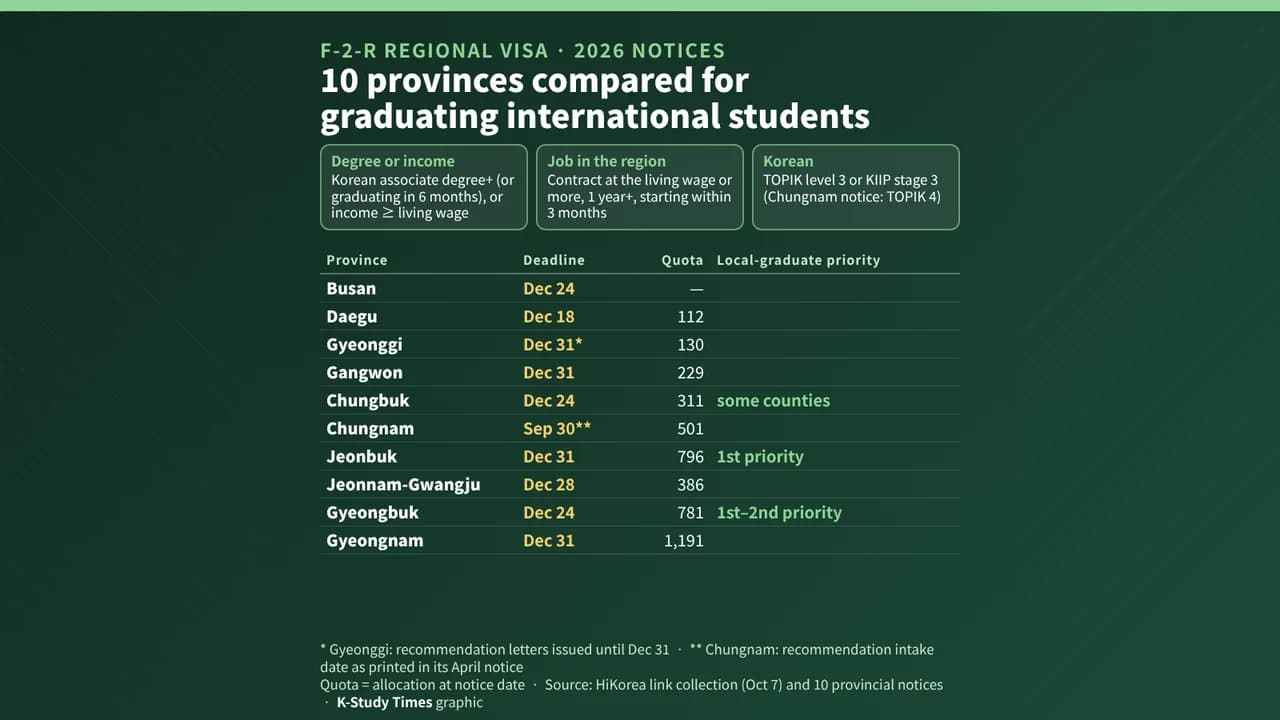
International students graduating from a Korean university who take a job at a company in a depopulation area can, with a provincial or metropolitan government's recommendation, change their status of stay to Regional Specialized Talent (F-2-R). Ten provincial and metropolitan governments are recruiting 2026 recommendation candidates: Busan, Daegu, Gyeonggi, Gangwon, Chungbuk, Chungnam, Jeonbuk, Jeonnam-Gwangju, Gyeongbuk and Gyeongnam (based on the Ministry of Justice's HiKorea link collection of October 7). The basic requirements are the same in all 10. What differs is the application deadline, the eligible cities and counties, the allocated quota, the living-wage threshold, and what priority is given to graduates of local universities. In most regions, applications close in mid-to-late December. Chungnam's deadline was September 30.
Requirements common to all 10: a degree or income, a job at or above the living wage, TOPIK level 3
Applicants need to meet either the education or the income requirement. The education requirement is an associate degree or higher earned in Korea, or expected graduation from a junior college or higher. An expected graduate is someone who will graduate and receive a degree within 6 months of the application date; they submit a certificate of expected graduation when applying and the diploma at their first extension of stay. A degree counts only if the applicant entered on a student (D-2) visa, stayed in Korea for 2 years or more, and completed the program set by school regulations. The income requirement is met when the applicant's own annual income is at or above the living wage of the relevant provincial or metropolitan government.
For employment, the salary on the employment contract must be at or above the provincial or metropolitan living wage, the contract term must be 1 year or more, and the start date must fall within 3 months after the application date. The workplace must be inside the depopulation area that is the recommending region. To apply as a business founder, the investment must be KRW 200 million or more. For Korean language, applicants need either TOPIK level 3 or higher, or completion of stage 3 or higher of the Ministry of Justice's Korea Immigration & Integration Program (KIIP), including placement in stage 4 by pre-assessment. This threshold was lowered from level 4 and stage 4 to level 3 and stage 3 by a revision of Ministry of Justice guidelines on July 29, 2026. Only Chungnam still lists TOPIK level 4 and KIIP stage 4, as stated in its April notice.
Applicants can apply from student (D-2) status. The statuses of stay barred from applying are D-3, D-4, E-6-2, E-8, E-9, E-10, G-1 and H-1. Applying to two provincial or metropolitan governments at the same time is not allowed, and within each city or county a single nationality may not exceed 30% of the allocated quota.
Deadlines, eligible areas and quotas by province and city
| Province/City | Deadline (2026) | Eligible F-2-R cities and counties | Quota | Living wage (per notice) |
|---|---|---|---|---|
| Busan | December 24, 18:00 | Dong-gu, Seo-gu, Yeongdo-gu | Ask the district office | KRW 30,785,700 per year |
| Daegu | December 18 | Seo-gu, Nam-gu | 112 | KRW 2,510,299 per month |
| Gyeonggi | Recommendation letters issued through December 31 | Gapyeong, Yeoncheon | 130 | KRW 31,480,416 per year |
| Gangwon | December 31 | 11 areas: Taebaek, Samcheok, Hongcheon, Hoengseong, Yeongwol, Pyeongchang, Jeongseon, Cheorwon, Yanggu, Goseong, Yangyang | 229 | KRW 30,314,196 per year |
| Chungbuk | December 24 | Jecheon, Boeun, Okcheon, Yeongdong, Goesan, Danyang | 311 | KRW 30,539,916 per year |
| Chungnam | September 30 (for additional intake, ask the Foreign Resident Policy Division at 041-635-4992) | Gongju, Boryeong, Nonsan, Geumsan, Buyeo, Seocheon, Cheongyang, Yesan, Taean | 501 | KRW 30,146,160 per year |
| Jeonbuk | December 31 (closes early once the quota is filled) | Jeongeup, Namwon, Gimje, Jinan, Muju, Jangsu, Imsil, Sunchang, Gochang, Buan | 796 | KRW 31,124,280 per year |
| Jeonnam-Gwangju | December 28 (receipt at city/county offices) | Damyang, Gokseong, Goheung, Boseong, Hwasun, Jangheung, Gangjin, Haenam, Yeongam, Yeonggwang, Jangseong, Jindo, Sinan | 386 | KRW 2,571,745 per month |
| Gyeongbuk | December 24 (issuance by December 31) | Andong, Yeongju, Yeongcheon, Sangju, Mungyeong, Uiseong, Cheongsong, Yeongyang, Yeongdeok, Cheongdo, Goryeong, Seongju, Bonghwa, Uljin, Ulleung | 781 (2025–26) | KRW 30,218,892 per year |
| Gyeongnam | December 31, 16:00 | Miryang, Uiryeong, Haman, Changnyeong, Goseong, Namhae, Hadong, Sancheong, Hamyang, Geochang, Hapcheon | 1,191 | KRW 30,371,880 per year |
In Gyeonggi, only two places issue F-2-R recommendations: Gapyeong County and Yeoncheon County. Dongducheon and Pocheon are covered only for Skilled Workers (E-7-4R) and do not take F-2-R. Quotas are the figures at the time of the notice. As of August, Daegu had 15 places left in Seo-gu and 50 in Nam-gu; as of September, Chungbuk had 103 left. Daegu is no longer taking Vietnamese nationals because the 30% cap has been reached, and Busan has also closed recruitment of Vietnamese nationals. Vietnamese graduates choose from the regions other than these two.
The living wage is the floor for the annual salary on the employment contract. Converted to a monthly figure, it is KRW 2.51 million in Daegu and KRW 2.57 million in Jeonnam-Gwangju, and in the other regions, which state it as an annual amount, it comes to about KRW 2.51–2.62 million per month. A contract below this level will not get a recommendation.
Jeonbuk and Gyeongbuk put local university graduates first
Jeonbuk divides priority for issuing recommendation letters into three tiers. First priority goes to international student graduates and expected graduates of universities in the province, second to those who live and work in a depopulation area, and third to everyone else who meets the basic requirements. A higher score in a lower tier does not overtake someone in a higher tier. Screening points are 30 for education and income, 30 for basic competence (30 for TOPIK level 4 or KIIP stage 4, 20 for level 3 or stage 3) and 40 for length of residence in Jeonbuk. Applications are accepted online (jbvisa.or.kr) as well as in person at the Jeonbuk Economic and Trade Promotion Agency's job center and the relevant city or county office, and screening results are sent by text message in the second and fourth weeks of each month. Jeonbuk also has a KRW 300,000 visa upgrade grant for those who change to F-2-R (for how to apply, contact the Foreign Resident and International Policy Division at 063-280-2082).
Gyeongbuk places international student graduates and expected graduates of universities in Gyeongbuk and Daegu in its first and second priority tiers. First priority goes to those among them who have signed an employment contract with a company registered as hiring with the Gyeongbuk K-Dream Foreign Resident Support Center (a "K-Dream registered employer"), and second to other international students from Gyeongbuk and Daegu universities. Gyeongbuk has one extra step. After registering as a job seeker with the K-Dream Foreign Resident Support Center (k-dreamcenter.co.kr) and completing its training, applicants receive a training completion certificate, which must be attached when applying to the city or county for a recommendation letter. Without the certificate the application is not accepted, so finish registration and training before signing an employment contract. The scoring sheet also awards points by age: 27 to 33 scores highest at 30 points, 26 or under scores 20, 34 to 40 scores 15, and 41 or over scores 5.
Chungbuk varies by city and county. Jecheon City puts graduates (or expected graduates) of junior colleges or higher in the Jecheon area first and graduates (or expected graduates) of universities in the province second, while Okcheon and Goesan counties put graduates (or expected graduates) of universities in the province first. The Chungbuk application form includes a recommendation letter from the school president that graduates of Korean universities must submit, so ask your school to issue it in advance.
Busan selects by points when applications exceed the quota. TOPIK level 4 or KIIP stage 4 earns 20 points and level 3 or stage 3 earns 10; a doctorate or annual income of KRW 40 million or more earns 30, a master's degree or KRW 35 million or more earns 20, and an associate or bachelor's degree or income at or above the living wage earns 10, plus points for length of residence in Busan (up to 20).
What to prepare before applying
| Item | Details |
|---|---|
| Certificate of expected graduation | Graduation expected within 6 months of the application date. Daegu, Chungnam and Jeonnam-Gwangju require a document issued in the name of the president or department head |
| Proof of Korean proficiency | TOPIK level 3 or higher score report, or KIIP stage 3 completion certificate. If you have a level 4 score, submit the level 4 report. To apply in Gangwon or Gyeongnam with a level 3 report, call the Gangwon division in charge (033-249-2498) or the Gyeongnam Visa Support Center (055-210-3032) before you go and ask whether level 3 is accepted |
| Employment contract | Salary at or above the living wage of the relevant province or city, term of 1 year or more, start date within 3 months after the application date, workplace inside the recommending city or county |
| Residence | Actual residence in the recommending city or county for the first 2 years from the date of permission |
| Nationality quota | Before applying, call the city or county division in charge and ask how many places remain for your nationality |
| Region-specific extra documents | Gyeongbuk: K-Dream Center training completion certificate; Chungbuk: school president's recommendation letter; Jeonnam-Gwangju: all documents in Korean on A4 paper |
| Where to apply | In person at the city or county division in charge. Gangwon also accepts email, and Chungbuk registered mail. Daegu, Gangwon, Chungnam and Jeonnam-Gwangju allow submission by proxy with a power of attorney. Jeonbuk also accepts applications online (jbvisa.or.kr), and Gyeongnam at the Gyeongnam Visa Support Center (055-210-3032) |
After receiving the recommendation letter
A recommendation letter is valid for 3 months from the date of issue. Within that period, apply for a change of status of stay at the immigration office with jurisdiction. The first period of stay is up to 1 year, and those who applied as expected graduates submit their diploma at the first extension. Holders must actually live in the recommending city or county for 2 years from the date of permission and sign a pledge to reside, work or run a business in that region for 5 years or more. Expected graduates in Gyeongnam can file their application to change to an employment visa, including F-2-R, through the Changwon Immigration Office's fast track for graduating international students (2 to 4 p.m. on the second and fourth Thursday of each month, accompanied by the university's international student officer, no advance reservation needed); see the article on the Changwon G-NEX job fair for the procedure.
Inquiries go to the division in charge at each provincial or metropolitan government.
- Busan Regional Industry-Academia Cooperation Division 051-888-6784 (Seo-gu Office 051-240-4711, Dong-gu Office 051-440-4111, Yeongdo-gu Office 051-419-4494)
- Daegu 053-803-6574
- Gyeonggi Immigrant Society Policy Division 031-8030-4673
- Gangwon 033-249-2498
- Chungbuk Foreign Resident Policy Task Force 043-220-2693
- Chungnam Foreign Resident Policy Division 041-635-4992
- Jeonbuk Foreign Resident and International Policy Division 063-280-2082
- Jeonnam-Gwangju Immigration Policy Division 061-286-2562 (multilingual call center 1588-5949)
- Gyeongbuk 054-880-3667 (K-Dream Center 054-464-2311)
- Gyeongnam Industrial Workforce Division 055-211-3395 (Gyeongnam Visa Support Center 055-210-3032)
Related Articles
- Visa
- Visa
- Visa
- Visa
- Visa
- Visa
Comments
Please sign in to post a comment.
You will return to this article after sign-in.
Sign inNo comments yet.