

2026 TOPIK PBT and IBT Formats, Domestic Test Fees, and Score Validity Periods at a Glance
This Korean-language document summarizes the formats, domestic test fees, and score validity periods for TOPIK PBT and IBT, as outlined in the 2026 announcements from the National Institute for International Education and the Ministry of Education, and explains why test-specific details must be reconfirmed in the official announcements.
Key Points
- For the 2026 Test of Proficiency in Korean (TOPIK) in Korea, the number of questions, test duration, and total score scales differ between the PBT and IBT formats.
- According to the current official format chart from the National Institute for International Education, TOPIK I has a maximum score of 200 points for the PBT and 400 points for the IBT, while TOPIK II has a maximum score of 300 points for the PBT and 600 points for the IBT.
For the 2026 Test of Proficiency in Korean (TOPIK) in Korea, the number of questions, test duration, and total score scales differ between the PBT and IBT formats. According to the current official format chart from the National Institute for International Education, TOPIK I has a maximum score of 200 points for the PBT and 400 points for the IBT, while TOPIK II has a maximum score of 300 points for the PBT and 600 points for the IBT.
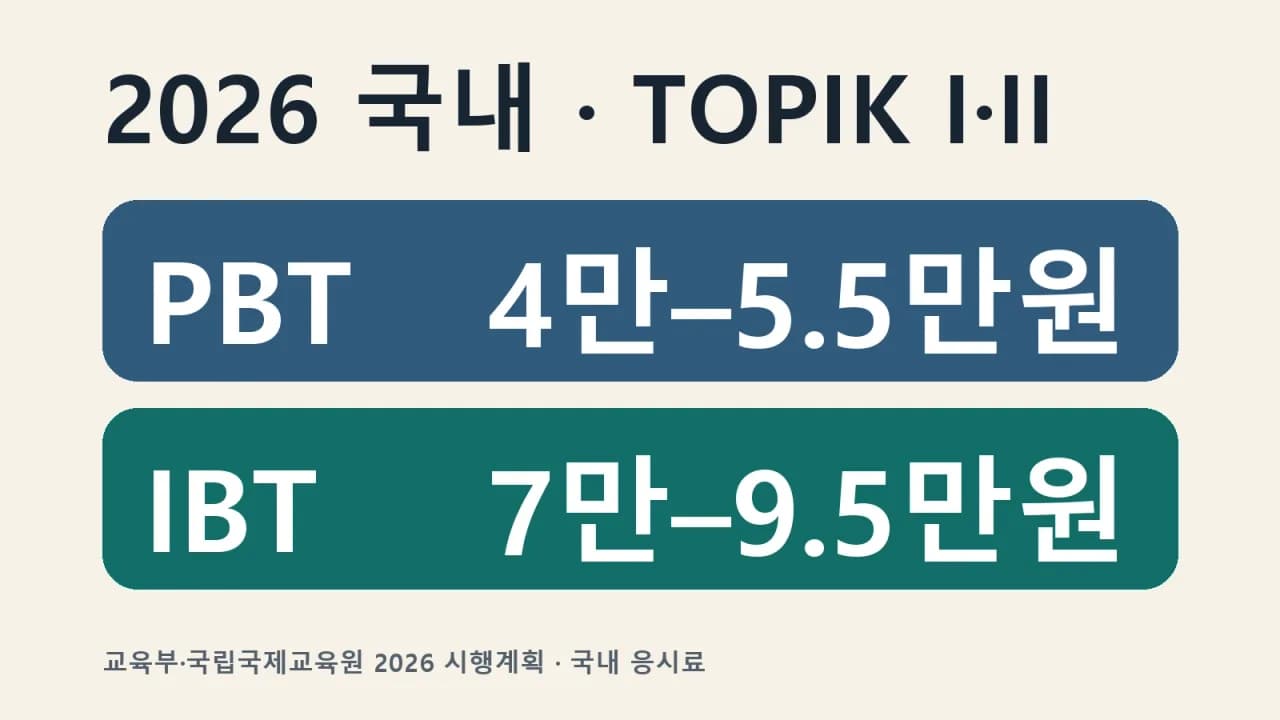
Domestic test fees also vary depending on the test format and level. Based on the 2026 implementation plan, PBT fees are 40,000 won for TOPIK I and 55,000 won for TOPIK II, while IBT fees are 70,000 won for TOPIK I and 95,000 won for TOPIK II; the speaking test is an additional 80,000 won. TOPIK scores are valid for two years from the date of release.
Test Formats by Method
The current official table for the “Test of Proficiency in Korean (TOPIK)” published by the National Institute for International Education classifies PBT I, PBT II, IBT I, and IBT II by section, number of questions, test duration, total score, and grade intervals. Since PBT and IBT use different total score scales and grade ranges, the same numerical score cannot be interpreted using the same scale.
| Format | Test | Sections/Number of Questions | Total Test Time | Total Score |
|---|---|---|---|---|
| PBT | TOPIK I | Listening 30 questions, Reading 40 questions | 100 minutes | 200 points |
| IBT | TOPIK I | Listening 26 questions, Reading 26 questions | 70 minutes | 400 points |
| PBT | TOPIK II | Listening: 50 questions, Reading: 50 questions, Writing: 4 questions | 180 minutes | 300 points |
| IBT | TOPIK II | Listening: 30 questions, Reading: 30 questions, Writing: 3 questions | 125 minutes | 600 points |
The score bands for each test format are listed in the current official score conversion table published by the National Institute for International Education. Since the total score scales differ by test format, when checking your score, you must first determine whether it is PBT or IBT, and whether it is TOPIK I or TOPIK II, and then refer to the corresponding score band in the official table.
2026 Domestic Test Fees
The domestic test fees outlined in the “Announcement on the 2026 Implementation Plan for the Test of Proficiency in Korean (TOPIK I, TOPIK II, and TOPIK Speaking Assessment)” issued by the Ministry of Education and the National Institute for International Education are as follows.
| Test Format | Test | Domestic Test Fee |
|---|---|---|
| PBT | TOPIK I | 40,000 won |
| PBT | TOPIK II | 55,000 won |
| IBT | TOPIK I | 70,000 won |
| IBT | TOPIK II | 95,000 won |
| Separate Assessment | TOPIK Speaking | 80,000 won |
These amounts represent the 2026 domestic test fees.
Items to Verify When Transferring Score Reports to an Admissions Application
PBT and IBT differ in the number of questions, test duration, total score scale, and grade ranges. When entering TOPIK score information on an admissions application, it is necessary to verify the following items based on the same test format to avoid confusion between the different testing systems.
- Whether the test format is PBT or IBT
- Whether the test level is TOPIK I or TOPIK II
- What is the maximum total score for that test format?
- What are the grade ranges for that test format on the official score report?
- Is the score still valid within the two-year validity period from the date of release?
Scores are valid for two years from the date of release. This validity period does not, however, serve as the sole criterion for individual universities to determine whether to accept a specific test format or to approve an applicant’s admission application.
Official Verification Channels
Test formats can be verified on the National Institute for International Education’s “Test of Proficiency in Korean (TOPIK)” page. This page provides detailed information on the sections, number of questions, test duration, total score, and grade ranges for PBT I, PBT II, IBT I, and IBT II.
- National Institute for International Education, “Test of Proficiency in Korean (TOPIK)”: https://www.niied.go.kr/web/niied/contents/niied_topik
The 2026 domestic test fees and score validity periods can be found in the “Announcement on the 2026 Test of Proficiency in Korean (TOPIK) I, TOPIK II, and TOPIK Speaking Assessment Implementation Plan” issued by the Ministry of Education and the National Institute of International Education.
- Ministry of Education and National Institute for International Education, “Announcement of the 2026 Implementation Plan for the Test of Proficiency in Korean (TOPIK) I, TOPIK II, and TOPIK Speaking Test”: https://www.niied.go.kr/convert/preview/1764509391006/index.html
Since changes such as service disruptions for specific 2026 test sessions, refunds, cancellations, or additional registration may be posted in the current operational notices on the official TOPIK website, candidates must check these official notices for the specific operational details at the time of taking the exam.
- Official TOPIK Website Notices: https://register.topik.go.kr/tmpNotice.do
Related Articles
- Features
- Features
- Seoul to Recruit 8 Foreigners for a Three-Week Practical Korean Special Lecture Starting September 3Features
- Features
- Features
- Features
Comments
Please sign in to post a comment.
You will return to this article after sign-in.
Sign inNo comments yet.