

Study in Korea from India: MEA apostille for academic documents, visa filing points that vary by state (designated travel agencies in Mumbai), TB test
Indian students get an MEA apostille on academic documents and apply for a student visa via the Korean mission for their state: visa centres for New Delhi and Chennai, only designated travel agencies for Mumbai from Oct 1, 2026. Times, fees, TB test, finances, TOPIK, GKS, 3-year degrees.
Key Points
- Indian students heading to a Korean university get an apostille from India's Ministry of External Affairs (MEA) on their academic documents and apply for a student visa through the Korean mission with jurisdiction over the state where they live.
- In the jurisdictions of the Embassy in New Delhi and the Consulate General in Chennai, applications are accepted at Korea Visa Application Centres.
Indian students heading to a Korean university get an apostille from India's Ministry of External Affairs (MEA) on their academic documents and apply for a student visa through the Korean mission with jurisdiction over the state where they live. In the jurisdictions of the Embassy in New Delhi and the Consulate General in Chennai, applications are accepted at Korea Visa Application Centres. Since October 1, 2026, applications in the jurisdiction of the Consulate General in Mumbai have been accepted only through travel agencies designated by the Consulate General, which announced in November that applications had more than doubled and advised applicants to apply at least one month before departure. Visas for stays of more than 90 days require a tuberculosis (TB) test result from a designated institution.
Step-by-step preparation
- Decide which universities to apply to and their type (top-rated IEQAS-certified, IEQAS-certified, general, or under enhanced visa screening). The visa route and Korean-language requirements differ by university type.
- Plan when to take TOPIK. India's 2027 test sessions will be announced in January.
- Have Class 12 marks and degree documents certified by the authority designated by the state government, then obtain an MEA apostille. Documents held in a digital depository are apostilled through e-Sanad.
- Once you receive an admission letter, gather documents according to the checklist of the filing point for your jurisdiction. Obtain the bank balance certificate within 30 days of the visa application date.
- Take the TB test at an institution designated by the Korean mission with jurisdiction.
- Add the time it takes for documents to reach the mission to the processing time for your jurisdiction, and work backward to set your application date.
Your state determines where you file your visa
| Korean mission with jurisdiction | States and union territories covered | Filing point | Processing time (for reference) |
|---|---|---|---|
| Embassy of the Republic of Korea in India (New Delhi) | Arunachal Pradesh, Assam, Bihar, Chhattisgarh, Haryana, Himachal Pradesh, Jharkhand, Manipur, Meghalaya, Mizoram, Nagaland, Odisha, Punjab, Rajasthan, Sikkim, Tripura, Uttar Pradesh, Uttarakhand, West Bengal, Delhi, Chandigarh, Jammu and Kashmir, Ladakh | Korea Visa Application Centre (New Delhi, Kolkata) | At least 15 working days (New Delhi), 17 working days (Kolkata) |
| Consulate General of the Republic of Korea in Mumbai | Maharashtra, Gujarat, Goa, Madhya Pradesh, Telangana, Daman and Diu, Dadra and Nagar Haveli | Travel agencies designated by the Consulate General (no walk-in applications) | Regular 10 working days, express 3 working days (from the date of receipt at the Consulate General) |
| Consulate General of the Republic of Korea in Chennai | Andhra Pradesh, Kerala, Karnataka, Tamil Nadu, Lakshadweep, Puducherry | Korea Visa Application Centre (Chennai, Bengaluru) | At least 25 working days (Chennai), 27 working days (Bengaluru) |
The list of designated travel agencies for the Mumbai jurisdiction is attached to the Consulate General's notice. Processing times are for reference only, and the actual wait may be longer. In Chennai and Bengaluru, the minimum periods alone exceed five weeks.
Step 1: Apostille for academic documents
India and Korea are both parties to the Apostille Convention (in force for India since July 14, 2005). An apostilled document carries the same effect as consular legalization by a Korean mission, and the checklists of the Korea Visa Application Centres in India also require an apostille.
- Sequence: The MEA issues apostilles on the basis of the signatures of signatories designated by state governments (including union territories). Academic documents are first certified by the authority designated by the state government and then go to the MEA.
- Submission: Individuals cannot hand in documents directly at MEA counters. Documents are submitted through outsourced service providers authorized by MEA and are also processed at MEA Branch Secretariats and Regional Passport Offices (RPOs) in 16 cities.
- Cost: Each apostille sticker costs ₹50. The outsourced provider's service fee is ₹84 per document, and scanning costs ₹3 per page (MEA guidance, updated October 22, 2026).
- e-Sanad: Documents registered in a digital depository are apostilled online through e-Sanad. Connected boards include CBSE, the Maharashtra State Board of Secondary and Higher Secondary Education and the Tamil Nadu Board of Higher Secondary Education. CBSE documents from 2014 onward cannot be submitted as paper copies.
For visa purposes, the apostille is placed on a copy of the final academic document. In the Chennai jurisdiction, an original apostille is attached separately to all academic records, the most recent degree and, for current students, the Bonafide certificate. On the Chennai checklist, the admission letter from the Korean university is not subject to certification. The MEA advises applying in advance.
Step 2: Visa documents and costs
Key documents. These are the documents listed on the student (D-2, D-4) visa checklist of the Korea Visa Application Centres in New Delhi and Kolkata. Follow the checklist for the actual order of submission.
- Passport (original, valid for at least 6 months), Application Form (completed on the Korea Visa Portal)
- Standard Admission Certificate, copy of the Korean university's business registration certificate
- Apostilled final academic records, proof of employment or, for current students, a Bonafide certificate
- Income Tax Return (applicant or immediate family), Bank Statement (6 months)
- TB Test (original from a designated institution), Health Condition Report, Declaration Form
Applicants in the Chennai jurisdiction also submit 2 color photographs and a copy of their PAN card, and if their parents are sponsoring them, the parents' 6-month transaction history and income tax filings.
Financial capacity. The Korean Ministry of Justice standard is one year's tuition plus living expenses (6 months for language programs). The bank balance certificate must be issued within 30 days of the visa application date, and the balance must be maintained throughout the stay. The checklists of the Korea Visa Application Centres in India set no minimum amount.
Fees. According to the websites of the Korea Visa Application Centres in New Delhi and Chennai, a long-term single-entry visa costs ₹5,400 (multiple-entry ₹8,100), with a separate centre service fee of ₹1,600 (including taxes). Courier delivery is optional at ₹550.
TB test. India is one of the 35 countries the Korean Ministry of Justice has designated as required to submit a tuberculosis (TB) test certificate. Applicants for a visa for stays of more than 90 days submit the original test result from an institution designated by the Korean mission with jurisdiction. The Consulates General in Mumbai and Chennai have posted lists of designated hospitals in their notices.
University type and Korean-language requirements. Because India is among the countries designated by notice of the Minister of Justice, Korean-language requirements apply to students admitted to universities under enhanced visa screening (formerly “lower-tier”). The requirement is TOPIK Level 2 for associate degrees and TOPIK Level 4 for bachelor's degrees and above, and it can also be met by completing the Korea Immigration and Integration Program (KIIP) or a King Sejong Institute course. Entering Korea on a short-term status such as tourism and switching to student (D-2) status in Korea is restricted. Students admitted to top-rated IEQAS-certified universities can also obtain a visa through a Certificate for Confirmation of Visa Issuance or an e-visa, in addition to a visa issued by a Korean mission.
Korean language: TOPIK in India
TOPIK in India, run by the Korean Education Centre in India, was held three times in 2026: April 12, July 5 and November 15. Registration is first-come, first-served at each test centre in New Delhi, Bengaluru and Manipur, and it is complete only once the applicant receives a confirmation email from the Korean Education Centre. Based on the 2025 notice, the fee is ₹1,200 for TOPIK I and ₹1,500 for TOPIK II.
Among overseas tests in 2027, the dates for the Sunday test zone (Asia, parts of Europe and Oceania) are April 11, May 16, July 4, October 17 and November 14. In 2026, India's test dates fell on the same Sundays as this zone. India's 2027 test sessions and registration venues will be announced in January 2027. EPS-TOPIK, used for employment under the Employment Permit System, is a separate test unrelated to studying in Korea.
Scholarships: GKS Embassy Track
In India, the GKS Embassy Track is handled by the Embassy in New Delhi. Interviews for the 2026 GKS-G Embassy Track were conducted by the Korean Education Centre in India.
- Undergraduate (GKS-U): For the 2027 selection, the call was announced on September 11, 2026, and online applications through Study in Korea closed on September 30.
- Graduate (GKS-G): For the 2026 selection, the general quota for the India Embassy Track was 26. Online applications ran from February 12 to 25, 2026, followed by the first round (interviews) in March and the final announcement in late June.
Quotas change every year. The Consulate General in Mumbai states that it waives visa fees for GKS scholars.
Education system and eligibility
Undergraduate. Korea recognizes people who have completed at least 12 years of schooling abroad as having the same academic standing as high school graduates (Article 98(1)9 of the Enforcement Decree of the Elementary and Secondary Education Act). Passing the Class XII board examinations may be regarded as meeting this requirement. Actual eligibility and grade requirements are set by each university's admission guidelines.
Graduate. Master's programs are open to those who hold a bachelor's degree or are recognized as having equivalent or higher academic credentials (Article 33 of the Higher Education Act). Indian undergraduate degrees come in both three-year and four-year formats. Neither Korean law nor the 2026 GKS-G guidelines set a separate requirement for years of education, so whether a three-year bachelor's degree is enough to apply is determined by the admission guidelines of the graduate school in question.
How to check a university's type is explained in the article on finding Korean universities and checking certified universities, and TOPIK dates by session are in the article on the 2027 TOPIK schedule.
Indian students in Korea by the numbers
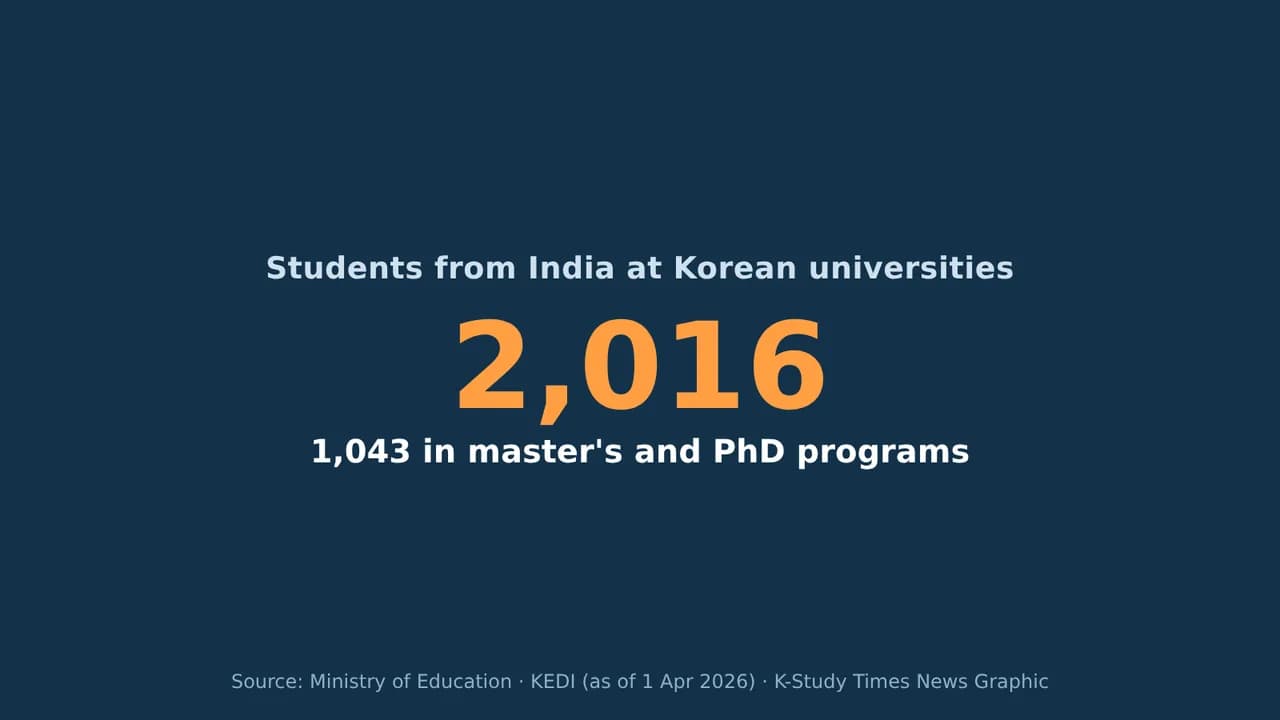
As of April 1, 2026, there were 2,016 Indian students at Korean higher education institutions. Graduate students, 529 in master's and 514 in doctoral programs, totaled 1,043, more than double the 465 undergraduates (including junior colleges). Indian students attend 141 institutions.
--- Document certification information is based on India's Ministry of External Affairs (MEA, updated October 22, 2026) and HCCH; visa information on notices from the Embassy of the Republic of Korea in India and the Consulates General in Mumbai and Chennai and on the Korea Visa Application Centre websites (accessed November 24, 2026); visa criteria on the Korean Ministry of Justice visa manual (October 19, 2026 edition); and student numbers on Ministry of Education and Korean Educational Development Institute (KEDI) statistics (as of April 1, 2026). TOPIK fees are based on the 2025 notice.
Related Articles
- Features
- Features
- Features
- Features
- Features
- Features
Comments
Please sign in to post a comment.
You will return to this article after sign-in.
Sign inNo comments yet.