

Jeonju Kijeon College signs MOU with GEA on recruiting and educating international students: 'Recruitment is not the end of education but the beginning'
Jeonju Kijeon College signed an MOU with GEA on Nov. 25 to recruit and educate foreign students. Director Kang Jin-seok praised GEA's quality control in selection, Korean teaching and settlement support. 572 of its 574 foreign students are Vietnamese; its innovation campus works with local industry.
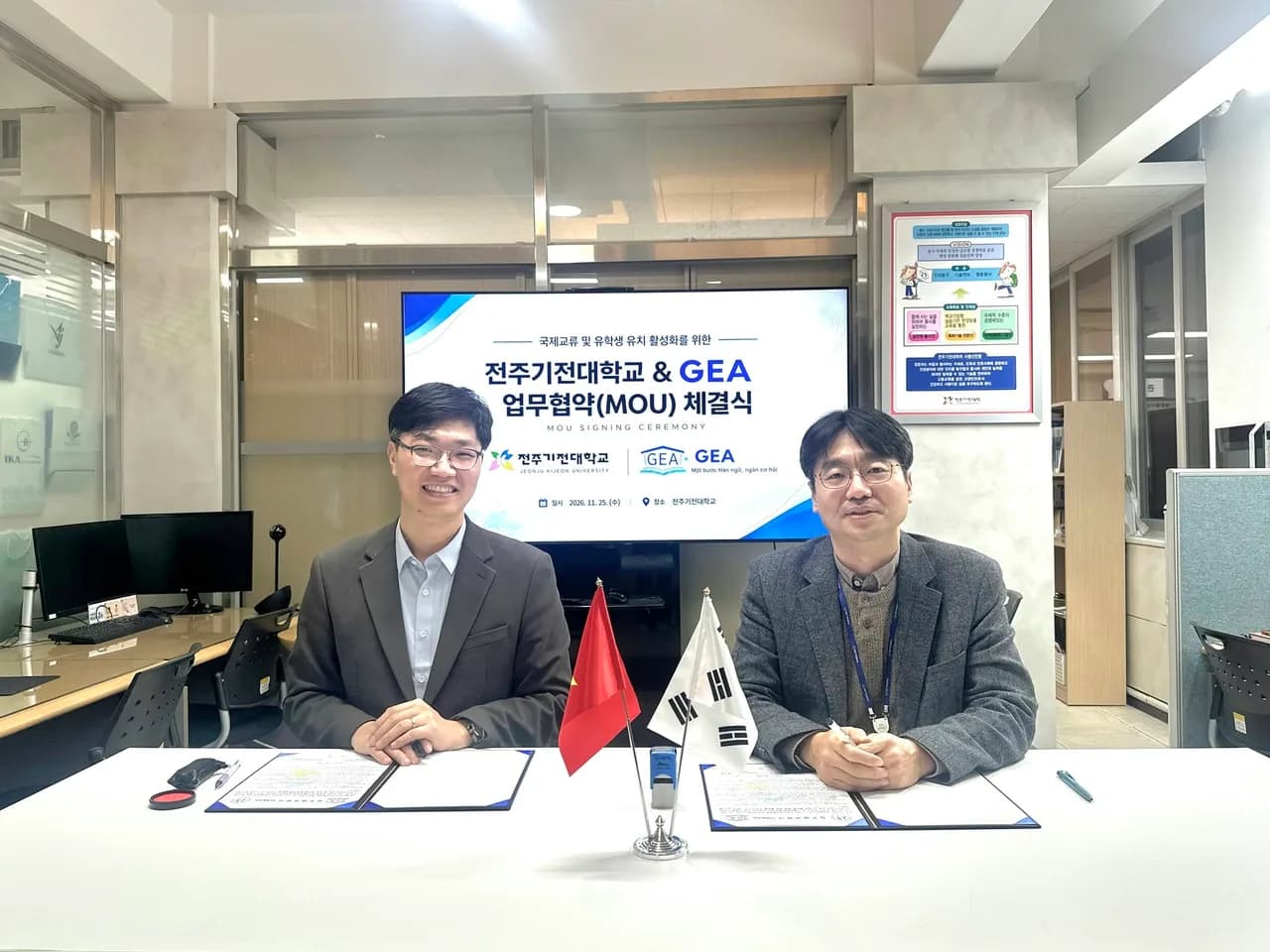
Jeonju Kijeon College in Jeonju, Jeonbuk State, signed a memorandum of understanding (MOU) with international education company GEA on Nov. 25, agreeing to cooperate on international exchange and the recruitment of international students. The signing ceremony was held at Jeonju Kijeon College. GEA representatives visited the college, signed the agreement and then exchanged views with the college on recruiting and educating international students and on supporting their employment and settlement after arrival in Korea.
GEA's 3-stage support system for international students
GEA's support system for international students, as introduced by Kang Jin-seok, Director of the Office of International Cooperation at Jeonju Kijeon College, in a Facebook post on Nov. 28, consists of three stages. The first is student recruitment: recruiting and counseling students locally, running university admission information sessions, and matching students with colleges and departments that suit their career paths. The second is quality control in student selection: verifying academic and financial documents, checking career aptitude and fit with a chosen major, and providing pre-departure Korean language education and study-abroad preparation. The third is support for settling in Korea: adjusting to daily life in the early period after arrival, counseling in students' native languages, academic and career counseling, links to employment, and support for settling in the region.
Director Kang wrote that, among these, he thinks highly of the quality control in student selection and the Korean language education. He pointed out that GEA develops its own Korean textbooks, runs a learning app and makes sure students are well prepared before they come to Korea.
GEA is an international education company headquartered in Busan that supports the recruitment, admission, visas and settlement of international students. Its name comes from "Good Education for All." It operates an education center in Hanoi, Vietnam, and also provides pre-departure education covering legal, medical and daily-life information.
A private junior college in Jeonju founded in 1974
Jeonju Kijeon College is a private junior college that opened in 1974 as Kijeon Women's Junior College. Its main campus is in Junghwasan-dong, Wansan-gu, Jeonju, and it has an Innovation Convergence Campus in Jeonbuk Innovation City in Iseo-myeon, Wanju County. Its departments are grouped into creative convergence, wellness industry and health industry divisions, among others, and it runs the Department of Hotel Culinary Arts, the Department of Hotel Baking, the Department of Social Welfare Counseling, the Department of Dental Hygiene and the Department of Clinical Laboratory Science, among others. It also offers an Army Reserve Non-commissioned Officers' Training Corps (RNTC) candidate program.
The college's exchanges with Vietnam also extend beyond student recruitment. In 2023, it ran an early childhood education project for ethnic minorities in Gia Lai Province, Vietnam, under the Korea International Cooperation Agency (KOICA) civil society cooperation program. This year, under KOICA's university program for raising awareness of international development cooperation, 11 of its students did educational volunteer work for 168 young children at 2 kindergartens in Gia Lai Province from Nov. 9 to 14. In June, the college took part in the opening ceremony of the Saemangeum Hangeul School that the Jeonbuk International Cooperation Agency opened in Nghe An Province, Vietnam, and ran a counseling booth providing information on its departments, scholarships and study-abroad procedures.
572 of 574 international students are Vietnamese
According to Ministry of Justice international student management data (as of Dec. 31, 2025), Jeonju Kijeon College has 574 international students. Of these, 572 (99.7%) are Vietnamese nationals and 2 are Chinese nationals. By program, 330 are in Korean language training at the college's language institute, 243 in associate degree programs and 1 in a bachelor's program.
New students in the 2nd semester of this year include students from Nepal, Bangladesh and Myanmar as well as Vietnam, and in October the college's International Student Support Center held a traditional culture experience program in Muju for new students from these 4 countries. Language trainees are taught by the Korean Language and Culture Education Center. In July, the center held a special training session for 102 language trainees covering the management of periods of stay and attendance rates, points to note when extending visas and changing visa status, and traffic rules for personal mobility devices (e-scooters, etc.).
Director Kang said that while demand in Vietnam for study in Korea is declining compared with the past, competition among Korean universities to attract international students is growing fiercer, and that the meeting also discussed strengthening ties with existing overseas partner institutions and differentiating recruitment and promotion strategies.
Jeonju Kijeon College hopes to be selected as an institution certified under the International Education Quality Assurance System (IEQAS) for degree programs (D-2) in March 2027. Certified institutions under this system, which is run by the Ministry of Education and the Ministry of Justice, receive benefits in visa screening for international students.
Innovation Convergence Campus and cooperation with local industry
The Innovation Convergence Campus opened in 2025 as a project jointly supported by the Ministry of Land, Infrastructure and Transport, Jeonbuk State and Wanju County. The 4 departments of Healing Agriculture, Companion Animals, Secondary Battery Materials and Parts, and Equine Industry and Sports Rehabilitation moved there, and about 240 students are enrolled. Jeonbuk State said in March this year that the campus had signed 76 business agreements with companies and public institutions, including SungEel HiTech, Jeonbuk Technopark and the National Institute of Horticultural and Herbal Science, and that its employment rate in the project's 1st and 2nd years was 90%.
In the secondary battery field, the college established the Department of Secondary Battery Materials and Parts in March 2024 and set up a K-eco-friendly mobility lab in 2025. In May this year, the college's RISE (Regional Innovation System & Education) project group signed an agreement with Grapsil, a silicon-based anode materials company, covering field training and links to employment, among other areas. Under the Jeonbuk ANCHOR (regional growth talent development) project, the college is pursuing education that combines healing agriculture and tourism, as well as the Buan K-healing agriculture project, among other initiatives.
Agreements with regional institutions have followed. Jeonju Kijeon College agreed in August with the HRD Korea Jeonbuk branch to cooperate on expanding employment and field training linked to member companies, and in October with the Jeonju Chamber of Commerce and Industry to cooperate on running curricula that reflect corporate demand and on links to employment.
Jeonbuk's support for international students settling in the region
Jeonbuk State operates a support system for international students that runs from pre-departure education to local employment. The starting point is the Saemangeum Hangeul School, operated at 11 locations in 7 countries overseas, through which the province said it has attracted 469 international students since 2023. After arrival, the province supports job internships for international students and connects them with companies in the province using the provincial job center's company database.
One system related to settling in Jeonbuk after graduation is the region-specific visa. It grants long-term residence status on the governor's recommendation to international students and others who live and seek employment in population-decline areas, and Jeonbuk attracted 857 people under the skilled talent track in 2023-2025. Because Jeonju is not a population-decline area, those seeking this visa must live and work in a population-decline area elsewhere in the province.
'Recruitment is not the end of education but the beginning'
Director Kang said GEA's attention to regional settlement through its domestic operations division in Korea, including help adjusting to daily life after arrival, native-language counseling, building employability, job fairs and links with local companies, aligns with the direction the college seeks to take in education, employment and regional settlement. "Recruiting international students is not the end of education but the beginning," he said, adding that he hopes colleges and study-abroad agencies will grow together while each stays faithful to its own role.
Further reading
- GEA formalizes Korea study cooperation with Vietnam's Foreign Trade Intermediate School (FTS)
- Steps to a D-2 student visa after admission: standard certificate of admission, then visa application
The agreement and the college's account are based on a Facebook post by Kang Jin-seok, Director of the Office of International Cooperation at Jeonju Kijeon College (Nov. 28, 2026), and photos of the signing ceremony (including date and location markings); student numbers on Ministry of Justice international student management data (as of Dec. 31, 2025). The college's history draws on the Encyclopedia of Korean Culture and the Jeonju Kijeon College website; exchanges with Vietnam and international student programs on press reports of college announcements (June, July, October and November 2026); the status of the Innovation Convergence Campus on an announcement by Jeonbuk State (March 13, 2026); the secondary battery and ANCHOR projects and agreements with regional institutions on reports from May, June, August and October 2026; and Jeonbuk's international student support and the region-specific visa on announcements by Jeonbuk State (Feb. 8 and Nov. 20, 2026). K-Study Times is operated by GEA, a party to the agreement.
Related Articles
- Universities
- Universities
- Universities
- Universities
- Universities
- Universities