

Dong-A University K-Food culinary arts department for international students opens March 2027 in Busan: 'Culinary Class Wars' chefs as adjunct professors, round 2 Dec. 9–23
Dong-A University's K-Food culinary department for international students opens March 2027, taught in Korean, 300 hours of Korean in year one. 4 adjunct professors include 'Culinary Class Wars' chefs. TOPIK 2+ or Dong-A institute Intermediate 1+; first-term tuition cut 30–100%. Round 2: Dec. 9–23.
Key Points
- Dong-A University in Busan will open its Culinary & Food Business department, which admits only international students, in March 2027.
- Its official English name is the Department of K-Food Culinary Arts and Business.
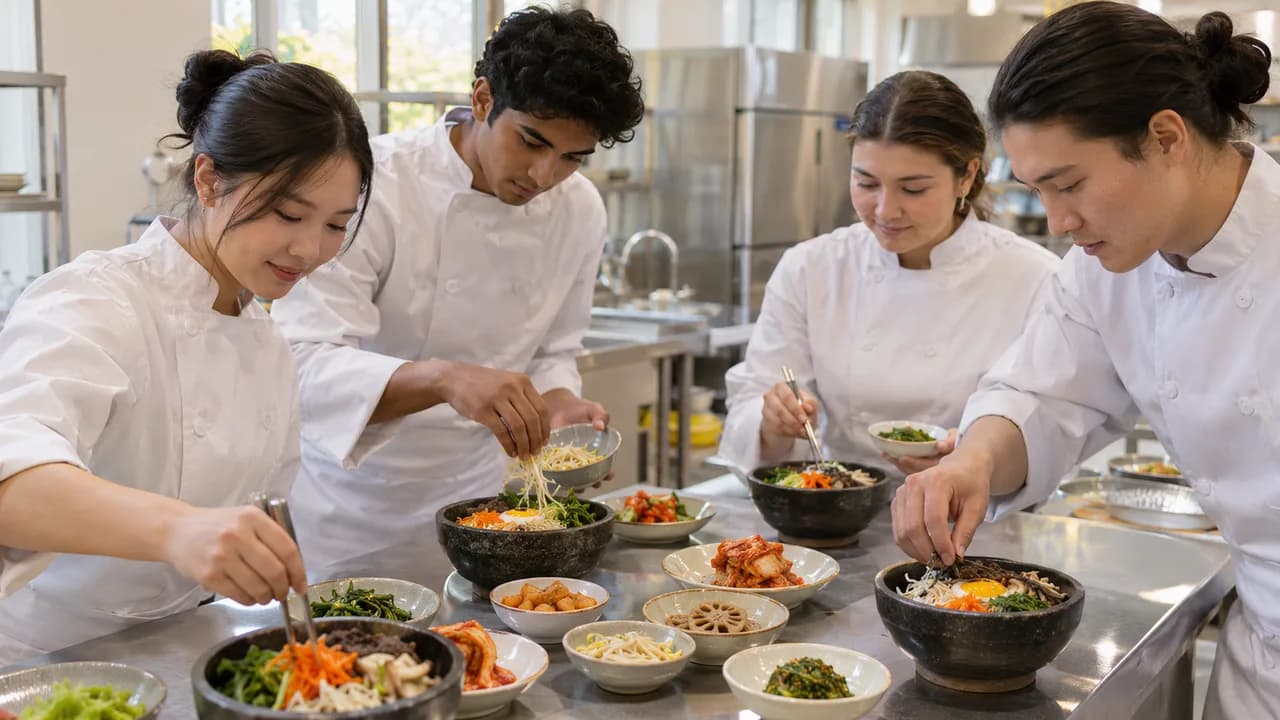
Dong-A University in Busan will open its Culinary & Food Business department, which admits only international students, in March 2027. Its official English name is the Department of K-Food Culinary Arts and Business. The department covers everything from Korean cooking to food service management and K-food branding, and all classes are taught in Korean. For the first year after admission, students take 300 hours of Korean language instruction alongside basic cooking classes.
Four industry professionals, including two chefs who appeared on Netflix's "Culinary Class Wars," have been appointed as adjunct professors. Incoming students who meet admission requirements receive a scholarship covering 30–100% of first-semester tuition, depending on their TOPIK level and other criteria. Both students who have taken a Korean language course in Korea and students applying directly after earning TOPIK in Vietnam are eligible. Round 2 applications will be accepted online from Dec. 9 to 23, 2026, and for applicants in Vietnam it is the last application window for March 2027 admission.
What kind of department: exclusively for international students, taught in Korean
The Department of K-Food Culinary Arts and Business belongs to Dong-A University's College of Health Sciences and is located at Seunghak Campus in Busan. It is a Korean-language-track department that admits only foreign students, listed as a "department exclusively for international students" among the 2027 admission units for international applicants.
The department has three educational goals. The first is understanding and applying K-food scientifically (Science). The second is reinterpreting the value of traditional food in a modern way (Tradition). The third is integrated competence covering everything from cooking to management (Business).
Because classes are taught in Korean, Korean language education makes up a large share of the first year. Students take basic cooking classes and Korean language instruction together for one year, a structure designed to help them adjust to both their major studies and life in Korea. Students admitted with TOPIK Level 2 (or an equivalent score) must complete the designated regular Korean language curriculum for one year, while those with TOPIK Level 3 or higher are exempt from this requirement. After admission, students can also take major-linked Korean courses such as "Korean for K-Food Majors" and "Practical Korean for Food Business."
Four adjunct professors: Korean, Western, Chinese and fine dining
Dong-A University held an appointment ceremony for its industry adjunct professors in the president's office at Seunghak Campus on Oct. 12, 2026. President Lee Hae-woo, Dean of Academic Affairs Jeon Mi-ra and faculty from the Department of Food Science and Nutrition attended. The four adjunct professors will each teach hands-on classes in their fields of expertise when the department opens in March 2027.
| Adjunct professor | Current affiliation and background | Area to teach |
|---|---|---|
| Lee Mi-young | "Master of School Meals" on "Culinary Class Wars"; 15 years or more in school meal services | Korean cuisine, large-scale cooking |
| Park Ji-young | "Kitchen Gangster" on "Culinary Class Wars"; owner-chef of Nau Namyeong | Modern European cuisine, desserts, wine |
| Jeong Yong-jae | Executive chef of Chaoran, the Chinese restaurant at Signiel Busan | High-end Chinese cuisine |
| Park Ki-seop | Owner-chef of Sogonggan Dining | Korean fine dining |
Adjunct professor Lee Mi-young works in both Korea and Taiwan. She served as head cook in charge of school meals at Habuk Elementary School in Yangsan, South Gyeongsang Province, and took part in a Korean cuisine collaboration event at Grand Hyatt Taipei in Taiwan.
Adjunct professor Park Ji-young studied culinary arts at Johnson & Wales University in the United States. She worked at restaurants listed in the MICHELIN Guide, including Marea in New York and Arzak in Spain.
Adjunct professor Jeong Yong-jae has been in charge of Chinese banquets for major state events. He trained at luxury hotels in Hong Kong, Japan, Taiwan, Singapore and Thailand, including the Mandarin Oriental in Hong Kong.
Adjunct professor Park Ki-seop majored in culinary arts in Vancouver, Canada. He worked as a chef abroad, including at La Mer French fine dining at The Ritz-Carlton, Doha, in Qatar.
Jeong Yong-jae's Chaoran and Park Ki-seop's Sogonggan Dining have been named MICHELIN Guide selected restaurants for three consecutive years, from 2024, when the MICHELIN Guide Busan was first published, through 2026. They are selected restaurants, not starred ones.
Six full-time food science and nutrition faculty members will teach the theory courses. Their specialties are bioactive compound nutrition, institutional food service and dining out, clinical nutrition, food microbiology, food science and food chemistry. Dean of Academic Affairs Jeon Mi-ra said, "By adding the chefs' vivid field experience to the academic expertise of our existing faculty, who have researched food and nutrition, students will grow into global talent equipped with both theory and practice."
What students learn: cooking, desserts, food business and food and nutrition
The curriculum is divided into six areas. Key courses are as follows.
- Cooking: Basic Cooking Practice, Understanding Cooking Principles, K-Food Cooking I–V (Korean Cuisine Basics, Korean Cuisine Mastery, Royal Court Cuisine and Traditional Jang, Regional Food and Modern Korean Cuisine, Contemporary), Western, Chinese and Japanese Cooking, K-Food Styling and Design, K-Food Global Menu Development (Capstone Design)
- Desserts: K-Bakery I (Confectionery) and II (Breadmaking), K-Dessert Theory and Practice, Coffee Barista Practice
- Food business: Food Purchasing and Procurement, Food Consumer Behavior, Food Service Management, Cost and Financial Accounting Management, Organization and Human Resource Management, Global Food Distribution Management, K-Food Branding and Marketing Management, Global Food Startups and Entrepreneurship, Food Service Tech Seminar, K-Food Internship and Global Internship
- Food and nutrition: Food and Nutrition, Principles of Food Science, Basic Nutrition, Food Hygiene and HACCP, Food Processing and Storage
- Food culture: Understanding Korean Food Culture, Korean Fermented Foods and Traditional Liquor
- Korean language: Korean for K-Food Majors, Practical Korean for Food Business
To coincide with the new department, Dong-A University built a K-food lab, Western, Chinese and Japanese cooking labs, a bakery and dessert lab, and a fermentation and aging storage room. The university cooperates with the World Institute of Kimchi, the Institute of Traditional Korean Food and local food companies, and supports internships at local food companies such as Samjin Eomuk and Daesun Distilling as well as national cooking certification. Suggested career paths after graduation include chef, food service company researcher, food MD, global food distribution specialist, food service manager and food service entrepreneur.
Eligibility: TOPIK Level 3, or Level 2 with one year of Korean courses
Eligibility for international freshman admission for the spring semester of the 2027 academic year is as follows.
- Nationality: Foreign nationals whose parents are both foreign nationals. Dual nationals and stateless persons are not recognized as foreign nationals.
- Education: High school graduates or those recognized by law as having equivalent or higher academic qualifications. Only regular school programs under the laws of the relevant country are recognized.
- Korean language: TOPIK Level 3 or higher, or an equivalent score. Applicants with TOPIK Level 2 or an equivalent score may apply, but must complete the designated regular Korean language curriculum for one year after admission. Only scores obtained within two years as of the application deadline are recognized.
Some scores are accepted in place of TOPIK. Only the tests and programs in the table below are recognized.
| TOPIK | Dong-A TOPIK | Dong-A University Korean Language Institute | KIIP | King Sejong Institute Korean course (in person) | Sejong Korean Assessment (SKA) |
|---|---|---|---|---|---|
| Level 2 | Level 2 | Completion of Intermediate 1 | Pre-assessment score of 41 or higher, or completion of Stage 2 | Completion of Beginner 2 | 216 points or higher |
| Level 3 | Level 3 | Completion of Intermediate 2 or higher | Pre-assessment score of 61 or higher, or completion of Stage 3 | Completion of Intermediate 1 | 296 points or higher |
Selection is based on document screening that evaluates academic ability and other factors. Interviews may be held depending on the department. The number of openings was announced only as "a few" per department.
Tuition and scholarships: 30–100% off first-semester tuition for freshmen
Tuition for the Department of K-Food Culinary Arts and Business is about VND 88.5 million (KRW 4,608,800) for the first semester and about VND 85.4 million (KRW 4,450,600) for each semester after that. These amounts are before scholarships and are based on the 2026 academic year, so they may change for the 2027 academic year. Vietnamese dong conversions use the Hana Bank base exchange rate of Nov. 3, 2026 (VND 100 = KRW 5.21).
Freshman scholarships reduce tuition in the semester of admission. Students who meet admission requirements receive at least 30%.
| Scholarship | TOPIK Level 5 or higher | Level 4 | Level 3 | Other |
|---|---|---|---|---|
| Scholarship for Outstanding International New Students | 100% | 60% | 50% | 40% for Dong-A TOPIK Level 3 or higher, 30% for all others |
| DAU Scholarship for Outstanding International New Students (completion of two or more semesters at Dong-A University Korean Language Institute, with an attendance rate of 80% or higher in the final two semesters) | 100% | 70% | 60% | 50% |
For example, a student admitted with TOPIK Level 3 pays half of first-semester tuition, and one with Level 4 pays only 40%. From the second semester, scholarships are determined by the previous semester's grades. Students ranked within the top 10% of their department receive a 100% tuition reduction, within the top 40% receive 70%, within the top 60% receive 40%, and within the top 80% receive 20%.
There is also a work-study scholarship for helping with campus administrative work (an average of about VND 9.6 million, or KRW 500,000, per month). A TOPIK scholarship is also available to enrolled students who submit a TOPIK score report: about VND 9.6 million (KRW 500,000) for Level 3, about VND 13.4 million (KRW 700,000) for Level 4, and about VND 9.6 million (KRW 500,000) for Levels 5 and 6. Scholarship criteria and amounts may change in line with the university's policies.
How Vietnamese students can apply: language course students and those with TOPIK from Vietnam
Students who have taken a Korean language course in Korea. Applicants staying in Korea can apply in both Round 2 and Round 3. Round 3 (Jan. 20–28, 2027) is open only to applicants residing in Korea. The bank balance certificate requirement is about VND 154 million (KRW 8,000,000) or more, issued by a Korean bank, which is lower than for applicants residing outside Korea.
The only language institute program recognized for the language requirement is Dong-A University's Korean Language Institute. Completion of Intermediate 1 is recognized as TOPIK Level 2, and completion of Intermediate 2 or higher as TOPIK Level 3. Students who have completed two or more semesters at Dong-A University's Korean Language Institute with an attendance rate of 80% or higher in their last two semesters are eligible for a 50% first-semester tuition scholarship even without TOPIK, provided they qualify to apply by completing Intermediate 1 or higher. With TOPIK, the rate is 60% for Level 3, 70% for Level 4 and 100% for Level 5 or higher.
For students who completed a language institute program at another university, completion alone does not satisfy the language requirement. They must have a score listed in the table, such as TOPIK, and the scholarship rates are 50% for TOPIK Level 3, 60% for Level 4, 100% for Level 5 or higher and 30% for others.
Students applying directly after earning TOPIK in Vietnam. Applicants residing outside Korea cannot apply in Round 3, so for those aiming for March 2027 admission, Round 2 (Dec. 9–23, 2026) is the remaining opportunity. Applicants must have TOPIK (or a score listed in the table, such as completion of an in-person King Sejong Institute course or the Sejong Korean Assessment) when submitting the application, and only scores obtained within two years as of the deadline are recognized. TOPIK Level 3 qualifies for a 50% first-semester tuition scholarship, Level 4 for 60% and Level 5 or higher for 100%. Applicants can also apply with Level 2, but they must complete Korean courses for one year after admission, and the scholarship is 30%.
Overseas applicants who pass Round 2 must complete both tuition payment and delivery of original documents by Jan. 29 after results are announced on Jan. 22, 2027. Because the schedule is tight, it is advisable to prepare the money transfer and international mail in advance.
Documents Vietnamese applicants need to prepare are as follows.
- As proof of the parent-student relationship, submit a government-issued family relationship document such as a birth certificate (Giấy khai sinh) or household registration book (Sổ hộ khẩu). If parents are divorced or deceased, submit the relevant certificate as well, and single-parent families must also submit a single-parent family certificate authenticated by a government agency.
- High school diplomas and transcripts must have an apostille or consular legalization from the Korean mission in Vietnam.
- If the official diploma is issued late, applicants may submit a certificate of expected graduation or a temporary graduation certificate. Vietnam is a country where this exception is recognized, and it applies only to those within one year of graduation as of the issue date of the Certificate of Admission. Those who graduated more than a year ago because they were taking a Korean language course in Korea must submit an official diploma. Temporary graduation certificates also require an apostille or consular legalization, and the final diploma must be submitted additionally when extending the period of stay.
- Vietnamese-language documents must have a notarized translation into Korean or English.
- For applicants residing outside Korea, the bank balance certificate must show about VND 310 million (KRW 16,000,000) or more. Because the requirement is set in won, those preparing funds in dong should leave a margin for exchange rate fluctuations.
The differences between a language training visa (D-4) and a degree program visa (D-2) are explained in Language course vs. going straight to a degree.
Admission schedule and required documents
Round 1 applications for the spring semester of the 2027 academic year closed on Oct. 14. The remaining schedule is as follows.
| Category | Round 2 | Round 3 (applicants residing in Korea only) |
|---|---|---|
| Online application | Dec. 9–23, 2026, until 24:00 | Jan. 20–28, 2027, until 24:00 |
| Dong-A Korean proficiency test | Dec. 23, 2026 (scheduled) | Jan. 27, 2027 (scheduled) |
| Announcement of successful applicants | Jan. 22, 2027, 14:00 (scheduled) | Feb. 16, 2027, 14:00 (scheduled) |
| Tuition payment (09:00–16:00, Korea time) | Jan. 27–29, 2027 | Feb. 17–18, 2027 |
| Deadline for original documents | Jan. 29, 2027 | Feb. 18, 2027 |
Round 1 successful applicants are scheduled to be announced at 14:00 on Nov. 17, 2026. They must pay tuition Nov. 18–20, and their original documents must arrive at the Office of International Affairs by Nov. 24. The schedule may change, and any changes will be posted on the website of Dong-A University's Office of International Affairs.
Applications are submitted through Dong-A University's online application system (applydonga.accomsystem.co.kr). After signing up, applicants fill out the application, scan and upload all documents, and pay an application fee of about VND 770,000 (KRW 40,000) to complete submission. The application fee is nonrefundable.
Required documents are the application form, academic verification consent form, high school diploma (or certificate of expected graduation), high school transcript, proof of the parent-student relationship, copies of the applicant's and parents' IDs, bank balance certificate, proof of language proficiency and a copy of the passport. The personal statement (study plan) and letters of recommendation have been abolished and cannot be submitted. Optional documents, which may be used in document screening, include materials introducing the applicant's high school, records of school activities bearing the principal's seal or signature, and scores from the home country's high school graduation exam or university entrance exam.
- High school diplomas (or certificates of expected graduation) and transcripts must have an apostille or Korean consular legalization, and documents not in Korean or English must be submitted with a notarized translation.
- Bank balance certificates are accepted only if issued within one month before or after the online application date.
- The bank balance certificate required by the embassy for a visa application must be prepared separately from admission documents.
- If the bank balance certificate is not in the applicant's name, submit a financial guarantee confirmation, the financial guarantor's proof of income and a certificate of employment as well.
Successful applicants' original documents must arrive at the Office of International Affairs by the deadline (by mail or in person). Those unable to submit them by the deadline must contact the Office of International Affairs in advance, and failure to submit without a valid reason will result in cancellation of admission. Visa documents such as the Certificate of Admission are issued only to successful applicants who have paid tuition and submitted original documents. Admission may be canceled if an applicant fails to obtain a visa or change their status of stay. Students cannot take a leave of absence in their first semester after admission and cannot be enrolled at another university at the same time. Successful applicants sending tuition from abroad must request an invoice for the remittance from the Office of International Affairs.
Dormitory, insurance and inquiries
The dormitory is Hanlim Dormitory at Seunghak Campus. Costs per semester, excluding vacations, are about VND 18 million (KRW 939,000) for Seunghak Hall 1, the women's dormitory, and about VND 20.5 million (KRW 1,070,000) for Seunghak Hall 2, the men's dormitory. These may change once 2027 dormitory fees are set. International students must enroll in the National Health Insurance (about VND 1.15 million, or about KRW 60,000, per month) and private insurance for international students (about VND 670,000, or about KRW 35,000, per semester).
Admission inquiries are handled by Dong-A University's Office of International Affairs (+82-51-200-6444, contact@donga.ac.kr). Hours are 9:00 to 17:00 on weekdays, excluding 12:00 to 13:00. Department news is posted on the department website (kfoodbusiness.donga.ac.kr).
The number of international students at Dong-A University can be found in Dong-A University international student statistics, and a comparison of private universities in Busan in Guide to international students at Busan private universities. Visa procedures after admission are explained in Applying for a D-2 visa after admission.
---
The department's launch and adjunct professor appointments are based on Dong-A University's announcement (Oct. 16, 2026); the admission schedule, eligibility, tuition and scholarships on Dong-A University's "2027 Spring Semester Undergraduate Special Admission Guidelines for International Freshmen and Transfer Students (Korean Track)" (announced Sept. 30, 2026); and the curriculum and full-time faculty on the department brochure and introductory materials provided by Dong-A University.
Related Articles
- Universities
- Universities
- Universities
- Universities
- Universities
- Universities
Comments
Please sign in to post a comment.
You will return to this article after sign-in.
Sign inNo comments yet.