

K-Tech Pass new tracks begin: how they differ from student work visas
Korea's July 2, 2026 K-Tech Pass update adds new tracks for advanced-industry talent and separates K-Tech Pass from D-2, D-10, E-7, and F-2-T planning.
Key Points
- On July 2, 2026, Korea's Ministry of Justice and Ministry of Trade, Industry and Resources announced new K-Tech Pass tracks.
- The update adds a qualitative-evaluation track and a government scholar-attraction linkage track, connecting top-tier visa support more closely with advanced-industry hiring demand.
On July 2, 2026, Korea's Ministry of Justice and Ministry of Trade, Industry and Resources announced new K-Tech Pass tracks. The update adds a qualitative-evaluation track and a government scholar-attraction linkage track, connecting top-tier visa support more closely with advanced-industry hiring demand.
This does not mean that every international student in Korea can automatically receive a work visa. KOTRA's Global Talent Center describes K-Tech Pass as a certification program for top overseas talent who sign an employment contract with a Korean advanced-industry company. For Indian and other international students, the practical question is not "Can I apply now?" but "Which major, project record, and employer fit should I prepare?"
Key Answer: K-Tech Pass Is Not a General Student Work Visa
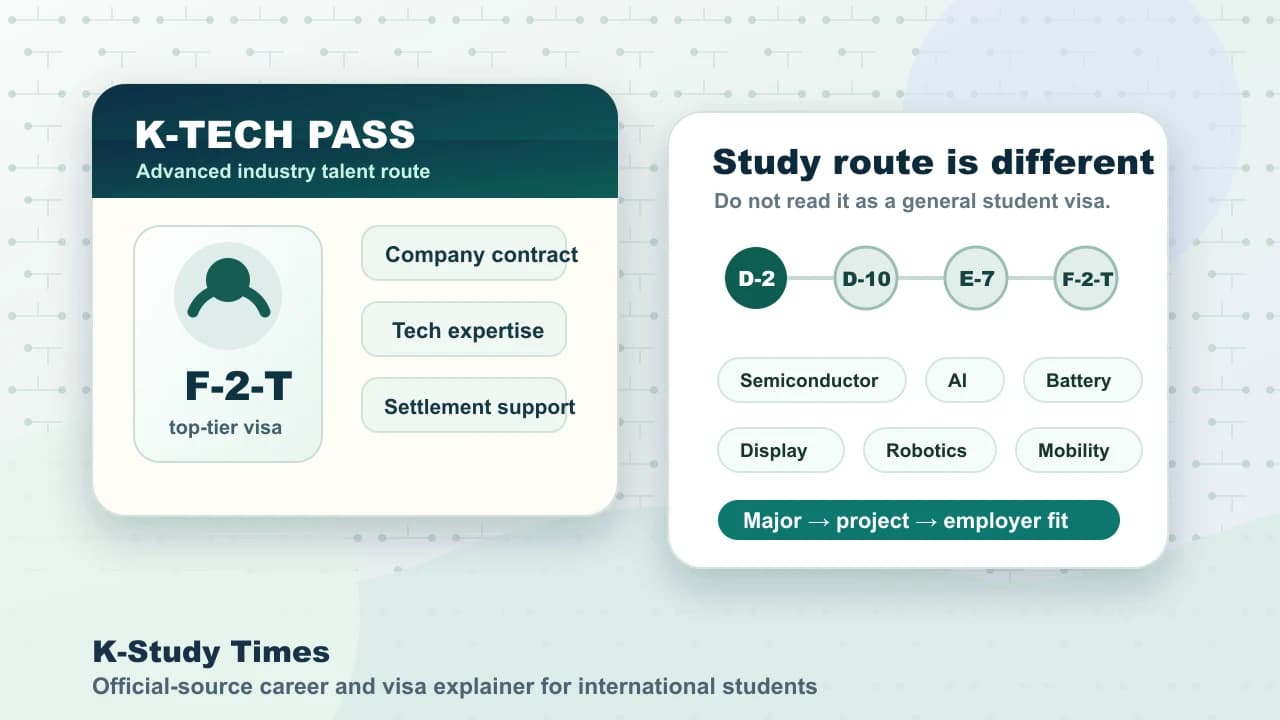
K-Tech Pass is different from the usual student-to-work sequence of D-2 study, D-10 job seeking, and E-7 professional employment. Based on official guidance, it is a policy package for advanced-industry employers and high-level overseas talent.
| Route | Main target | What it means |
|---|---|---|
| D-2 | International degree students | Admission, enrollment, and study status |
| D-10 | Graduates seeking work | Job search and major-career matching |
| E-7 | Professional employees | Job role, employment contract, education and career requirements |
| K-Tech Pass / F-2-T | Advanced-industry top talent | Employer demand, high technical capability, settlement support |
Students should not read the announcement as a shortcut from university admission to a top-tier visa. At student stage, the sequence is still degree route, major choice, research or project experience, employer fit, and workplace communication.
What Changed on July 2, 2026
The new point is the addition of two tracks: qualitative evaluation and linkage with government scholar-attraction programs. Korea.kr explains that quantitative criteria alone did not fully reflect company hiring demand.
| New track | Official meaning | Applicant interpretation |
|---|---|---|
| Qualitative evaluation | Combines quantitative and qualitative review | Technical depth and job necessity must be explained, not only degree numbers |
| Government scholar-attraction linkage | Connects with government-selected high-level talent programs | Closer to senior research or expert routes than ordinary student admission |
| SME and mid-sized company consideration | Supports smaller companies that need overseas talent | Students should look beyond large-company names and read real job demand |
For students, this is a long-term policy signal. Korea is moving faster on advanced-industry talent attraction, but individual preparation still starts with major selection, labs, projects, internships, portfolio, and job-role literacy.
What Top-Tier Visa Support Means
Korea.kr explains that K-Tech Pass holders may receive fast online issuance of the F-2-T top-tier resident visa, later permanent-residence eligibility, expanded family support, and settlement help in areas such as tax, housing, finance, and communication. KOTRA also describes concierge support, immigration priority cards, and settlement-related services.
These are possible support items for qualified talent, not basic benefits for all students. KOTRA's eligibility page lists an employment contract with a Korean advanced-industry company as a common requirement. Target sectors include semiconductors, display, secondary batteries, bio, robotics, defense, artificial intelligence, and advanced mobility.
Major Signals for Indian Students
K-Tech Pass is more useful as an industry map than as a visa keyword. The relevant sectors overlap with areas where Korea has strong industrial capacity and talent demand.
| Target industry | Major group | Preparation | Possible roles |
|---|---|---|---|
| Semiconductors | Electrical engineering, semiconductor engineering, materials, chemical engineering | Circuits, devices, process, cleanroom projects | Process, equipment, device, quality, R&D |
| AI and software | Computer science, AI, data science | Python, ML, systems, project portfolio | AI engineer, data engineer, software developer |
| Batteries | Chemical engineering, materials, electrochemistry, mechanical engineering | Materials, cell safety, process data | Battery materials, cell development, process, quality |
| Display | Electronics, optics, materials, mechanical engineering, OLED | Panel structure, circuits, thin films, optics | OLED process, panel design, evaluation |
| Robotics and mobility | Mechanical, electrical, control, embedded systems | Control, sensors, ROS, motors, real-time systems | Robot control, autonomous systems, manufacturing automation |
If the D-2 major choice is weak, it becomes harder to explain job-major fit later in D-10 or E-7 planning. If major, projects, and employer demand point in the same direction, visa and university counseling become more concrete.
Preparation Order
First, check strengths in math, physics, coding, and lab work. Advanced-industry employment cannot be built on vague interest alone. Second, narrow the major group. Semiconductors and displays may look similar, but the courses and labs differ. AI and robotics require different project portfolios.
Third, evaluate English-track study and Korean ability separately. A degree may be possible in English, but internships, interviews, workplace communication, and long-term stay may still require practical Korean. Fourth, practice reading company job descriptions. K-Tech Pass emphasizes employer demand; that means the student's target role must match real company needs.
Documents and Sources to Check
Students should read official documents first. The Ministry of Justice press release announces the new K-Tech Pass tracks. Korea.kr explains the public-facing visa and settlement support. KOTRA's Global Talent Center provides the program introduction, eligibility, and application-document guidance. Study in Korea remains the baseline source for student visa and stay categories such as D-2 and D-4.
FAQs
Can a Korean university student apply for K-Tech Pass immediately?
Not as an automatic student route. KOTRA guidance sets an employment contract with a Korean advanced-industry company as a common requirement. Students should first build major fit, project record, and employer relevance.
How is K-Tech Pass different from E-7?
E-7 is a professional employment visa route. K-Tech Pass is a separate certification and settlement-support package for advanced-industry top talent, connected with F-2-T support. Actual eligibility depends on job, contract, education, career, and company requirements.
Which majors are closest to K-Tech Pass sectors?
Official target sectors include semiconductors, display, secondary batteries, bio, robotics, defense, AI, and advanced mobility. For students, the job role and project record matter as much as the major name.
Is Korean language unnecessary?
Some degree routes may be available in English, but employment and long-term stay should be evaluated separately. Interviews, internships, workplace communication, and settlement may make practical Korean important.
What should high school or college students do first?
Start by narrowing the target industry and major group. Then check whether undergraduate, transfer, or master's routes are realistic, and compare English-track study, TOPIK planning, scholarship options, and post-graduation visa timing.
Related Articles
- Visa
- Visa
- Visa
- Visa
- Visa
- Visa
Comments
Please sign in to post a comment.
You will return to this article after sign-in.
Sign inNo comments yet.