

K-CORE’s 16 Designated Departments and E-7-M: A New Route from Admission to Employment
This article explains, within the scope currently verifiable, the admission, graduation and employment-contract conditions for 16 junior-college departments designated by the Ministry of Justice and the E-7-M program launched in March 2026.
Key Points
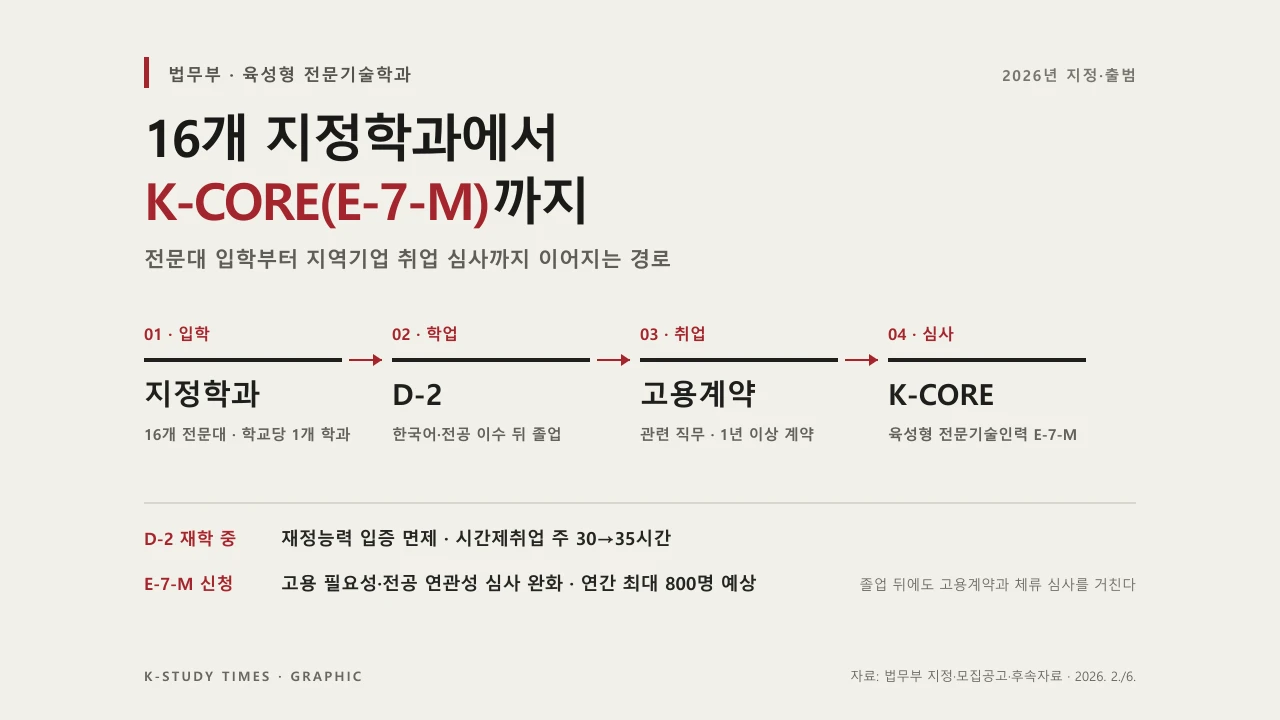
- In February 2026, the Ministry of Justice selected one ‘development-focused professional technology department’ at each of 16 junior colleges for a pilot program.
- Follow-up material released in June confirmed that E-7-M had launched in March.
In February 2026, the Ministry of Justice selected one ‘development-focused professional technology department’ at each of 16 junior colleges for a pilot program. Follow-up material released in June confirmed that E-7-M had launched in March. The program does not mean that graduating from a junior college automatically results in a visa. It is a route that proceeds from admission to a designated department, through study and graduation, to a related employment contract and immigration-status review.
The designation applies only to 16 departments at 16 institutions
| Institution | Designated department |
|---|---|
| Gyeonggi University of Science and Technology | Future Electric Vehicle Department |
| Daelim University College | School of Future Automotive Engineering |
| Bucheon University | Department of Textile and Fashion Business |
| Seojeong University | Department of Global Textile and Fashion Business |
| Osan University | Department of Electrical Engineering |
| Yong-In Arts and Science University | Department of Automotive Machinery |
| Yeungjin University | Department of Smart CAD/CAM |
| Gumi University | School of Specialized Construction Machinery Engineering |
| Kyungnam College of Information & Technology | Department of Mechanical Engineering |
| Dong-Eui Institute of Technology | Department of Mechanical Engineering |
| Busan Institute of Science and Technology | Department of Automotive Engineering |
| Koje College | Department of Mechanical Engineering |
| Ulsan College | School of Mechanical Engineering |
| Kunjang University College | Department of Smart Agricultural Food |
| Jeonju Vision University | Department of Future Mobility |
| Mokpo Science University | Department of Renewable Energy and Electrical Engineering |
A similarly named department or a different campus must therefore not be treated as having the same designation. At the application stage, students should compare the exact name of the designated department with the admissions notice for the relevant year.
Some D-2 conditions were eased for admission and study
The February material listed one of the following as the Korean-language requirement for admission: TOPIK Level 3 or higher; completion of Level 3 or higher of the Korea Immigration and Integration Program, or a score of at least 61 on its pre-assessment; or Sejong Institute Intermediate 1 or higher. It also said that international students in designated departments would be exempt from proving financial capacity when receiving D-2 status and could have their permitted part-time employment hours expanded from 30 to 35 per week. Meeting one of the language conditions does not mean automatic admission, and exemption from proof of financial capacity does not mean exemption from tuition and living expenses or the award of a scholarship. The June material again referred to these eased conditions and the program launch. This is the program design for students on this particular route, not a change to the common schedule for every D-2 international student.
After graduation, E-7-M requires a contract and review
When announced, the route required graduation from a designated department, completion of Level 4 of the Korea Immigration and Integration Program or TOPIK Level 5, and a contract with a related employer. The initial recruitment notice specified a starting annual salary of at least KRW 26 million and an employment contract of at least one year. The ministry said that E-7-M would ease review of employment need and relevance to the student’s major, the range of permitted occupations and the foreign-worker employment ratio, and projected up to 800 participants per year.
These conditions are not a table of automatic approvals. Graduation alone does not result in E-7-M status, nor does a future F-2 status change occur automatically. The February announcement said that an F-2 application route was planned for people who work continuously for five years under E-7-M, or for three years at a company in an area with a declining population. At the time of an actual application, however, the then-current wage threshold, occupation, employer and review guidance must be checked again.
General guidance on D-10 and E-7 broadly explains what employment-related immigration routes may be available after graduation. The question in this article is narrower: Is the department to which I am applying exactly one of the 16 in the table, and can I maintain the language, related-job and contract conditions through graduation?
Sources and scope of verification
The designations and attached material were checked in the Ministry of Justice’s February press release, the starting salary and contract period in the initial recruitment notice, and the launch and eased conditions in the ministry’s June 8 follow-up material, all on August 4, 2026. Wage thresholds, occupations, employers and immigration review requirements may change, so the latest official guidance should be checked before applying for admission or immigration status.
Related Articles
- Visa
- Visa
- Visa
- Visa
- Visa
- Visa
Comments
Please sign in to post a comment.
You will return to this article after sign-in.
Sign inNo comments yet.