

K-ETA exemption extended to end of 2027 for 22 countries and regions including Japan and the US; long-term language courses require a D-4 visa
Korea extended the K-ETA exemption for 22 countries and regions, including Japan, the US and Taiwan, by a year to December 31, 2027. Their students can visit campuses without a visa or K-ETA; some language institutes accept them for short courses, but long-term courses need a D-4, degrees a D-2.
Key Points
- Korea's Ministry of Justice has extended by one more year, to December 31, 2027, the temporary exemption from the Korea Electronic Travel Authorization (K-ETA) that applies to nationals of 22 countries and regions, including Japan, the United States and Taiwan.
- In a notice posted on the official K-ETA website on November 23, the ministry said it would extend the exemption period to cover January 1 to December 31, 2027, to boost tourism.
Korea's Ministry of Justice has extended by one more year, to December 31, 2027, the temporary exemption from the Korea Electronic Travel Authorization (K-ETA) that applies to nationals of 22 countries and regions, including Japan, the United States and Taiwan. In a notice posted on the official K-ETA website on November 23, the ministry said it would extend the exemption period to cover January 1 to December 31, 2027, to boost tourism. As a result, students from these countries can continue to enter Korea visa-free in 2027 without obtaining a K-ETA.
K-ETA and the 22 exempt countries and regions
The K-ETA is a pre-travel authorization that nationals of countries eligible for visa-free entry to Korea obtain online before departure for short-term stays such as tourism, visiting relatives, attending events or meetings, and business. The fee is KRW 10,000, and screening is usually completed within 72 hours. The Ministry of Justice has temporarily exempted 22 countries and regions from this procedure since April 2023, and this is the third extension.
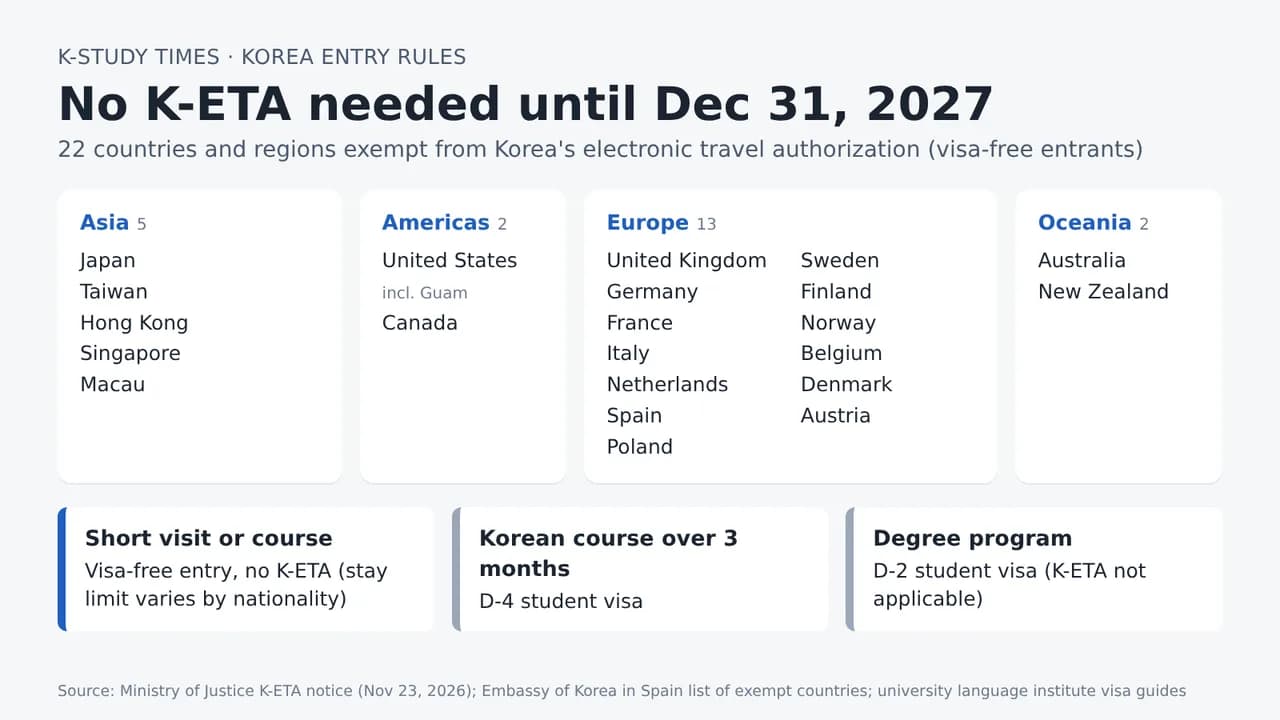
The exempt countries and regions are Japan, Taiwan, Hong Kong, Singapore and Macao in Asia; the United States (including Guam) and Canada in the Americas; the United Kingdom, Germany, France, Italy, the Netherlands, Spain, Poland, Sweden, Finland, Norway, Belgium, Denmark and Austria in Europe; and Australia and New Zealand in Oceania. Nationals of visa-free countries not on this list must still obtain a K-ETA before departure, as they do now. However, people aged 17 or under or 65 or over as of the date of entry, among others, are exempt from applying for a K-ETA.
People eligible for the exemption may still apply for a K-ETA and pay the fee if they wish. Those who receive authorization do not need to fill out an arrival card on entry. K-ETAs already issued can be used until they expire, and fees already paid are not refundable.
When a K-ETA is needed in preparing to study in Korea
The K-ETA applies only to people entering without a visa. Students entering on a D-2 (degree program) or D-4 (language training) visa are not required to apply for a K-ETA.
The K-ETA becomes relevant for short visits to Korea without a visa. These include campus visits or interviews before admission, short Korean-language programs lasting a few weeks, and family visits for a child's entrance or graduation ceremony. Nationals of the 22 countries and regions will not need a K-ETA for such visits until the end of 2027.
Courses open to visa-free entrants and courses that require a visa
Some university language institutes say students from countries eligible for visa-free entry can take Korean-language courses without a separate visa. Sungkyun Language Institute (Sungkyunkwan University) states that students from countries with a visa waiver agreement or countries eligible for visa-free entry by designation can join its courses without changing their visa. This is the institutes' own guidance; language training is not specifically listed among the purposes of visa-free short-term stays (tourism, visiting relatives, events and business) stated on the K-ETA website. The length of visa-free stay also varies by country: 90 days in most cases, but 6 months for Canada.
Longer courses require a D-4 visa. Sungkyun Language Institute advises that students from 90-day visa-free countries who want to study for more than 3 months must change to a D-4 visa, should first check with an immigration office whether the change can be made in Korea, and in some cases must leave the country and obtain the visa abroad. The Korean-language course of the Office of International Affairs at Yonsei University Mirae Campus lists Japan, the United States and Germany as the nationalities that can switch to a student visa after visa-free entry. This is the course's own guidance; whether a change of status of stay can be made in Korea is determined by the competent immigration office.
Students admitted to degree programs must obtain a D-2 visa regardless of nationality. Students from countries not eligible for visa-free entry who want to study for only one semester can also obtain a short-term visit (C-3-1) visa from a Korean consulate and take a course of up to 90 days.
What to check before departure
- Check whether your nationality is among the 22 exempt countries and regions. If you are from a visa-free country not on the list, obtain a K-ETA before departure.
- Check how long nationals of your country can stay visa-free. The period varies by country.
- If your course lasts more than 3 months, obtain a D-4 visa before entering. In some cases, a visa-free entrant cannot change to a D-4 visa in Korea and must leave the country to obtain the visa at a Korean embassy or consulate.
- Ask the language institute you plan to enroll in whether visa-free participation is possible and how long the course runs.
- If you apply for a K-ETA, use only the official website (www.k-eta.go.kr) or the official app. The K-ETA Center warns applicants to beware of agency and phishing sites that charge high fees.
Further reading
- Estimating study costs in Korea for Japanese students: how to calculate 90 days visa-free, 1 language institute term, 1 year of language training and the first year of a degree program
- Korean language training on a D-4-1 visa followed by a degree program and a change to D-2 vs. entering a degree program directly: the two are not an 'automatic pathway'
Information on the K-ETA exemption extension and applications is based on a notice on the official K-ETA website (November 23, 2026) and its application guide; the list of exempt countries and regions is based on a notice from the Embassy of the Republic of Korea in Spain (December 23, 2025); information on language training and visa changes for visa-free entrants is based on the visa guidance of Sungkyun Language Institute and the Korean-language course of the Office of International Affairs at Yonsei University Mirae Campus (checked November 29, 2026); and the permitted length of visa-free stay and the people exempt from applying are based on guidance on the K-ETA website. The permitted length of visa-free stay and whether a visa can be changed in Korea vary by nationality, so readers should check with the competent Korean embassy or consulate or an immigration office. On November 29, 2026, the name of the Yonsei University course and the link to the K-ETA notice were corrected, and the explanations of the purposes and length of visa-free stays and of the people exempt from applying were expanded.
Related Articles
- Visa
- Visa
- Visa
- Visa
- Visa
- Visa
Comments
Please sign in to post a comment.
You will return to this article after sign-in.
Sign inNo comments yet.