

12 private universities in central and northeastern Seoul: 30,105 international students, tuition and dormitories at a glance
This article compares reported international-student enrollment, average annual tuition, dormitory capacity, and official admissions contacts at 12 private four-year universities recruiting international students in central and northeastern Seoul.
Key Points
- When choosing a private four-year university in Seoul that recruits international students, applicants should check campus location and program-specific admissions guides before the school name.
- Of the 51 Seoul universities recruiting international students compiled by GEA, 37 are private four-year institutions.
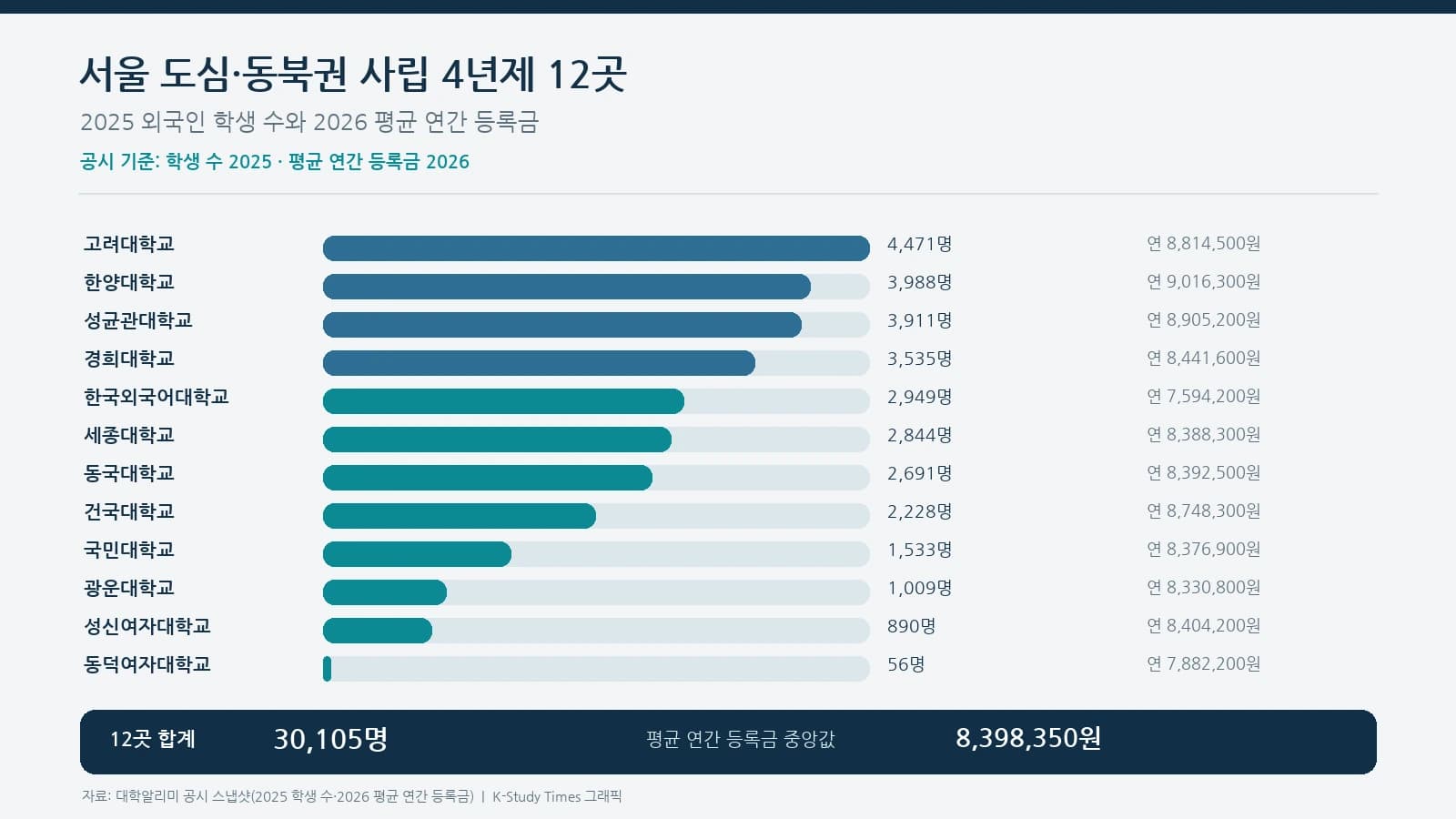
When choosing a private four-year university in Seoul that recruits international students, applicants should check campus location and program-specific admissions guides before the school name. Of the 51 Seoul universities recruiting international students compiled by GEA, 37 are private four-year institutions. The 12 central and northeastern institutions covered here reported a combined 30,105 international students in 2025.
This figure adds University Information disclosure data using the same criteria. Tuition uses each institution's average annual tuition for 2026, while dormitory capacity uses the institution-wide figure for 2025.
30,105 international students at 12 central and northeastern institutions
This article covers universities with campuses in Jongno, Jung, Seongdong, Gwangjin, Dongdaemun, Seongbuk, Nowon, and nearby districts, based on the main-campus addresses registered on the Public Data Portal. It does not mix figures from branch campuses or campuses with different addresses, even within Seoul.
| University | Main-campus address / area | International students, 2025 | Average annual tuition, 2026 | Dormitory capacity, 2025 |
|---|---|---|---|---|
| Konkuk University | 120 Neungdong-ro, Gwangjin-gu, Seoul / Northeast | 2,228 | KRW 8,748,300 | 17.1% |
| Kyung Hee University | 26 Kyungheedae-ro, Dongdaemun-gu, Seoul / Northeast | 3,535 | KRW 8,441,600 | 17.1% |
| Korea University | 145 Anam-ro, Seongbuk-gu, Seoul / Northeast | 4,471 | KRW 8,814,500 | 11.5% |
| Kwangwoon University | 20 Kwangwoon-ro, Nowon-gu, Seoul / Northeast | 1,009 | KRW 8,330,800 | 12.3% |
| Kookmin University | 77 Jeongneung-ro, Seongbuk-gu, Seoul / Northeast | 1,533 | KRW 8,376,900 | 13.3% |
| Dongguk University | 30 Pil-dong-ro 1-gil, Jung-gu, Seoul / Central | 2,691 | KRW 8,392,500 | 13.7% |
| Dongduk Women's University | 60 Hwarang-ro 13-gil, Seongbuk-gu, Seoul / Northeast | 56 | KRW 7,882,200 | 12.7% |
| Sungkyunkwan University | 25-2 Sungkyunkwan-ro, Jongno-gu, Seoul / Central | 3,911 | KRW 8,905,200 | 20.2% |
| Sungshin Women's University | 2 Bomun-ro 34da-gil, Seongbuk-gu, Seoul / Northeast | 890 | KRW 8,404,200 | 10.2% |
| Sejong University | 209 Neungdong-ro, Gwangjin-gu, Seoul / Northeast | 2,844 | KRW 8,388,300 | 11.4% |
| Hankuk University of Foreign Studies | 107 Imun-ro, Dongdaemun-gu, Seoul / Northeast | 2,949 | KRW 7,594,200 | 18.2% |
| Hanyang University | 222 Wangsimni-ro, Seongdong-gu, Seoul / Northeast | 3,988 | KRW 9,016,300 | 15.6% |
The student counts in the table total 30,105. Korea University has the most, with 4,471, followed by Hanyang University with 3,988, Sungkyunkwan University with 3,911, and Kyung Hee University with 3,535. Because these are international-student counts disclosed by each school in 2025, they do not equal the number of students an applicant will actually meet or this year's recruitment scale.
Annual tuition ranges from KRW 7.59 million to KRW 9.02 million
The median average annual tuition for the 12 institutions in 2026 is KRW 8,398,350. The lowest figure is KRW 7,594,200 at Hankuk University of Foreign Studies, and the highest is KRW 9,016,300 at Hanyang University. These averages represent an institution-wide undergraduate average, so actual billed tuition can vary by field, including humanities, engineering, arts, and physical education.
Tuition differences may look small on their own, but payment timing and scholarship conditions vary by university. Some universities present first-semester scholarships and language-proficiency requirements together in their international admissions guidance. Applicants should use average tuition as a starting point for their budget, then check the latest tuition notice and scholarship information for the program they intend to apply to.
Dormitory capacity ranges from 10.2% to 20.2%
The median institution-wide dormitory capacity for the 12 institutions is 13.5%. Sungkyunkwan University is above that median at 20.2%, followed by Hankuk University of Foreign Studies at 18.2%, and Konkuk University and Kyung Hee University at 17.1% each. In contrast, Sungshin Women's University is at 10.2% and Sejong University at 11.4%.
This indicator does not mean that a given percentage of rooms is allocated to international students. It is the disclosed institution-wide capacity, including graduate and domestic students. Applicants for whom dormitories are a priority should separately check each university's dormitory notices to see whether applications are made after admission, whether international freshmen receive separate allocations, and whether meal charges and vacation-period fees are included.
Spring 2027 schedules differ by university
Schedules and document procedures shown by official admissions contacts also differ from school to school.
- Korea University states that online applications for spring 2027 run from 10 a.m. on August 3, 2026 to 5 p.m. on August 31, with document submission due by 5 p.m. on September 7. The expected results announcement date is November 27. An online application is complete only after the application fee is paid and documents are uploaded.
- Kyung Hee University divides spring 2027 online applications into a first round from August 17 to 28 and a second round from October 26 to November 6. It directs applicants to submit documents by post; its timetable separately shows steps for apostilled or consular-authenticated academic documents and a bank-balance certificate for visa purposes.
- Yonsei University provides international-student admissions information by menu for schedules, eligibility, required documents, and admissions tracks. Whether a program recruits and its language requirements must be checked in the relevant admissions guide.
- Sogang University separates admissions guides and notices on its international admissions page. Application timing and documents required for each track should be checked against that year's notice.
Even within the same international admissions track, online-application deadlines, arrival dates for original documents, and accepted language-score ranges differ. After choosing a university, it is safer to first download the schedule and document list in the admissions guide and prepare according to the translation, notarization, and apostille procedures the university requires.
Three things to check before applying
- Check whether average tuition matches the billed amount for the program you plan to apply to. The table shows an institution-wide annual average, not program-specific fees.
- Check what dormitory capacity measures. Read the university notice to see whether it is an institution-wide figure, whether international freshmen receive separate allocations, and whether deposits, meal charges, and vacation-period fees are included.
- Separate the admissions-contact deadlines. Online application, document-upload, and original-document arrival deadlines may differ, so record each date separately.
Related Articles
- Universities
- Universities
- Universities
- Universities
- Universities
- Universities
Comments
Please sign in to post a comment.
You will return to this article after sign-in.
Sign inNo comments yet.