

Which visa is Vietnam's 'vocational study in Korea' (du học nghề)? A junior college degree (D-2-1) and private vocational training (D-4-6) are different paths
Vietnam's 'vocational study in Korea' maps to three visas: junior college degrees (D-2-1), private vocational training (D-4-6) and university language training (D-4-1). We compare eligibility, costs, part-time work and post-study jobs using Ministry of Justice manuals and college disclosures.
Key Points
- In Vietnam, study packages to Korea are widely marketed as “Korean vocational study” (du học nghề Hàn Quốc).
- But Korea's visa system has no status called “vocational study.”
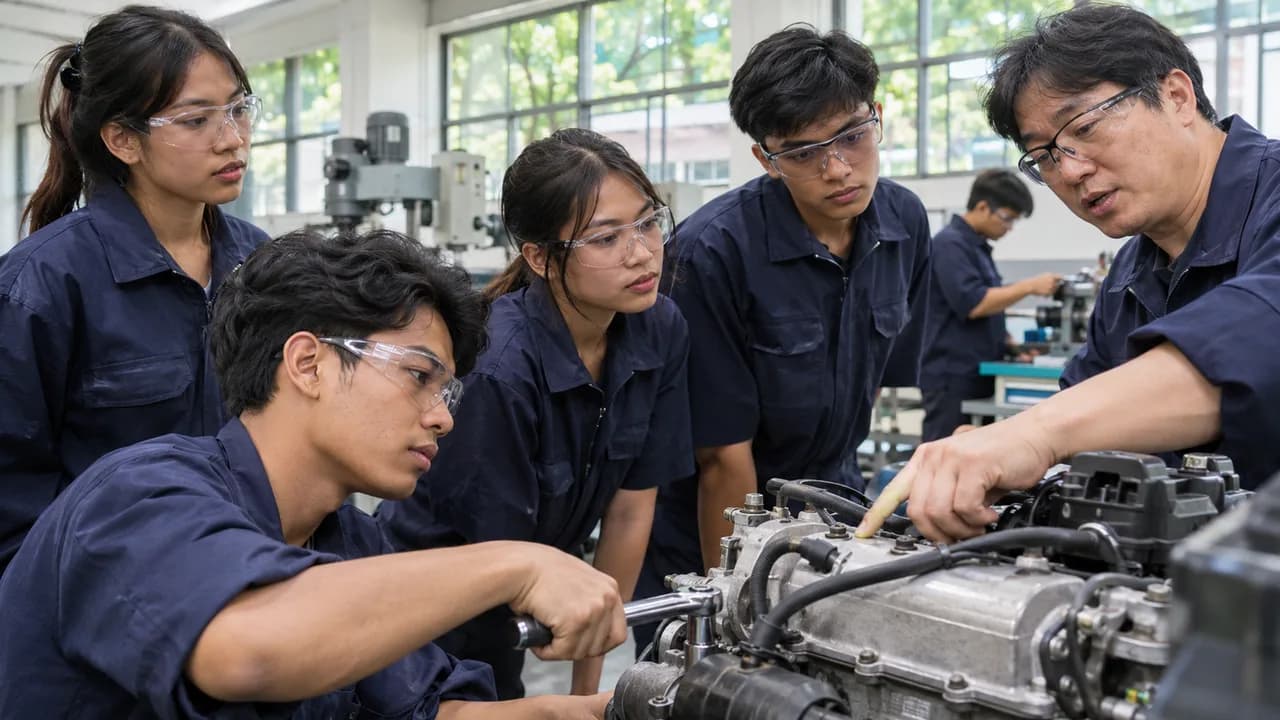
In Vietnam, study packages to Korea are widely marketed as “Korean vocational study” (du học nghề Hàn Quốc). But Korea's visa system has no status called “vocational study.” Products sold under the same name actually lead to entirely different visas.
Translated into Korean residence statuses, there are three paths: the associate degree program at a junior college (D-2-1), vocational training at a non-university institution (D-4-6), and Korean language training at a university-affiliated language institute, where students start with Korean (D-4-1). The three differ in degree, part-time work and post-graduation work eligibility. That is why the first question to ask a counselor is “Which visa am I going on?”
Amounts in this article are given in Vietnamese dong first, with Korean won in parentheses (Hana Bank base exchange rate on November 3, 2026: VND 100 = KRW 5.21).
The three paths at a glance
| Category | Associate degree (D-2-1) | Vocational training (D-4-6) | Language training (D-4-1) |
|---|---|---|---|
| Where you study | Degree programs at junior colleges or higher | Private educational institutions meeting Ministry of Justice standards | University-affiliated language institutes |
| Degree | Associate degree (2–3 years) | None | None |
| Part-time work | Can apply for a permit right after entry | Not eligible for part-time work (reported field practicum only) | Can apply for a permit 6 months after entry |
| After graduation or completion | Job-seeking (D-10), major-related E-7, etc. | E-7 special provision if all requirements are met | Change to D-2 upon university admission |
“Vocational programs” that do not lead to a D-2 visa
The student visa (D-2) is issued for regular programs at junior colleges or higher-level schools established under the Higher Education Act and special acts. Even if their names include “college” or “school,” the following programs are not eligible for D-2.
- Vocational training courses at polytechnic colleges. Korea Polytechnics' vocational training courses qualify for neither D-2 nor Korean language training (D-4-1) visas. Only the multi-skilled technician program, which is a degree program, is recognized.
- Courses at vocational competency development training facilities using names such as “vocational school” (jikeop jeonmun hakgyo). The Ministry of Justice considers applying for D-2 on the basis of such courses inconsistent with the purpose for which these facilities operate.
- Lifelong education institutions under the Lifelong Education Act (including university-affiliated lifelong education centers) and private academies
- Remote universities (broadcast, correspondence and cyber universities)
Before signing a contract based only on the pitch “you'll attend school in Korea and learn a skill,” check that the school does not fall into any of the categories above.
Junior college degree programs (D-2-1): eligibility and costs
Eligibility. Degree programs at Korean junior colleges last 2–3 years. Applicants must have completed 12 years of primary and secondary education in their home country. They must prove Korean proficiency, such as through TOPIK, and some schools require language training first if an applicant's Korean is insufficient. Language requirements vary by school and department. Graduates (and expected graduates) may also transfer into the second or third year of a four-year university.
If a school has been classified by the Ministry of Justice as a university under enhanced visa screening, a separate Korean language requirement applies. It covers nationals of countries designated by notice of the Minister of Justice and countries under focused management who enroll in associate degree programs at such schools. The list of designated countries (21 countries) in the Ministry of Justice manual includes Vietnam. In this case, applicants must meet one of the following:
- TOPIK level 2
- Completion of KIIP level 2 (or a KIIP pre-assessment score of 41 or higher)
- Completion of King Sejong Institute Beginner 2 or higher
Costs. An analysis of the April 2026 university information disclosure (Academy Info) found that average annual tuition at 125 junior colleges was about VND 127.7 million (KRW 6,653,100). It was about VND 135.9 million (KRW 7,081,900) in the Seoul metropolitan area and about VND 120.7 million (KRW 6,287,800) outside it. These figures are averages for all students. Tuition for international students is set separately by each school.
For example, Chungkang College of Cultural Industries' 2027 academic-year tuition for international students in associate degree majors is about VND 78.3 million (KRW 4,079,500) per semester before reductions. The school's application requirements are as follows:
- One of TOPIK level 2, King Sejong Institute Beginner 2, or KIIP level 2 (pre-assessment score of 41). Applicants who do not meet this are evaluated through a portfolio and interview instead.
- For visa financial proof, a bank balance certificate of about VND 383.9 million (KRW 20 million) or more
These amounts are that college's own standards. Tuition and dormitory costs by region can be compared in Seoul junior college tuition and dormitories and International students at Busan junior colleges.
Financial documents. A D-2 visa requires proof of a balance covering one year of tuition and living expenses. The bank balance certificate must be issued within 30 days of the application date, and the balance must be maintained throughout the permitted period of stay. Vietnamese nationals submit a separate blocked-deposit study-fund bank balance certificate issued by a bank. Ministry of Justice standards set no fixed amount; the amount is specified by the university. Academic documents must carry an apostille or Korean consular legalization.
Visa duration and family. The first associate degree visa is a single-entry visa with a period of stay of up to 2 years. Associate degree students are restricted from bringing a spouse or children on dependent visas (F-3). Exceptions are made for humanitarian reasons.
Private vocational training (D-4-6): the actual conditions
D-4-6 is a training visa for learning vocational skills at a private educational institution that meets standards set by the Ministry of Justice. No degree is awarded.
Institution requirements. A D-4-6 institution must be one of the following types:
- Professional technical training institutions established by or affiliated with companies listed in Korea
- University-affiliated professional technical training institutions (excluding general lifelong education centers)
- Korean branches of renowned overseas professional technical training institutions
- Vocational competency development training corporations licensed by the Ministry of Employment and Labor
- Incorporated lifelong vocational education academies in vocational technical fields that have passed the Ministry of Education's credit recognition evaluation
- Specialized colleges under the Lifelong Education Act
They must also meet all of the following requirements:
- At least 1 year since establishment
- Tuition charged by the institution of at least about VND 76.8 million (KRW 4 million) per half-year or about VND 153.6 million (KRW 8 million) per year (a minimum threshold for the institution, not actual tuition)
- Classes on at least 4 weekdays a week, with at least 15 hours a week of daytime instruction
- Their own dormitory and training facilities
Business and office administration and culture and tourism fields, as well as the occupations of wallpapering, plastering, laundry, funeral services, hospice care and cleaning, are excluded from training programs. Institutions that recruited a combined total of 100 or fewer Korean trainees across all their D-4-6 training programs in the past year cannot invite foreign trainees.
Trainee requirements. Trainees must be aged 18 to 30 and have at least a high school education. The Korean language standard was raised as of January 1, 2026. Trainees must now meet one of the following:
- TOPIK level 2
- Completion of KIIP level 2 (or a KIIP pre-assessment score of 41 or higher)
- Completion of King Sejong Institute Beginner 2 or higher
Visa procedure. A D-4-6 visa is issued only with a Certificate of Confirmation of Visa Issuance from the immigration office with jurisdiction over the training institution's location. Diplomatic missions do not issue it directly at their own discretion. The first visa is single-entry with a period of stay of 6 months or less. Trainees submit the following documents:
- Notarized documents of final academic credentials and an admission letter issued by the head of the institution
- Proof of finances (in principle, a bank balance certificate in the trainee's own name; documents issued overseas require an apostille or consular legalization)
- Proof of tuition payment
- Certificate of Korean language proficiency
The training period is, in principle, up to 1 year from the date of entry; a training plan must be submitted to go beyond 1 year.
Institution oversight. A single D-4-6 institution may accept up to 300 trainees. When trainees overstay illegally, the quota is cut by that number. If the illegal-stay rate reaches 15–30%, depending on the number of trainees invited, new invitations are blocked for 1 year. Training is suspended at institutions confirmed to have subjected trainees to forced labor, unpaid wages, sexual violence or similar abuses. During counseling, it is advisable to get the institution's name and ask whether it has ever faced such sanctions.
Part-time work rules differ on all three paths
Associate degree (D-2-1). Students can apply for a part-time work permit immediately after entry. Permitted hours during the semester are as follows:
- 10 hours a week without TOPIK level 3 (or completion of KIIP level 3 or a pre-assessment score of 61, or King Sejong Institute Intermediate 1)
- 25 hours a week with it, and no limit on weekends and during vacations
- 30 hours a week for students who meet the standard and attend an IEQAS-certified university, have excellent grades or have excellent Korean (10 hours a week, even at a certified university, if the standard is not met)
Permits are valid for up to 1 year, with up to 2 workplaces at a time. Work may be restricted if the previous semester's grade average falls below C (2.0). Manufacturing jobs are allowed only with Korean proficiency of level 4 or higher. Construction, special-type employment such as delivery, and dispatch or subcontracted work are restricted.
Language training (D-4-1). Students can apply for a permit from 6 months after entry. Permitted hours are 20 hours a week for those who meet Korean requirements such as TOPIK level 2, and 10 hours a week for those who do not. Work is restricted if attendance falls below 90%.
Vocational training (D-4-6). D-4-6 is not eligible for part-time work permits. Instead, there is field practicum related to the training. All of the following conditions must be met, and the training institution must report it in advance:
- 6 months of stay completed
- TOPIK level 2 or higher
- Attendance of 90% or higher
- Recommendation from the head of the institution
Field practicum is limited to 28 hours a week, including weekends, and is not allowed after 9 p.m. Simple production jobs in manufacturing, construction, delivery and dispatch work are restricted. Working without a report is treated as illegal employment. The pitch “go on vocational training and earn money while you work” does not square with these rules.
Part-time work rules in general are summarized in Part-time work hours and pay for international students.
What is possible after graduation or completion
Junior college graduates (D-2-1). Those who earn an associate degree or higher from a Korean university and change to job-seeking (D-10-1) status for the first time are granted 1 year without the points system. The points system applies from the first extension.
Those who find work in a permitted E-7 occupation related to their major are exempt from the requirement of at least 1 year of work experience. Other screening, such as the need for the hire, still applies.
There is also the region-specific talent visa (F-2-R) for those who work in depopulation areas with a recommendation from a metropolitan/provincial government. People who have stayed in Korea on D-2 for 2 years or more and earned an associate degree or higher meet its education requirement. TOPIK level 3 or higher, among other conditions, is also required.
In March 2026, the Ministry of Justice designated 16 “nurturing-type” professional technical departments at junior colleges. International students in these departments receive the following benefits:
- With TOPIK level 3, they are exempt from the financial requirements for the D-2 visa.
- They can work part-time up to 35 hours a week (versus 25 hours in regular associate degree programs and 30 hours at certified universities or for high achievers).
- After graduation, if they are employed at a company related to their major and meet Korean language and salary requirements, they can obtain an E-7-M visa.
The nurturing-type benefits apply only to the 16 designated departments.
Completing vocational training (D-4-6). Trainees who meet all of the following requirements can change their status to E-7 in their field of study:
- They already hold an associate degree or higher obtained abroad.
- They have completed at least 20 months of a D-4-6 program in the same field in good standing.
- They have obtained a nationally recognized Korean certification.
- They have completed KIIP level 4 or higher.
The job must be a professional technical or skilled position related to the field of study, and skilled worker (E-7-4) is excluded. A high school education alone does not qualify for this special provision. D-4-6 completers also get no exemption from the D-10 points system, and D-4 holders cannot apply for F-2-R.
E-7-4 is not a direct route for international students or trainees. It is for registered foreign residents who have stayed in Korea for 4 years or more on E-9, E-10 or H-2 status within the past 10 years.
Checklist before counseling
- I asked the counselor “Which visa (D-2-1, D-4-6, D-4-1) am I going on?” and got the answer in writing.
- If told it is a junior college degree (D-2-1), I checked that it is not a vocational training course, vocational school or lifelong education center. If told it is vocational training (D-4-6), I confirmed that the institution is an eligible D-4-6 institution type and that the immigration office issues a Certificate of Confirmation of Visa Issuance.
- I checked that classes are not concentrated on nights and weekends (stay permission may be restricted for students taking night and weekend classes).
- For a junior college, I checked in the admission guidelines that it is a degree program and what TOPIK level and balance amount the school requires.
- For D-4-6, I matched the age range (18–30), TOPIK level 2, the training period and the post-completion E-7 special provision requirements against my own education.
- I compared part-time work rules after entry (D-2-1: apply for a permit immediately; D-4-1: after 6 months; D-4-6: field practicum only).
- I decided which bank will issue the blocked-deposit study-fund bank balance certificate.
For whether to start with language training or go straight into a degree program, see D-4 language training vs. going straight to a D-2 degree; for transferring to a four-year university after junior college, see Korean junior college and transfer pathways for Vietnamese students.
--- Visa and stay rules are based on the Ministry of Justice visa and stay services manual (October/November 2026 editions), tuition figures on an analysis of the April 2026 university information disclosure, and the nurturing-type professional technical departments on the Ministry of Justice's March 2026 announcement.
Related Articles
- Features
- Features
- Features
- Features
- Features
- Features
Comments
Please sign in to post a comment.
You will return to this article after sign-in.
Sign inNo comments yet.