

253,434 International Students in Korea: A University Choice Map by Nationality, Degree, Language Training and Region
As of April 1, 2025, Korea had 253,434 international students. This guide compares degree, language and other training routes by country of origin, region, and university/main-or-branch-campus unit, and shows how to narrow study paths, regions and university options.
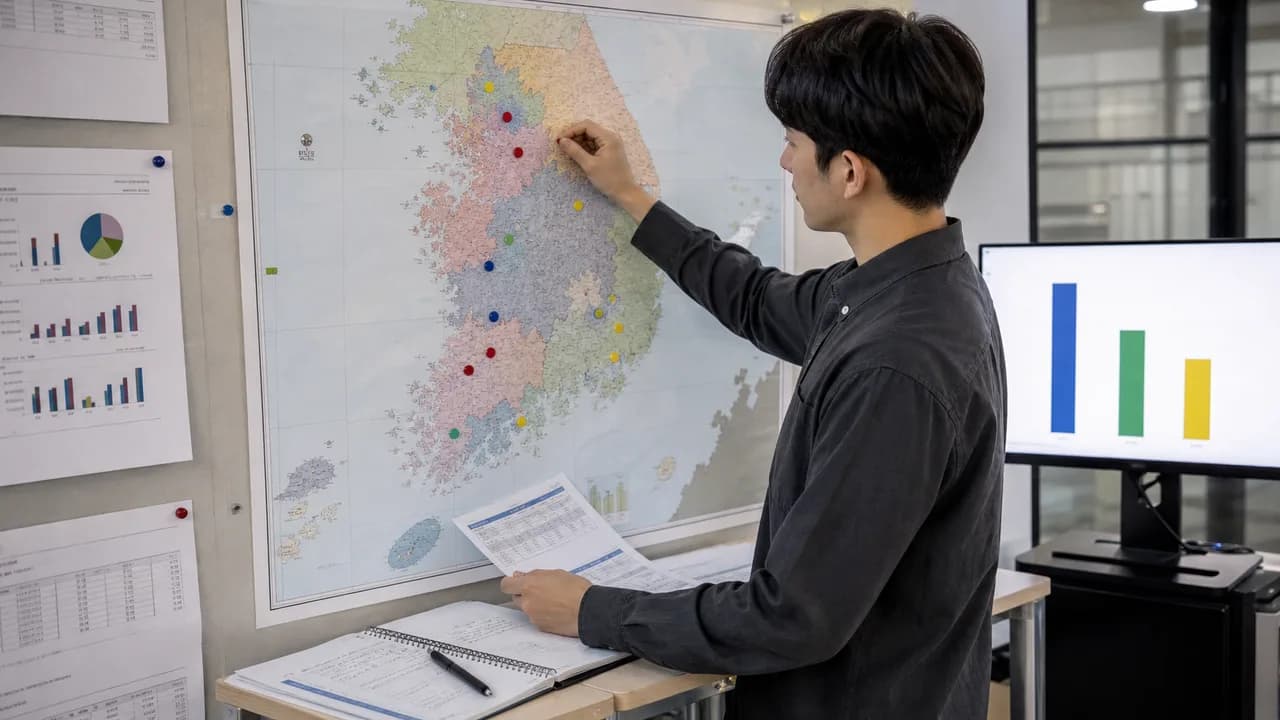
Key Points
- Korean higher education institutions had 253,434 international students as of April 1, 2025.
- That figure shows the overall scale of study in Korea, but choosing where to apply requires separating degree study from language training, where students of the same nationality are concentrated by region, and which routes account for large numbers at each university/main-or-branch-campus unit before looking at the total headcount.
Korean higher education institutions had 253,434 international students as of April 1, 2025. That figure shows the overall scale of study in Korea, but choosing where to apply requires separating degree study from language training, where students of the same nationality are concentrated by region, and which routes account for large numbers at each university/main-or-branch-campus unit before looking at the total headcount.
Based on the Ministry of Education’s official XLSX, “Status of International Students at Domestic Higher Education Institutions in 2025,” this article provides a first map for narrowing study goals and regional and university options. The statistical reference date is April 1, 2025. At the application stage, compare this enrollment distribution with the latest admissions guidelines, tuition and scholarships, dormitories, and information on majors.
1. Overall structure: 253,434 students across three routes
| Category | Students | Share of total |
|---|---|---|
| Degree programs | 179,190 | 70.7% |
| Language training | 58,764 | 23.2% |
| Other training | 15,480 | 6.1% |
| Total | 253,434 | 100.0% |
Source: Ministry of Education, “Status of International Students at Domestic Higher Education Institutions in 2025,” survey reference date April 1, 2025; source data institution: Korean Educational Development Institute (KEDI).
Here, degree programs combine undergraduate enrollment at junior colleges and universities with master’s and doctoral enrollment. For language training, only the original 어학연수 column was used. 기타연수 was kept separate rather than included in degree programs or language training.
Even at the same university, the admissions guidelines and conditions to check differ depending on whether international students are concentrated in degree programs, language training, or other training. It is therefore more useful to examine the size of your target route together with the latest admissions guidelines than to rely on the university’s total international-student count.
Data aggregation basis
Cross-checking the totals in the 국가·지역, 대학·본분교, and 국가×대학·본분교 sheets showed the same overall total of 253,434 in all three tables. The totals for degree programs, 179,190, language training, 58,764, and other training, 15,480, also match. The tables and comparisons below use this reconciled aggregation.
2. Differences by nationality: similar totals can hide different study routes
Students from China and Vietnam together account for 151,685, or 59.9% of the total. But treating them simply as “the two countries with the most students studying in Korea” obscures meaningful differences in their study routes.
| Country | Total | Degree programs | Language training | Other training |
|---|---|---|---|---|
| China | 76,541 | 68,045 | 5,471 | 3,025 |
| Vietnam | 75,144 | 40,865 | 33,629 | 650 |
China has a large degree-program count of 68,045, compared with 5,471 in language training. Vietnam has large numbers in both degree programs, 40,865, and language training, 33,629. Even when total enrollment is similar, the routes applicants should use as reference are not the same.
Top 10 countries and regions of origin
| Rank | Country/region | Total | Degree | Language training | Other training |
|---|---|---|---|---|---|
| 1 | China | 76,541 | 68,045 | 5,471 | 3,025 |
| 2 | Vietnam | 75,144 | 40,865 | 33,629 | 650 |
| 3 | Uzbekistan | 15,786 | 14,318 | 1,285 | 183 |
| 4 | Mongolia | 15,270 | 10,570 | 4,491 | 209 |
| 5 | Nepal | 12,784 | 12,626 | 152 | 6 |
| 6 | Myanmar | 8,114 | 4,415 | 3,691 | 8 |
| 7 | Japan | 5,395 | 2,849 | 1,453 | 1,093 |
| 8 | United States | 3,331 | 1,323 | 481 | 1,527 |
| 9 | Bangladesh | 3,218 | 3,007 | 205 | 6 |
| 10 | Russia | 3,125 | 1,649 | 1,067 | 409 |
The first thing to examine in this table is not the ranking but the route mix.
- Of Nepal’s 12,784 students, 12,626 are in degree programs and 152 are in language training. This differs sharply from the structure of countries centered on language training.
- Myanmar has 8,114 students in total, with 4,415 in degree programs and 3,691 in language training, so both routes are substantial.
- Degree-program students make up a large share of the totals for Uzbekistan and Bangladesh.
- Japan and the United States have 1,093 and 1,527 students, respectively, in
기타연수. Mixing these students into degree or language-training figures would distort the nationality-level route picture.
Questions to ask first when reading statistics for your nationality
- Am I seeking a degree, planning to study Korean first, or pursuing another type of training?
- Have I checked the number of students in my chosen route, rather than only the total number from my nationality?
- Separately from the number of students of my nationality, have I checked the eligibility and selection criteria in the latest admissions guidelines?
- Have I treated the current enrollment distribution and future recruitment policy as different kinds of information?
Nationality-level enrollment is a starting point for understanding the study routes and living areas of current students. Whether you can actually apply should be checked against each university’s latest admissions guidelines and selection criteria.
3. Regional distribution: Seoul and Gyeonggi account for 51.5%, with the rest spread across many regions
Seoul and Gyeonggi together have 130,493 students, or 51.5% of the total. The remaining 48.5% are spread across Busan, Gyeongbuk, Chungnam, Daejeon, Chungbuk, Jeonbuk, and other regions. Before limiting your options to Seoul and Gyeonggi, compare programs offered elsewhere along with living costs, housing, and career options.
| Rank | Region | Total | Degree | Language training | Other training |
|---|---|---|---|---|---|
| 1 | Seoul | 86,165 | 60,652 | 17,296 | 8,217 |
| 2 | Gyeonggi | 44,328 | 30,893 | 12,298 | 1,137 |
| 3 | Busan | 18,817 | 13,271 | 4,147 | 1,399 |
| 4 | Gyeongbuk | 16,565 | 12,600 | 3,560 | 405 |
| 5 | Chungnam | 16,182 | 11,960 | 3,749 | 473 |
| 6 | Daejeon | 13,467 | 9,005 | 3,578 | 884 |
| 7 | Chungbuk | 10,439 | 8,463 | 1,740 | 236 |
| 8 | Jeonbuk | 9,283 | 6,901 | 1,947 | 435 |
Regional totals also need to be separated by route. Seoul’s overall count, for example, includes 60,652 degree students, 17,296 language trainees, and 8,217 students in other training. When comparing regions, also check which universities actually offer your target route, as well as costs and housing conditions.
Major regions differ even within the same nationality
| Nationality | Regions with large counts | Route mix to read alongside them |
|---|---|---|
| China | Seoul 37,901, Gyeonggi 10,186, Gyeongbuk 5,034 | Of 76,541 total: 68,045 degree, 5,471 language training |
| Vietnam | Gyeonggi 18,194, Seoul 10,812, Busan 6,716 | Of 75,144 total: 40,865 degree, 33,629 language training |
| Uzbekistan | Gyeonggi 2,688, Gyeongbuk 2,136, Chungnam 2,027 | Of 15,786 total: 14,318 degree, 1,285 language training |
| Mongolia | Seoul 4,858, Gyeonggi 4,125, Chungnam 1,352 | Of 15,270 total: 10,570 degree, 4,491 language training |
| Nepal | Seoul 2,418, Gyeonggi 2,342, Busan 2,165 | Of 12,784 total: 12,626 degree, 152 language training |
| Myanmar | Gyeonggi 2,721, Seoul 2,062, Chungnam 702 | Of 8,114 total: 4,415 degree, 3,691 language training |
This table shows examples of regions with relatively large counts within each nationality’s overall regional distribution. When building an application shortlist, compare regions not shown here by the same criteria: programs actually offered, living costs, housing, and career options.
When choosing a region, do not ask only 같은 국적 학생이 많은가; also check the following.
- Is the degree program or language-training route I want actually available?
- Do the departments accepting applications and language-proficiency requirements fit me?
- Are the tuition, scholarship options, dormitory and housing arrangements, and commuting conditions manageable for me?
- Does the regional choice connect with my plans after graduation?
4. How to narrow university options: separate enrollment scale from application fit
The Ministry of Education source counts universities by 대학·본분교 구분 단위. This table is a starting point for seeing which routes international students are enrolled in, and combining it with the latest admissions guidelines helps narrow application options.
A large total can still have a very different route mix
The following are university/main-or-branch-campus units with large overall enrollment but different route mixes.
| University/main-or-branch-campus unit | Statistical region | Total | Degree | Language training | Other training |
|---|---|---|---|---|---|
| Gachon University Main Campus (Campus 1) | Gyeonggi | 6,668 | 5,288 | 1,320 | 60 |
| Yonsei University Main Campus (Campus 1) | Seoul | 6,414 | 3,812 | 1,713 | 889 |
| Sungkyunkwan University Main Campus (Campus 1) | Seoul | 5,407 | 3,756 | 329 | 1,322 |
| Seojeong University Main Campus (Campus 1) | Gyeonggi | 5,092 | 4,242 | 850 | 0 |
| Dongguk University Main Campus (Campus 1) | Seoul | 4,097 | 2,555 | 1,329 | 213 |
The Gachon University main-campus unit records 5,288 degree students and 1,320 language trainees. The Yonsei University main-campus unit records 3,812 degree students, 1,713 language trainees, and 889 students in other training. The Sungkyunkwan University main-campus unit includes 1,322 students in other training. Comparing only the total would hide these differences.
When building an application shortlist, overlay these enrollment figures with the latest international admissions guidelines: departments accepting applications, eligibility, language proficiency, tuition, scholarships, dormitories, and application deadlines.
Separate degree and language-training enrollment when reading university distribution by nationality
| Nationality | Main-campus units with large degree-program counts | Main-campus units with large language-training counts |
|---|---|---|
| China | Kyung Hee University · Hanyang University · Chung-Ang University | Yonsei University · Dongguk University · Hanyang University |
| Vietnam | Gachon University · Seojeong University · Soongsil University | Ajou University · Keimyung University · Dong-A University |
| Mongolia | Gachon University · Shinhan University · Cheongju University | Chung-Ang University · Sungshin Women’s University · Keimyung University |
For students from Uzbekistan in degree programs, large counts were recorded at the main-campus units of Seojeong University, Seowon University, and Joongbu University. Check the universities’ current departments accepting applications and eligibility requirements in their latest international admissions guidelines.
Build your application shortlist in this order
- Choose your study purpose. First decide whether you are looking for a degree program, language training, or other training.
- Check the route mix for students of your nationality. Look at the combination of degree, language, and other training rather than the total alone.
- Overlay the regional distribution. See which regions have many students of your nationality, then compare programs and living conditions there.
- Check the route mix at the university/main-or-branch-campus-unit level. Look at how many students are recorded in your target route, not just the overall count.
- Filter again using the latest admissions guidelines. Check departments accepting applications, language proficiency, tuition, scholarships, dormitories, and application deadlines.
- Check administrative risks separately. Verify the university’s education-internationalization accreditation status and whether it is subject to visa-issuance restrictions using separate, current official lists.
- Ask the university about the actual teaching location and support languages. Distinguish the statistical label
본교(제1캠퍼스)from the campus where classes are actually held. - Compare final fit. Consider academic fit, costs, housing, commuting, and post-graduation career plans together rather than relying on the current student count.
Separate what the statistics answer from what current materials answer
| Question to check | What the 2025 statistics indicate | What you need for a final decision |
|---|---|---|
| Which routes are common among students of my nationality? | Degree, language-training, and other-training counts | My study goal and application eligibility |
| Where are they concentrated? | Current enrollment by region | Latest admissions guidelines and living conditions at universities in each region |
| Which university/main-or-branch-campus units have students? | Current enrolled-student distribution | Departments accepting applications, language proficiency, tuition, scholarships, dormitories, deadlines |
| Are there many students of my nationality? | Current enrollment distribution | The university’s official admissions policy and actual selection criteria |
| What are the visa and administrative risks? | Cannot be determined from these statistics alone | Current accreditation and visa-restriction lists plus competent-authority guidance |
| Which campus hosts the classes? | Statistical main-campus/branch-campus label | Confirmation of the actual teaching campus from the university’s international office |
| Is support for international students available? | Cannot be determined from these statistics alone | Services and support languages provided by the international office |
Four ways to read enrollment statistics together with admissions information
- Separate enrollment scale from selection criteria. Use the number of current international students as a starting point for route selection, and check admission prospects in the latest admissions guidelines and selection criteria.
- Separate nationality distribution from admissions policy. Use the distribution of students of the same nationality to explore living areas and support environments, and check selection policies by nationality in official university guidance.
- Compare the statistical campus label with the actual teaching location. Main-campus and branch-campus labels are statistical units, so confirm the teaching campus for your program with the university’s international office.
- Compare Seoul/Gyeonggi and regional options using the same criteria. Seoul and Gyeonggi account for 51.5%, while other regions account for 48.5%. Compare regions by program, costs, housing, and career options.
5. What to check before finalizing an application shortlist
- [ ] I confirmed that the survey reference date is April 1, 2025.
- [ ] I chose my target route among degree programs, language training, and other training.
- [ ] I checked both the overall number of students of my nationality and their route mix.
- [ ] I compared programs actually offered, living costs, and housing conditions in two or three preferred regions.
- [ ] I distinguished enrollment by university/main-or-branch-campus unit from the actual departments accepting applications and teaching campus.
- [ ] I checked eligibility, language proficiency, tuition and scholarships, dormitories, and deadlines in the latest admissions guidelines.
- [ ] I checked the latest education-internationalization accreditation and visa-issuance-restriction lists.
- [ ] I asked the university’s international office about the actual teaching campus and languages available for international-student support.
- [ ] I compared academic fit, costs, commuting and housing, and post-graduation career plans together.
Official sources and data-use conditions
- Status of International Students at Domestic Higher Education Institutions in 2025 | Ministry of Education — posted October 30, 2025; page shows a revision dated April 14, 2026
- Official source XLSX | Ministry of Education — survey reference date April 1, 2025; source data institution: Korean Educational Development Institute (KEDI)
The Ministry of Education page displays the Korea Open Government License condition 출처표시+변경금지. This article cites the Ministry of Education, KEDI, and the survey reference date while explaining the source classifications and totals; it does not redistribute an altered copy of the source XLSX.
These statistics are a starting point for narrowing your study route and regional and university options. Make the final choice by comparing the latest admissions guidelines, accreditation and visa restrictions, actual campus, costs and housing, and post-graduation career plans.
Related Articles
- Universities
- Universities
- Universities
- Universities
- Universities
- Universities
Comments
Please sign in to post a comment.
You will return to this article after sign-in.
Sign inNo comments yet.