

Vietnamese Teachers' Day, November 20: The First Since the Law on Teachers Took Effect, How It Differs From Korea's Teachers' Day (May 15), and How to Say Thank You to Your Teacher in Korean
Nov. 20 is Vietnamese Teachers' Day, the first since Vietnam's Law on Teachers, which fixes the date, took effect Jan. 1, 2026. How it differs from Korea's Teachers' Day (May 15), Vietnamese student numbers in Korea, and Korean thank-you phrases, texts and emails for teachers and professors.
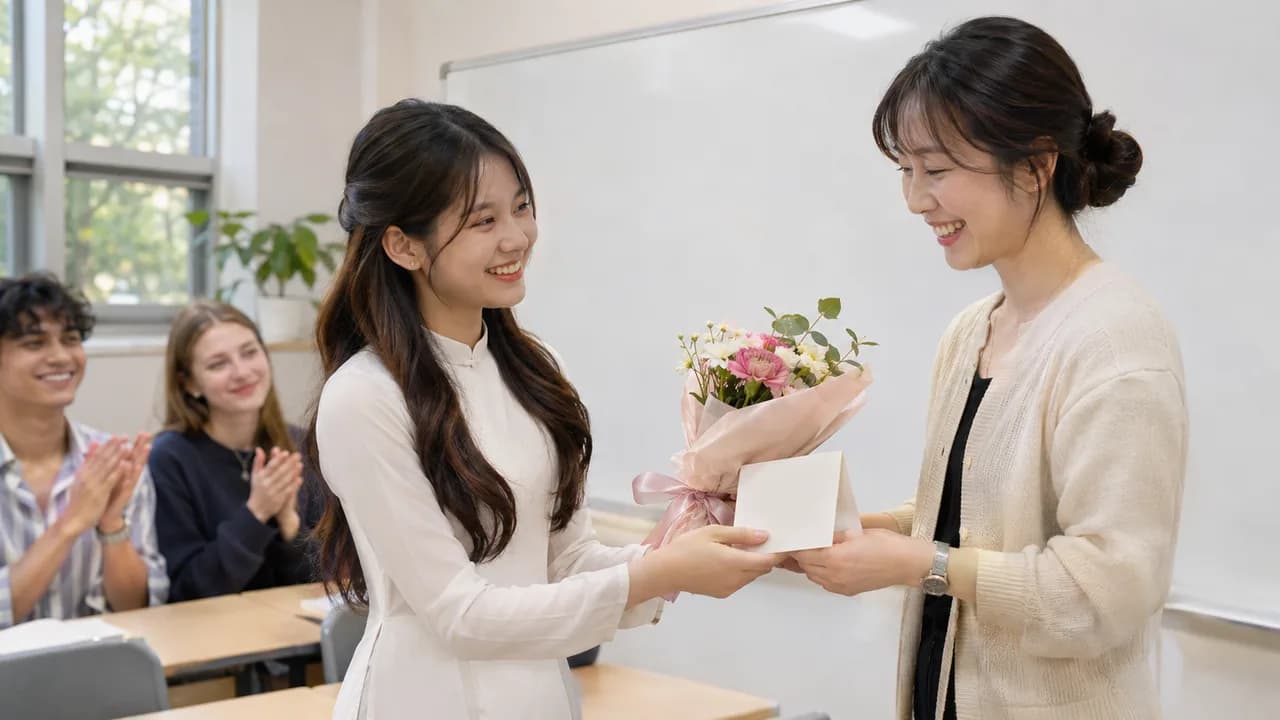
Key Points
- November 20 is Vietnamese Teachers' Day (Ngày Nhà giáo Việt Nam).
- Vietnam's National Assembly passed the Law on Teachers (Luật Nhà giáo) in June 2025, and the law took effect on January 1, 2026.
November 20 is Vietnamese Teachers' Day (Ngày Nhà giáo Việt Nam). Vietnam's National Assembly passed the Law on Teachers (Luật Nhà giáo) in June 2025, and the law took effect on January 1, 2026. November 20, 2026 is the first Teachers' Day since the Law on Teachers took effect.
Korea's Teachers' Day is May 15. Vietnamese students at Korean higher education institutions number 96,834 (as of April 1, 2026), the largest group by nationality. Here we look at the origins of the two countries' Teachers' Days and how they differ, along with Korean expressions and sample messages for thanking your Korean teachers.
November 20, the day set by Vietnam's Law on Teachers
Vietnam's Law on Teachers is Law No. 73/2025/QH15. It was passed on June 16, 2025, at the 9th session of the 15th National Assembly. Article 32 contains the sentence “November 20 every year is Vietnamese Teachers' Day (Ngày 20 tháng 11 hằng năm là ngày Nhà giáo Việt Nam).” Under Article 41, the law took effect on January 1, 2026.
November 20 was Vietnamese Teachers' Day before as well, but its basis was a government decision. Now the date is written into a law enacted by the National Assembly. The law does not make it a day off.
Origins: the 1982 decision and International Teachers' Charter Day
Vietnamese Teachers' Day was established in 1982 by Decision 167-HĐBT of Vietnam's Council of Ministers (Hội đồng Bộ trưởng). The decision is titled “Decision on Vietnamese Teachers' Day (Quyết định về ngày Nhà giáo Việt Nam)” and was signed by Võ Nguyên Giáp.
The November 20 date is linked to International Teachers' Charter Day. According to Báo Nghệ An, the provincial newspaper of Vietnam's Nghệ An province, the World Federation of Teachers' Unions (FISE) drew up a Teachers' Charter in 1949 and, at a meeting held in Warsaw, Poland, in August 1957, designated November 20 as International Teachers' Charter Day. In Vietnam, the first commemorations were held across the North on November 20, 1958.
Korea's Teachers' Day is May 15
Korea's Teachers' Day is May 15. It is a government commemorative day listed in Appendix Table 1 of the government's Regulation on Various Commemorative Days, and the Ministry of Education is the organizing ministry. On this day, events are held to foster respect for teachers' rights and to honor teachers. It is not a public holiday.
May 15 is the birthday of King Sejong the Great, who created Hangul. Korea's Teachers' Day began in 1958, when members of the Korean Red Cross Youth held an event to comfort their teachers. In April 1965, the date was moved to May 15, King Sejong's birthday. In March 1973, it was merged into Charter of National Education Proclamation Day (December 5). In May 1982, it became a statutory commemorative day again.
The two Teachers' Days at a glance
| Category | Vietnam | Korea |
|---|---|---|
| Date | November 20 | May 15 |
| Legal basis | Article 32 of the Law on Teachers (in effect since January 1, 2026). Previous basis: 1982 Council of Ministers Decision 167-HĐBT | Appendix Table 1 of the Regulation on Various Commemorative Days (government commemorative day) |
| Origin of the date | International Teachers' Charter Day (designated by FISE in 1957; first observed in Vietnam in 1958) | Birthday of King Sejong the Great |
| Public holiday? | No holiday provision in the Law on Teachers | Not a public holiday |
| Organizer | - | Ministry of Education |
Vietnamese students in Korea
As of April 1, 2026, international students at higher education institutions in Korea numbered 307,464 (Ministry of Education · KEDI, “2026 Status of International Students at Higher Education Institutions in Korea”). Vietnamese students were the largest group at 96,834, followed by Chinese students at 78,890. Counted by institution, the same data show 322 universities, junior colleges and other institutions with at least one Vietnamese student.
Ministry of Justice statistics, which count by visa status, use a different basis. As of September 30, 2026, 129,253 Vietnamese students were staying in Korea: 77,881 on student visas (D-2), 51,352 on Korean language training visas (D-4-1) and 20 on foreign language training visas (D-4-7). Because the two sets of statistics have different reference dates and count different groups, they should not be added together or mixed in comparisons.
Korean expressions for thanking your teacher
Offering your Korean teacher a short greeting in Korean on November 20 is good Korean practice and a way to show your gratitude. With teachers, use honorific speech. Expressions ending in 「-습니다」, such as 「감사합니다」 (thank you), are the most formal, while those ending in 「-요」, such as 「감사해요」, sound a little softer. For text messages and letters, 「-습니다」 is a safe choice.
| What you want to say | Korean expression | Usage |
|---|---|---|
| Thank you | 선생님, 감사합니다. (Teacher, thank you.) | The most basic greeting |
| Thank you for teaching me | 가르쳐 주셔서 감사합니다. (Thank you for teaching me.) | 「-아/어 주셔서 감사합니다」 (thank you for doing ...): to thank someone for something they did for you |
| Thanks to you, I've improved | 선생님 덕분에 한국어 실력이 많이 늘었습니다. (Thanks to you, my Korean has improved a lot.) | 「덕분에」 (thanks to): when someone's help led to a good result |
| Always stay healthy | 항상 건강하세요. (Please always stay healthy.) | Closing line for letters and texts |
| Today is Vietnamese Teachers' Day | 오늘은 베트남 스승의 날입니다. (Today is Vietnamese Teachers' Day.) | To explain what the day means first |
| I'll keep working hard | 앞으로도 열심히 공부하겠습니다. (I will keep studying hard.) | To add a promise |
Pay attention to forms of address, too. Instructors at a Korean language institute are called 「선생님」 (teacher), and university faculty are called 「교수님」 (professor). When using a name, put the title after the family name, as in 「김 선생님」 (Teacher Kim) and 「박 교수님」 (Professor Park). When addressing someone you honor, as in 「선생님께」 and 「교수님께」 (to the teacher, to the professor), use 「께」 instead of 「에게」 (to).
Useful words to learn
| Word | Meaning | Example sentence |
|---|---|---|
| 스승 | A person who taught and guided you | 그분은 제 인생의 스승입니다. (That person is my mentor in life.) |
| 은사 | A teacher you learned from and are grateful to | 졸업 후에 은사를 찾아뵈었습니다. (After graduating, I went to visit my former teacher.) |
| 제자 | A person who is taught by a teacher; a student or disciple | 저는 김 선생님의 제자입니다. (I am a student of Teacher Kim.) |
| 담임 선생님 | The teacher in charge of looking after a class; homeroom teacher | 담임 선생님께 상담을 신청했습니다. (I asked my homeroom teacher for a consultation.) |
| 지도교수 | A professor who supervises a graduate student's research and thesis; academic advisor | 지도교수님과 면담이 있습니다. (I have a meeting with my academic advisor.) |
| 찾아뵙다 | To go and see an elder (a humble expression that lowers oneself) | 방학 전에 찾아뵙겠습니다. (I will come to see you before the break.) |
「감사하다」 and 「고맙다」 have similar meanings (to be thankful). Both can be used with teachers, but in formal settings and in writing, 「감사합니다」 and 「감사드립니다」 are used more often. 「감사드립니다」, with 「드리다」 attached, sounds even more polite than 「감사합니다」.
「-아/어 주셔서」 combines 「-아/어 주다」 (to do something for someone else) with the honorific 「-시-」 and 「-어서」 (because). It is attached to the action the other person did for you, as in 「도와주셔서 감사합니다」 (Thank you for helping me) and 「기다려 주셔서 감사합니다」 (Thank you for waiting).
Sample text messages, emails and letters
A text message to your Korean language institute teacher
선생님, 안녕하세요. 저는 3반 응우옌 티 마이입니다. 오늘 11월 20일은 베트남 스승의 날입니다. 한국어를 친절하게 가르쳐 주셔서 정말 감사합니다. 선생님 덕분에 한국 생활이 많이 편해졌습니다. 항상 건강하세요. (Hello, teacher. This is Nguyễn Thị Mai from Class 3. Today, November 20, is Vietnamese Teachers' Day. Thank you so much for teaching me Korean so kindly. Thanks to you, life in Korea has become much easier for me. Please always stay healthy.)
An email to your academic advisor
교수님, 안녕하십니까. 경영학과 석사과정 쩐 반 남입니다. 베트남에서는 11월 20일을 스승의 날로 기념합니다. 그동안 연구를 지도해 주셔서 진심으로 감사드립니다. 앞으로도 열심히 공부하겠습니다. 감사합니다. 쩐 반 남 올림. (Dear Professor, I hope you are well. This is Trần Văn Nam, a master's student in the Department of Business Administration. In Vietnam, November 20 is celebrated as Teachers' Day. I sincerely thank you for guiding my research all this time. I will continue to study hard. Thank you. Respectfully, Trần Văn Nam.)
A message from classmates together
선생님, 오늘은 베트남 스승의 날입니다. 저희 3반 학생 모두 선생님께 감사의 마음을 전합니다. 어려운 문법도 쉽게 설명해 주셔서 감사합니다. 남은 학기도 잘 부탁드립니다. (Teacher, today is Vietnamese Teachers' Day. All of us students in Class 3 would like to express our gratitude to you. Thank you for explaining even difficult grammar so clearly. Please continue to take good care of us for the rest of the semester.)
A short handwritten letter
김 선생님께. 처음 한국에 왔을 때는 한국어로 인사도 잘 못했습니다. 지금은 한국어로 편지를 쓸 수 있게 되었습니다. 모두 선생님 덕분입니다. 고맙습니다. 마이 드림. (Dear Teacher Kim, When I first came to Korea, I could hardly even say hello in Korean. Now I can write a letter in Korean. It is all thanks to you. Thank you. From Mai.)
At the end of an email or letter, add 「올림」 or 「드림」 after your name. 「올림」 is slightly more formal. Write the email subject line so the content is clear right away, for example 「베트남 스승의 날을 맞아 감사 인사드립니다」 (Thank-you greetings on Vietnamese Teachers' Day).
Expressions you can also use on Korea's Teachers' Day, May 15
The same expressions work on Korea's Teachers' Day. On May 15, simply begin with 「오늘은 스승의 날입니다」 (Today is Teachers' Day). 「스승의 날을 맞아 감사의 마음을 전합니다」 (On Teachers' Day, I express my gratitude) is a formal opening line you can use on both countries' Teachers' Days. 「스승의 은혜에 감사드립니다」 (I am grateful for all my teacher has given me) is another common expression. 「은혜」 means help or teaching that you are grateful for.
Writing thank-you messages in Korean twice a year, on November 20 and May 15, is good practice for honorific speech. It is also a chance to show your teacher how much your Korean has improved over the year.
Check once more before sending
- State your name, class and department first. Teachers teach several classes and many students.
- Do not send text messages late at night or early in the morning. Greeting your teacher in person before or after class is also a good option.
- If a sentence came from a translation app, double-check that the honorifics are correct. Do not use 「너」 or 「당신」 (you) with a teacher.
- Two or three short, heartfelt sentences are enough.
You can find more Korean conversation expressions in Everyday Korean Conversation for International Students. Figures on international students by nationality are compiled in International Students in the 2026 Basic Education Statistics and 2026 Rankings of International Students by University.
Correction (November 22, 2026): This article has been corrected to state that International Teachers' Charter Day was designated at a FISE meeting in Warsaw, Poland, in August 1957, and that November 20, 1958 is the date when commemorations were first held in northern Vietnam.
---
Information on Vietnamese Teachers' Day is based on Vietnam's Law on Teachers (73/2025/QH15) and the 1982 Council of Ministers Decision 167-HĐBT; information on the origin of the date is based on Báo Nghệ An, the provincial newspaper of Nghệ An province; information on Korea's Teachers' Day is based on Appendix Table 1 of the Regulation on Various Commemorative Days (amended December 30, 2025) and National Archives of Korea records; student numbers are from the Ministry of Education · KEDI (as of April 1, 2026) and the Ministry of Justice's monthly statistical report (as of September 30, 2026).
Related Articles
- Korea Life
- Korea Life
- Korea Life
- Korea Life
- Korea Life
- Korea Life
Comments
Please sign in to post a comment.
You will return to this article after sign-in.
Sign inNo comments yet.